Bias maths - The BBC adds and subtracts Palestinians to create a narrative on Rafah
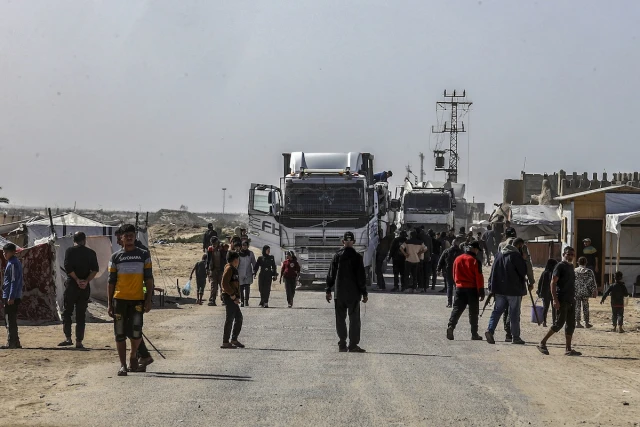
As movement over the Rafah crossing began a pattern quickly emerged in BBC radio and broadcast news in the counting of Palestinians making the journey either to or from Egypt.
Multiple reports from the 2nd and 3rd of February came from BBC journalist Yolande Knell in Jerusalem, highlighting her explanations of the situation at the Rafah crossing and the details of the process and numbers involved. Very quickly a mantra appeared. Three points were repeated in almost every report from Knell. First, that Rafah is Gaza’s “lifeline to the world”, second, that “only 5 Palestinians” left through the Rafah crossing on the first day, and finally that there are “fears that Israel could use the crossing point to push Palestinians out of the Gaza Strip”.
Each claim carefully creates a narrative by adding or erasing Palestinians and Egyptians, leading what should be simple, factual reporting of a complex bureaucratic process to become a constructed attack on Israel. On BBC News 24 on February 3rd:
Knell: “It’s just a very long and slow process for people to go in either direction through the newly reopened Rafah border crossing, Gaza’s gateway to the world. The only crossing point that it has that leads into another country to Egypt, not to Israel, but still, of course, since May 2024, when Israeli forces captured Rafah, they captured the Palestinian side of the Rafah border crossing. They remain in control there.”
What Knell is doing in this description is using a chain of technically true statements to create a misleading narrative. The Rafah crossing may indeed lead into Egypt and not Israel, but in July 2023 only 14,989 people gained Egyptian permission to cross, while in the same month 67,769 Palestinians crossed into Israel, a figure higher than pre-blockade numbers. So both the idea that there was ever freedom of movement between Gaza and Egypt, or that the Rafah crossing was ever the Palestinian’s only gateway out of Gaza collapse in the face of the pre-war statistics. Also questionable, is the argument that this “gateway to the world” was open and freely moving in both directions before the Israeli forces captured Rafah. As the BBC reported in November 2023 this is not the case. The Egyptian authorities closed the crossing almost immediately after October 7th and it has taken significant negotiation for them to allow even small numbers of wounded Gazans through since. No mention is made of course, of Egypt’s own security concerns or how they relate to their long running problems with Hamas allied jihadist insurgency in Sinai.
The most often repeated part of Knell’s Rafah mantra was on the numbers crossing:
“what we’re hearing is that it’s about 50 people who are from the list of sick and wounded who will be able to go out it’s the world health organisation who’s coordinating the medical evacuations and it’s only going to be with one or two carers in each case and then 50 people allowed to go back from the Egyptian side into the Gaza strip and what we’ve been hearing is initially at least it’s going to be those people who were let out for medical treatment that are now being allowed to go back home”
Radio 4 Today programme 3/2/26
“in the end only 5 Palestinians left from the Gaza Strip with 7 companions. that was a process that basically took all day. We got footage of them coming out in the night with ambulances, one man Mahmoud in his thirties, a leukaemia patient said that he felt lucky. People who were returning to Gaza were those who had fled earlier in the war. People who’d left for medical treatment coming back and only about 12 allowed were allowed back we’d expected 50 to go in each direction.”
BBC News 24 3/2/26
“So we have heard from the Palestinian Red Crescent Society in the past hour or so that it took 16 patients with 40 escorts to its hospital in the south of the Gaza Strip in Khan Younis. Then ambulances took them on to the edge of the Rafah crossing to try to exit today. This after only a dozen people made it out from the Gaza side into Egypt yesterday. Five patients with their seven companions and 12 people made it back into the Gaza Strip in a process that went on from early in the morning until very late at night.”
When crossing out of Gaza the only people who are Palestinians are the sick and injured, while their companions are downgraded to extra luggage, while coming back everyone is a Palestinian. This plants an idea in the audience of Israel reducing the numbers crossing, even when the full number is exactly the same, 12 each way. Plausible deniability says that the number being reported is the number of medical evacuations, however their companions are also Palestinians leaving Gaza and subject to the same security checks and processing times. “Only 5 with 7 companions” and “16 with 40 companions” is more narrative construction which uses facts to paint a distorted picture.
Finally, on the World at One on February 2nd Knell reported:
“I mean this whole question about numbers has really been a big issue, and the Egyptians have been insisting that they must have the same numbers of people returning into Gaza as those who are coming out, and that really goes back to these fears that Israel could use the crossing point to push Palestinians out of the Gaza Strip.”
This framing is unprecedented in modern conflict reporting and yet is ubiquitous in reporting on Gaza, the idea that the evacuation of civilians is a crime to be prevented rather than an urgent humanitarian priority. As recently as September 2025 the BBC published a piece highlighting the urgent need for 218,000 people including 16,500 children to be evacuated from the Donetsk region of Ukraine, nowhere in that article is it suggested that the evacuation of those civilians would constitute a reward for Russian territorial ambitions, and no country has refused to accept Ukrainian refugees on that basis at any time since Russia’s invasion.
Knell does not point out Egypt’s refusal to accept large numbers of Palestinian refugees, or President El Sisi’s insistence that the Gazans must “stay steadfast” and “remain on their land” because not to do so would “liquidate the Palestinian cause”. The sacrifice of Palestinian lives in pursuit of the political cause against Israel remains, as always, an unremarked-upon horror.
Knell’s reporting across the two days maintains a consistent pattern: mischaracterise the geography, minimize the numbers, and frame humanitarian evacuation as a sinister plot. Each individual statement is constructed with carefully chosen facts, but the overall picture is deeply biased, adding and subtracting the lives and agency of both Palestinians and Egyptians where necessary to fit the narrative.
Want to help more people find our reporting from Israel? Leave a quick Google review of our website HERE .
You might also like to read this: