After 2 US soldiers killed in Iranian attack, CENTCOM carries out 8th round of strikes
IRGC instructs regional proxies to prepare for broader escalation as US strikes continue






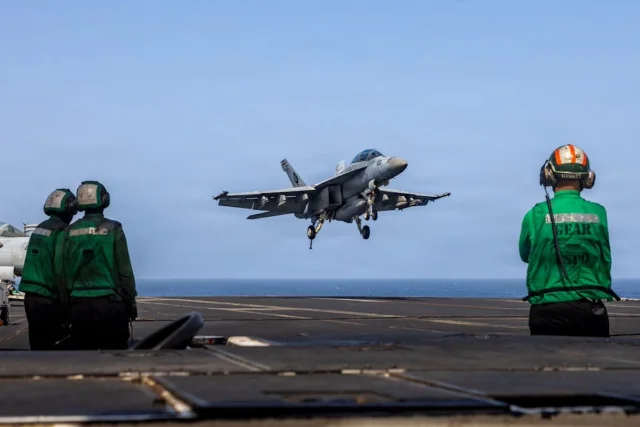
The United States Central Command (CENTCOM) completed an eighth round of strikes against targets in Iran overnight, following the death of two U.S. service members in an Iranian missile attack on a base in Jordan, as hostilities continue to escalate.
According to CENTCOM, U.S. forces “successfully hit Iranian military coastal surveillance and air defense facilities, maritime capabilities, and missile and drone storage sites to continue degrading Iranian military capabilities.”
The military command said it also targeted “Islamic Revolutionary Guard Corps forces that launched attacks against U.S. service members in Jordan on July 17.”
The Iranian attack on Saturday came in response to a seventh round of CENTCOM strikes over Friday night. During those strikes, U.S. forces targeted “surveillance sites, military logistics infrastructure, underground weapons storage, and maritime capabilities,” CENTCOM said in a statement.
Those strikes came after IRGC forces struck another commercial vessel transiting the Strait of Hormuz outside of the IRGC-approved route close to the Iranian coastline.
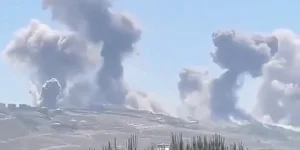
At least two U.S. service members were killed when the IRGC targeted the U.S. base in Al Azraq, Jordan. Besides the two service members killed, Iranian media claimed that two U.S. fighter jets and three other aircraft were destroyed in the attack.
This is some of the most insane war footage you will ever see. Iranian strike in Jordan.
— Andrew Fox (@Mr_Andrew_Fox) July 18, 2026
If the guy videoing survived the strike, he’s a very lucky man. pic.twitter.com/n8EcIsNUZm
Following the Iranian attack, U.S. Secretary of War Pete Hegseth posted a message on 𝕏, saying, “Godspeed, heroes. Their sacrifice only stiffens our resolve.”
Godspeed, heroes.
— Pete Hegseth (@PeteHegseth) July 18, 2026
Their sacrifice only stiffens our resolve. https://t.co/GIcfNdAol0
At the same time as the attacks on Jordan, IRGC forces also targeted U.S. facilities in Kuwait, Bahrain, and in Saudi Arabia. Iranian media claimed a radar facility in Kuwait was destroyed in the attack.
The attacks on Saudi Arabia mark the first time in three months that Iranian forces have attacked the Gulf state. There were no reported casualties in those attacks. So far, 16 U.S. service members have been killed since the conflict started in late February.
The United States and IRGC forces have been trading blows in an escalating series of strikes and attacks over free transit through the vital waterway. The IRGC-controlled regime has declared sovereignty over the strait as a red line over which it is unwilling to compromise.
In contrast, the U.S., the Gulf states, and the international community have stated the Hormuz is an international waterway, with no nation able to claim sovereignty.
IRGC forces have consistently targeted vessels attempting to depart the strait outside of its approved route, even during the time immediately following the Memorandum of Understanding. The Iranian regime claimed that the MoU gave it the right to regulate traffic through the strait, a claim disputed by the U.S. administration.
The administration of President Donald Trump claims the MoU guaranteed free passage for all vessels during the 60-day period covered by the agreement.
While Iran has attacked U.S. bases in Gulf states in retaliation for American strikes on its infrastructure, it had previously not targeted facilities in Saudi Arabia.
Despite these attacks on Saudi Arabia, Iran has not targeted the United Arab Emirates over the past week of back and forth hostilities. Prior to the ceasefire, the UAE was targeted by a greater number of missiles and drones than any other nation, including Israel.
The regime has also avoided striking Israel, despite threatening to do so if U.S. strikes continued. Analysts largely believe this is due to a desire to prevent Israel’s reentry to the conflict.
The IDF has prepared strike plans in the event of an Iranian attack, with Israeli leaders threatening that such strikes would be more powerful than those launched during Operation Roaring Lion, which started on Feb. 28.
Even President Trump has reportedly asked Israel not to enter the conflict, out of concern that such a move would reignite a larger conflagration, returning to full on war, and daily Iranian ballistic missile and drone attacks on a larger target bank.
The U.S. strikes on Friday and Saturday indicated Trump’s willingness to escalate, as they targeted some dual-use infrastructure, including several bridges and power plants which serviced IRGC or Iranian military facilities.
The breadth, depth, and tempo of U.S. military strikes on #Iran's regime is steadily increasing. Not only are bridges being destroyed, but tunnels as well (the Shahid Mirzaei tunnel). The strikes have also migrated from coastal areas like Bandar Abbas and around Chabahar inland… pic.twitter.com/zMr4Y6Yr4r
— Jason Brodsky (@JasonMBrodsky) July 18, 2026
During an address to the American public as part of political campaigning for the Fall elections in the U.S., President Trump insisted the most recent U.S. strikes have been successful.
“We are likewise winning big in Iran, and you will see the fruits of that labor very, very shortly,” Trump said.
A statement attributed Iranian Supreme Leader Mojtaba Khamenei, the son of the former supreme leader, claimed that the U.S. strikes prove the signature of President Trump is “utterly worthless and devoid of credibility.”
“Now that the American enemy seeks to incite war and bear its most serious consequences, it should know that the dear Iranian nation and the axis of resistance have unforgettable lessons to offer it,” the statement said.
According to Lebanon’s Nidaa Al Watan newspaper, the IRGC has instructed regional proxies Hezbollah and the Houthi rebels to prepare for escalation. Both the IRGC and the Houthis have previously threatened to close off the Bab al-Mandab Strait in the Gulf of Aden, alongside the closure of the Strait of Hormuz, to cause further economic damage to the United States and the West.
Such action could lead to a resumption of full-on war, and the targeting of Iran’s energy infrastructure.
You might also like to read this: