explainer Veteran terrorist and Nasrallah's 'right-hand' man: Who was Hezbollah commander Fuad Shukr?
Israel killed Hezbollah's 'most senior military commander' in its stronghold in Beirut
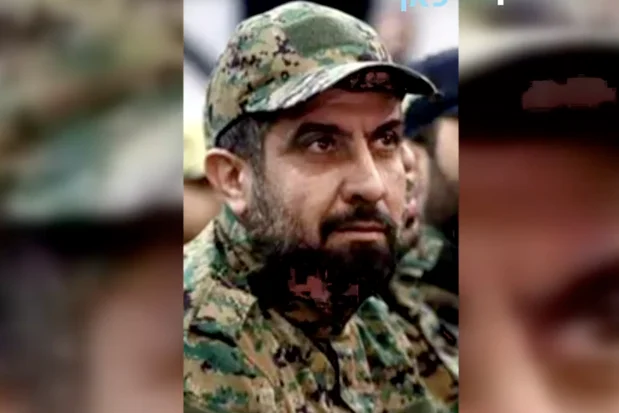
Israel Defense Forces confirmed Tuesday morning that it had eliminated Fuad Shukr, also known as “Sayyed Mohsen,” the highest-ranking commander of the terror group Hezbollah that Israel has targeted in the conflict so far.
The dramatic assassination in the Lebanese capital of Beirut came in direct response to the missile attack in Majdal Shams days before, and Hezbollah's response may determine whether the 10-month-long fighting will escalate into a full-scale war on Israel's northern border.
While the IDF described Shukr as the group’s “most senior military commander” and “right-hand man and adviser” to Hezbollah leader Hassan Nasrallah, this doesn’t do justice to Shukr’s importance and reputation within the terror group.
“I know him very well. Hajj Mohsen is not number 2, he is number 1 in Hezbollah,” Saudi researcher Ali Muhammad al-Husseini wrote on Tuesday.
Fuad Shukr: the man who killed 12 children in a soccer field on Saturday and is responsible of 30 years of Hezbollah terrorist attacks. pic.twitter.com/RuHO0W2py6
— Israel Defense Forces (@IDF) July 30, 2024
“He is among the founders, and was more important than Imad Mughniyeh,” al-Husseini added, referring to another one of Nasrallah’s former deputies, who was assassinated in 2008.
“He was there even before Hassan Nasrallah. He is the first senior member of the Jihad Council. He is Hezbollah’s Qassem Soleimani, at this level."
Most recently, Shukr had led Hezbollah’s fight against Israel which it initiated on Oct. 8 of last year. As such, he was responsible for the Majdal Shams attack that killed 12 children and wounded dozens.
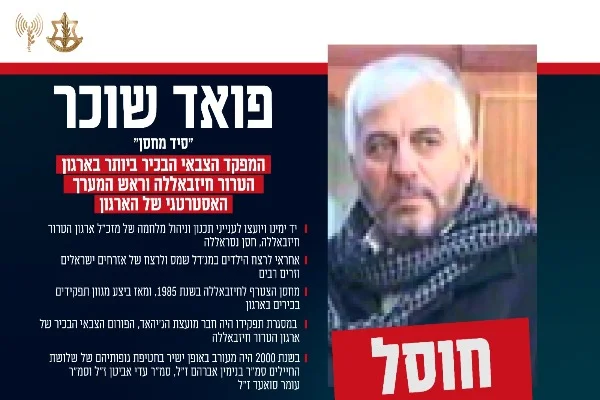
The veteran terrorist was also responsible for Hezbollah's strategic array, working to grow and improve its stockpile of “precision missiles, cruise missiles, coastal missiles, long-range rockets and unmanned aerial vehicles,” the IDF said.
Shukr’s past and his family history serve to illustrate the deep ties between Lebanese Shi’ite Muslims and the Iranian regime that came to power in 1979 following the Islamic Revolution.
If the initial reports are correct, Fa'ad Shakar, responsible for Hezbollah's precision missile project, a member of Hezbollah's Jihad Council, and Nasrallah's close advisor, was eliminated a short time ago in Beirut. pic.twitter.com/ZpxWdgOXLt
— Israel-Alma (@IsraelAlmaorg) July 30, 2024
Shukr was born in Nabi Chit, the same village as the first Hezbollah leader, Abbas al-Musawi, who was killed by Israel in 1991. This village lies in the Bekaa Valley, an area predominantly populated by Shi’ite Muslims. It later became a major Hezbollah stronghold, with many of its founding members originating from there.
The Shukr clan has long-standing affiliations with the Amal Movement, an older Shi’ite group allied with Hezbollah, and many of its members were educated in Iranian institutions, according to Ynet News.
Other members of the clan were involved in the South American operations of the terror group and have connections to the Lebanese community in São Paulo, Brazil, in particular, where Hezbollah has significant influence.
Like many of his relatives, Shukr received his military education at Imam Hussein University in Tehran and, soon after, became involved in terror planning activity.
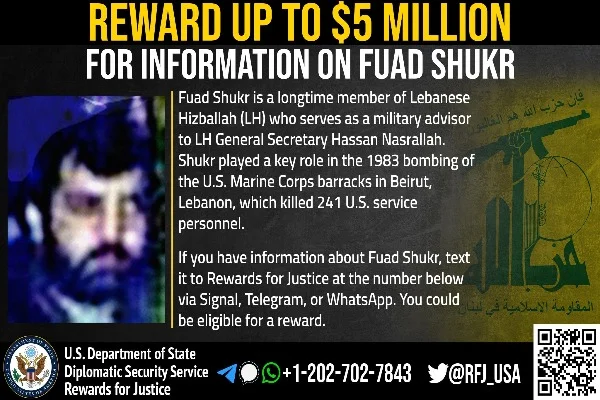
Shukr was designated a terrorist by the U.S. government for his role in the 1983 bombing of the U.S. Marine Corps barracks in Beirut that killed 241 American and 58 French military personnel, as well as six civilians. The U.S. posted a bounty of $5 million for information on his location.
Two years after the bombing, Hezbollah officially announced its establishment, and Shukr joined the group as a core member, rising through the ranks.
In 1994, he took part in the Iranian efforts to arm Hezbollah, traveling to Tehran to handle a shipment of Stinger anti-aircraft missiles, according to American intelligence reports.
Throughout the 1990s, Shukr led terror attacks against Israeli forces and its allied South Lebanese army in southern Lebanon. In 2000, he was directly involved in the kidnapping of the bodies of three Israeli soldiers after Hezbollah terrorists murdered them as they patrolled the perimeter fence in the area of Mount Dov.
Before the Syrian Civil War began in 2011, Shukr served as commander of Hezbollah’s southern Lebanon sector, including the border regions with Israel.
During the war in Syria, Shukr cooperated with the now-deceased Mustafa Badreddine and Iran’s Quds Force to lead Hezbollah’s operations that helped maintain Bashar al-Assad's regime in power
In recent years, Shukr has operated mainly out of Dahiyeh, a southern suburb of Beirut considered Hezbollah’s unchallenged stronghold and the likely hiding place of its leader, Hassan Nasrallah.
Some time ago, Shukr joined Hezbollah’s highest military forum, the "Jihad Council," and has since taken a direct role in deciding the terror group’s strategy during the last 10 months of fighting.
The loss of one of its last veteran leaders is a heavy moral blow to Hezbollah, which has now received the message that Israel can reach any of its leaders, even in their supposed stronghold in Beirut.
Hezbollah will now have to decide whether to respond in a measured way, which could make it appear weak but lead to a diplomatic arrangement with Israel, or respond with its usual aggression, which could lead to all-out war.
Popular article:

interview Easter message of resurrection hope amid war at Jerusalem's Garden Tomb

biblical commentary Let my people go: a Passover message for today

4 IDF soldiers killed, 2 wounded in fighting in southern Lebanon, as Israel eliminates dozens of Hezbollah terrorists

Receive latest news & updates
A message from All Israel News
Help us educate Christians on a daily basis about what is happening in Israel & the Middle East and why it matters.
For as little as $10, you can support ALL ISRAEL NEWS, a non-profit media organization that is supported by readers like you.
Latest articles:

1969 Dutch Eurovision winner Lenny Kuhr moves to Israel – cites antisemitism, family ties

Israel bars French far-left leader Mélenchon in response to France's entry ban on settlement leader
Change Bloc divided over coalition with Arab or ultra-Orthodox parties after week of negotiations

Huckabee fires back as Senate Democrats target US-Israel intelligence ties: 'Shocking!'

Israeli blood test detects early breast cancer with 95% accuracy, assesses recurrence risk