US military prepares for resumption of fighting against Iran after oil exports recover to pre-war levels
Israeli official: ‘After midterms chances of new US strikes in Iran increase significantly’


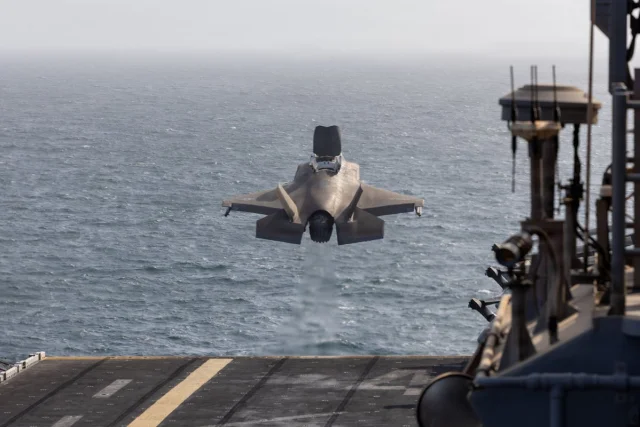
The U.S. military in the Middle East is reportedly preparing to resume fighting against the Iranian regime, even as oil exports through the Strait of Hormuz have risen steadily in recent weeks, at times surpassing pre-war levels.
The U.S. has instituted a naval blockade on Iranian ports while escorting tankers through the contested strait, which, combined with new tactics by shipping companies, has allowed crude oil exports to top pre-war levels at the end of September. This is despite ongoing attacks on ships by the Iranian regime.
At the same time, the White House has reportedly ordered the Pentagon to prepare the troops under the U.S. Central Command for a resumption of strikes against the regime.
According to Axios, orders didn’t include a specific date for launching new strikes but the outlet cited U.S. and Israeli sources saying a decision could be made possibly even before the Israeli elections at the end of October, or the U.S. midterms in mid-November.
🚫 CLAIM: Earlier today, a general from Iran's Islamic Revolutionary Guard Corps claimed in media reports that "the Strait of Hormuz is closed" and his country has "full control over it." This is FALSE. ✅ FACT: Traffic is flowing through the Strait of Hormuz right now carrying commercial goods and energy supplies, including 20 million barrels of crude oil. The United States and regional partners clearly control the strait.
— U.S. Central Command (@CENTCOM) October 7, 2026
Last week, The Washington Post reported that the Pentagon was considering increasing its naval presence further, up from around 50,000 troops already in the region.
According to two Israeli officials, these developments have caused concern in Jerusalem that the current situation could cause a miscalculation in the Iranian regime, leading it to strike first out of desperation, paranoia, and a desire to avoid a third surprise attack.
“The Department's job is to develop and present military options to the President,” a Pentagon official told Axios, while a White House official noted, “The U.S. is in a very strong position with control of the Strait of Hormuz and the Iranian economy collapsing. Iran has been decimated, and things will go one of two ways: the easy way or the hard way.”
An Israeli official said that Israel doesn’t rule out the possibility of new U.S. strikes before the elections, adding that “after the midterms the chances of it happening increase significantly.”
As of Oct. 5, CENTCOM forces have redirected 130 commercial vessels during strict enforcement of the ongoing U.S. naval blockade against Iran. "The U.S. military remains intensely focused on this mission," said Adm. Brad Cooper, CENTCOM commander. "We will swiftly act against any vessels trying to run the blockade. Our forces are highly trained, professional, and lethal."
— U.S. Central Command (@CENTCOM) October 5, 2026
The scope and potential targets of new strikes remain unclear. According to another report by The Atlantic, administration officials believe limited strikes could achieve military successes that could propel the Republicans in the midterms.
The report noted that options that are being discussed range from limited strikes to a broader operation with strikes against the Iranian energy infrastructure.
According to sources cited by Axios, a resumption of strikes is expected to include “massive bombing” of energy, infrastructure and also nuclear targets.
U.S. Vice President JD Vance told Reuters that the U.S. insists on a “meaningful” reduction in nuclear enrichment capacity to end the seven-month long conflict between the countries.
“If you don’t want a nuclear weapon, then why do you need 60 percent enriched fuel? And if you want to show commitment to not building a nuclear weapon, don’t build highly enriched fuel. That’s a very basic threshold issue,” Vance said in an interview published Thursday.
In response, a senior Iranian official said, “Vance’s comments are Washington’s ideas and requests. … Americans are free to make requests and have ideas, but they are at odds with Iran’s demands.”
The interview came as Vance rallied for Republican Senator Dan Sullivan in Alaska, focusing his speech on affordability concerns, particularly around energy.
A U.S. Air Force F-16 fighter jet is refueled by a KC-135 Stratotanker during a mission in the Middle East. https://t.co/MCEh1gZTWn
— U.S. Central Command (@CENTCOM) October 8, 2026
The attempted blockade of the Hormuz Strait has been a key factor increasing global energy prices in recent months; however, the U.S. escort of oil tankers appears to have rendered this Iranian tool ineffective.
Shipping data from trade intelligence firm Kpler showed that exports exceeded the pre-war average of about 18 million barrels per day (bpd) on four days in the final week of September.
Overall exports of crude oil, condensate and fuel from the Gulf, which don’t include Iran, reached over 81% of pre-war levels in September.
Producing countries have scrambled to adapt their strategies to the new situation. Saudi Arabia has led the recovery in part due to its East-West pipeline which reroutes exports to the Red Sea, though the pipeline was out of commission for several weeks due to strikes from Iranian proxies in Iraq.
Another strategy are “shuttle runs,” The Wall Street Journal reported. In this way, carriers enter the Persian Gulf for a short amount of time, loading at ports before exiting the Hormuz Strait and transferring the oil to another tanker waiting just outside.
Round trips in and out of the waterway now cost $30 million and $40 million, or $15 to $20 a barrel, according to WSJ, keeping energy prices high despite larger quantities being exported.
In early January, hiring an oil supertanker to sail from the Persian Gulf to China cost around $40,000 a day, while the price skyrocketed to over $1.2 million a day in late September, according to maritime data provider Clarksons Research.
You might also like to read this: