US grants Iranian president visa for UNGA as PA President Abbas is barred for 2nd year




The United States has approved visas for Iranian President Masoud Pezeshkian and members of his delegation to attend next week’s United Nations General Assembly in New York, a U.S. official told The Times of Israel on Thursday.
“Consistent with our host country obligations, the core delegation from the Iranian regime will be able to attend UN General Assembly High Level Week. The delegation will be under travel restrictions and will face prohibitions on the purchase of luxury and other goods per our policy. The delegation is smaller than last year,” a State Department spokesperson confirmed in an official statement.
The decision comes as the United States and Iran remain engaged in an ongoing conflict that began with joint U.S.-Israeli strikes on Iran on Feb. 28. The U.S. military operation, known as Operation Epic Fury, targeted Iranian military, nuclear and leadership facilities.
Iranian Supreme Leader Ayatollah Ali Khamenei was eliminated in the opening strikes, while dozens of other senior Iranian officials were also reported killed.
The strikes significantly damaged Iran’s military capabilities, but the Iranian government remained in power. Six months into the conflict, the Trump administration has continued to face challenges in securing its stated objectives, including reopening the Strait of Hormuz and preventing Iran from developing nuclear weapons capabilities.
U.S. President Donald Trump has alternated between pursuing diplomacy and threatening further military action against Iran as the conflict continues.
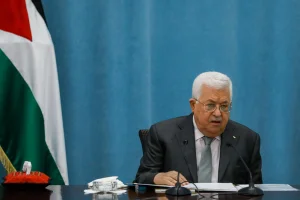
Washington’s decision to allow the Iranian president to attend the UN General Assembly comes one day after the State Department announced that it would deny visas to Palestinian Authority (PA) President Mahmoud Abbas and members of his delegation.
“The State Department has reported to Congress that the Palestine Liberation Organization (PLO) and Palestinian Authority (PA) have, once again, failed to live up to their commitments as described in the PLO Commitments Compliance Act of 1989 (PLOCCA) and the Middle East Peace Commitments Act of 2002 (MEPCA),” the State Department said in an official statement.
Abbas addressed last year’s UNGA virtually from his office in Ramallah. This year, the U.S. and Israel opposed a resolution allowing him to deliver his address virtually again. The resolution nevertheless passed, with 152 countries voting in favor, while the United States, Israel and Paraguay voted against and Colombia, Honduras, Panama and Peru abstained.
“If the PA wants to be treated as a partner, it must stop subsidizing terror and stop using diplomatic theater as a substitute for serious governance,” U.S. Deputy Ambassador to the UN Tammy Bruce told the UNGA ahead of the vote.
Bruce was referring to Washington’s longstanding criticism of payments to Palestinians convicted of attacks against Israelis and their families, a policy known as pay-for-slay.
Unlike Iran, Washington does not recognize the Palestinian Authority as the government of an independent state, and the United States has not recognized a Palestinian state.
The PA Foreign Ministry in Ramallah criticized Washington’s decision, arguing that it was inconsistent with efforts to advance peace in the Middle East.
“Punitive measures and restrictions imposed on Palestinian officials do not contribute to advancing peace or combating violence,” the PA ministry stated on Thursday.
“Rather, they weaken the Palestinian partner committed to a political solution and encourage forces working to undermine the two-state solution and impose the reality of occupation, settlement and annexation by force,” it added.
The PA has said it supports a two-state solution. At the same time, Israel and Palestinian watchdog groups have accused Ramallah of promoting anti-Israel rhetoric and antisemitic content, particularly in Arabic-language statements and educational materials. Abbas has also faced international criticism over past statements concerning Israel and the Holocaust.
You might also like to read this: