











Unity gov’t talks over after Netanyahu-Eisenkot meeting ends without results; new gov't could be formed this week
Eisenkot holds first direct negotiations with United Torah Judaism
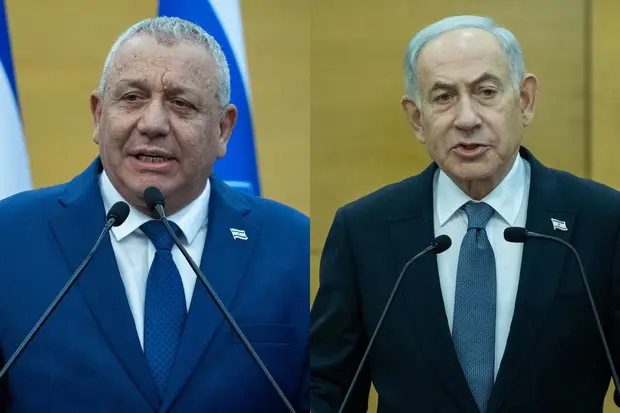
After talks to form a unity government failed to end in a deal on Sunday, Yashar party leader Gadi Eisenkot appeared set to move forward in forming a government without Likud.
The meeting between Likud and Yashar was scheduled on short notice after caretaker Prime Minister Benjamin Netanyahu offered Eisenkot the first turn in a rotation as prime minister, raising hopes for a unity government.
Netanyahu said he made this concession “in view of the magnitude of the existential threat and the possibility that a government might be formed that lacks the ability to deal with this threat.”
While the meeting was described as “businesslike” and focused on attempts to “bridge the substantial gaps” between the two parties, a statement released after the meeting did not refer to any additional meetings.
Over the weekend, Eisenkot had said he intends to announce an “emergency” government coalition before the end of the week, before his mandate ends on Dec. 6.
During the meeting Sunday, Eisenkot reportedly stood by agreements with his partners in the Change Bloc, telling Likud that he would welcome any party that accepted his guiding principles to join his government after it was formed, Channel 12 reported.
The question of which campaign promise Opposition Bloc voters are willing to break in order to form a government is fascinating. Sadly, this Kantar/Yisrael Hayom poll forced respondents to choose only one option, which means that only the figure for the "nones" is meaningful. https://t.co/KKXcnjEUCT
— Israel Elects (@israel_elects) November 28, 2026
Eisenkot has signed coalition agreements with Yisrael Beitenu and the Democrats. After the meeting with Likud, Eisenkot reportedly met with Together (Beyachad) leader Naftali Bennett to finalize an agreement between their parties.
Bennett led vigorous attempts to form a unity government rather than enter a coalition with United Torah Judaism (UTJ), which would require sweeping concessions in a new military draft law.
Channel 12 quoted sources close to Netanyahu who accused Eisenkot of showing no interest in a unity government, even with Netanyahu’s concession.
“Instead of holding genuine negotiations… Eisenkot is digging in behind an extreme position, has cancelled the negotiation meeting, and is focused solely on forming a government controlled by supporters of terrorism,” the statement said, referring to the Arab parties.
In an interview aired on Saturday, Ra’am chairman Mahmoud Abbas pointed to a bill his party co-sponsored which refers to Hamas as a terror organization, ostensibly fulfilling one of Eisenkot’s central demands and paving the way to be able to join the coalition.
However, Channel 12 reported that Netanyahu was not offering the usual rotation agreement, under which Eisenkot and Netanyahu would each serve two years as prime minister. Instead, Netanyahu reportedly wanted to remain in office, delay forming a government for several months until the security confrontation with Iran was resolved, and then rotate the premiership annually.
Yashar held parallel talks with several other parties on Sunday, including the first direct negotiations with UTJ.
However, reports on Saturday suggested that UTJ lawmakers were still not unified on whether to join a coalition. Meir Porush, identified with the party's right-wing faction, praised Netanyahu “for his willingness to make concessions,” and on Sunday told Radio Kol Hai: “Eisenkot hasn’t offered anything at all so far—nothing but hot air… It’s all lies—there is no offer. (Yisrael Beitenu’s Avigdor) Liberman can’t make any offer on his own either.”
Another senior UTJ figure said while Netanyahu was warning the ultra-Orthodox parties to not join an Eisenkot-led government, the prime minister himself made concessions "to throw Ben Gvir and the ultra-Orthodox out in a heartbeat, all so that those ‘leftists’ can form a government with him.”
Shas, the Sephardic ultra-Orthodox party, remains supportive of Netanyahu and hasn’t conducted any talks with Eisenkot. However, Israeli media outlets have cited Change Bloc and UTJ members who believe Shas will eventually follow UTJ if it joins the government.
If Eisenkot announces a coalition this week he will have seven days to present coalition agreements with all parties and to put the coalition to a vote of confidence in the Knesset.
Yashar’s faction leader Knesset Member Roy Folkman asked other Change Bloc leaders, as well as Ra’am and the Joint List, to be present during sessions through Dec. 7, amid “special preparations for the coming week,” apparently in anticipation of a quick vote to swear in a new government in the coming days.
This vote requires a simple, rather than an absolute, majority of the 120 Knesset members.
Popular article:

interview Easter message of resurrection hope amid war at Jerusalem's Garden Tomb

biblical commentary Let my people go: a Passover message for today

4 IDF soldiers killed, 2 wounded in fighting in southern Lebanon, as Israel eliminates dozens of Hezbollah terrorists

Receive latest news & updates
A message from All Israel News
Help us educate Christians on a daily basis about what is happening in Israel & the Middle East and why it matters.
For as little as $10, you can support ALL ISRAEL NEWS, a non-profit media organization that is supported by readers like you.
Latest articles:
Court accepts pause of Netanyahu corruption trial as prosecution, defense accept Pres Herzog’s mediation aimed at ending proceedings

Iran reportedly used Musk's Starlink satellite system to support attacks on US forces

Israel's political leadership reportedly prevented IDF action against Hezbollah tents before Oct 7

Former Amnesty UK coordinator accuses organization of ignoring Iranian regime’s human rights abuses amid anti-Israel bias

Balloons, drones emerge as new smuggling threat along Israel’s Egyptian border