











FULL TEXT: Ra’am leader Mansour Abbas regarding Hamas a terrorist organization: ‘The matter is settled’
Full English translation of Mansour Abbas’ Channel 12 interview with Dana Weiss
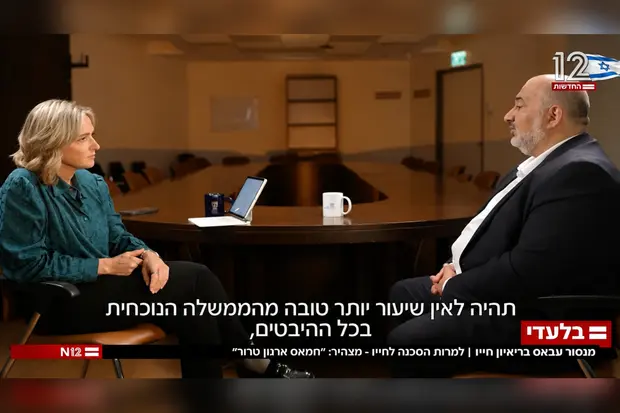
Dana Weiss: MK Mansour Abbas, chairman of Ra’am, and now also chairman of the Knesset’s Special Committee for Combating Crime and Violence. How does it feel to have eight seats?
Mansour Abbas: It feels good, but the responsibility is great, and there are expectations.
I see you brought your phone to the interview.
Yes, I can’t disconnect from it because we have a vote every 20 minutes.
I was actually thinking that perhaps you might pull a Tibi.
No, I don’t show off.
Why? Do you also have correspondence with Natan Eshel?
I do, with Natan Eshel and others.
Show me.
No, I don’t want to. You don’t do that.
You keep saying, “I have something.” Come on, show me what you have.
I did it once, actually, when we were backed into a corner. We were accused of being terror supporters throughout an entire speech, a speech in the Knesset that was supposed to be statesmanlike.
Are you talking about the swearing-in speech?
Yes, the swearing-in speech.
What went through your mind? Did you think about what you had on your phone?
That is exactly what went through my mind. The enormous discrepancy between a man who attacks us, incites against us and accuses us of supporting terrorism. I recalled a conversation I had with him at Balfour during Operation Guardian of the Walls, when he told me about his relationship with Sinwar. The two understood each other.
I don’t understand. Did you suddenly remember such a significant conversation only when you saw him attacking you in a statesmanlike speech? Or did you say to yourself, “Okay, now the time has come for me to make this public?"
During the speech, I asked myself, "What should I do?" Leave the chamber? Interrupt him?" Ultimately, I conducted myself in a statesmanlike manner.
You said to yourself, “I’ll get my revenge on air.”
It occurred to me that I should go out, give an interview and tell people about this incident involving Yahya Sinwar.
When the prime minister tells you, “I have an understanding with Sinwar,” what goes through your mind? Do you ask yourself why he is telling you this?
I was astonished. I said to myself, it cannot be that the prime minister of Israel trusts Yahya Sinwar. What is this supposed to mean?
Did you say that to him?
No, I didn’t say it to him. But internally, I thought it was an absurd situation.
Did you understand why he was telling you this?
It occurred to me that perhaps, in his perception, because I am from the Islamic Movement, I have some connection to him. I don’t know. Perhaps he didn’t know at the time that Yahya Sinwar had publicly attacked me and accused me of being a traitor.
But how is it possible that you kept such a conversation to yourself for five years? Didn’t you think about speaking about it after Oct. 7? In other words, did it have to reach the point where you were sitting through a speech in the Knesset and he was inciting against you, and only then did you think about telling the public that the prime minister had approached you regarding Yahya Sinwar?
After Oct. 7, I established a rule for myself: Regarding everything connected to his conduct as prime minister and his failures, if I am summoned before a commission of inquiry, I will say what I have to say.
If I knew everything he had told you, would my jaw drop as it did over the Sinwar issue? Was this a warning to Netanyahu? “Stop. Understand what I have on my phone?"
Yes.
What do you mean, yes?
Yes. God forbid, I am not trying to threaten or blackmail anyone. I don’t want to reveal anything, but on one condition: Enough. Stop. Act responsibly.
In other words, you are telling Netanyahu through us here to take notice, because this was only the preview if he continues.
Yes. I have no obligation to him if he continues inciting against us. We are not terror supporters. Period.
You are signatories to the bill establishing a state commission of inquiry into the Oct. 7 massacre.
Yes.
So that essentially takes care of a considerable number of my questions, right? Help me read the explanatory notes here for a moment.
“The Hamas organization, together with other terrorist organizations, in a large-scale terrorist attack launched from the Gaza Strip against the State of Israel.”
You are signatories to this bill, correct?
Yes.
And what does it say here?
“The terrorist organizations, foremost among them Hamas.”
Which, in simple terms, means what?
Look, throughout all these years, we have maintained an unequivocal position against any action...
Wait, but does this mean what I think it means as far as you are concerned?
I know where you are going with this, Dana. Our fundamental position is clear.
The only way to understand this is that in a bill you signed together with Ahmad Tibi, and which you have just voted for, it is written there in black and white.
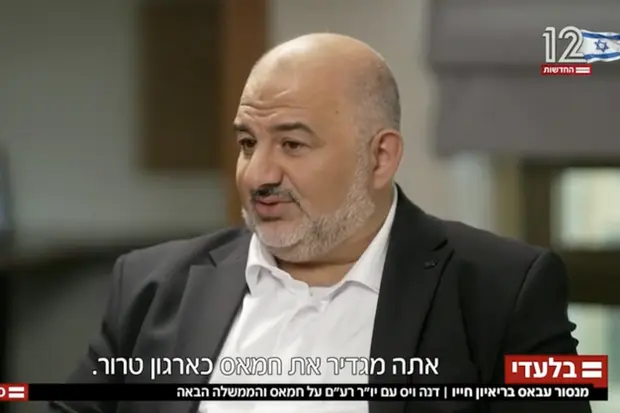
It defines Hamas as a terrorist organization.
So have we settled this matter?
Dana, as far as I am concerned, this matter was settled a long time ago.
Well, then why did it take so long to say it?
Our deliberation over whether or not to say it was not about their actions, their status or their conduct. We unequivocally condemned and defined their actions as acts of terrorism. But there are people who use this as a political tool, and that is why we were backed into a corner on this issue.
Furthermore, we also want to ensure that this is not used to declare an all-out war against every Palestinian baby, every Palestinian woman and the entire Palestinian people.
But you told me in our last interview in September that this was complicated for you, that it endangered your life and the lives of your family members, and that you wanted to preserve your ability to serve as a bridge. That is how you explained it at the President’s Residence.
Correct.
Now you are sitting here, having returned from a vote, reading me a proposal that the Ra’am faction signed together with Tibi, which states in black and white that Hamas is a terrorist organization. So I ask myself: Either everything you have said until now is no longer valid, or you were waiting to receive something in return politically.
This issue remains complex, and it has nothing to do with the accusation that we support terrorism. There are various aspects to this issue relating to the personal level, Arab society, relations with the Palestinian people as a whole and the way we view the conflict itself. We have not resolved these problems.
So why are you willing to say it now when you were not willing to say it before the election?
That’s not the point, Dana. That’s not the point.
No, it is the point. Just now, in the corridor, on your way to the interview, what did a boy who saw you say to you?
He asked me that question.
What did he ask?
Whether Hamas is a terrorist organization.
And you didn’t answer him.
I didn’t answer him. It is possible that if the bill had not been on the table, if two of our members had not signed it and we had not voted for it, perhaps I would not have said it.
Those who defined all the residents of the Gaza Strip as Hamas and as a terrorist organization intended either to eliminate them all, expel them all or throw them into the sea. That is why I am careful about my statements, and I do not want it to appear as though I am giving approval or support.
I am trying to understand the logic behind your political moves. That is why I am asking you: What you have just told me – is it a position of principle or a political position?
You have a bill, correct?
Yes.
What is written in it is written in it.
Which is what?
That Hamas is a terrorist organization. Don’t you see that it is written there? That’s it. The matter is settled.
So why did you wait? That is what I cannot understand.
I don’t have an answer.
You don’t have an answer because you don’t want to say?
I’ll think about it.
I have never encountered you without an answer.
Do you think I deliberately intended to wait?
Yes. I thought you were waiting in order to get something in the negotiations. And then I asked myself the following question: Perhaps this is not a position of principle? Because if it is a position of principle, you should remain faithful to your principles. And if it is a political position, then another question arises.
My perspective was that I did not need to make this declaration, even though I have a firm opinion. Anyone who wants to understand my attitude toward the Hamas movement or the actions it carried out on Oct. 7, as well as before and afterward, has a clear picture.
I did not intend to say it, but don’t be surprised if they continue accusing us of supporting terrorism and come up with another question: “He doesn’t define Fatah as a terrorist organization.” Okay?
They will always find things to push us to the margins and delegitimize Arab citizens and their representatives.
In other words, you are saying that you knew that even if you said it, a new accusation would come tomorrow morning.
There is no doubt.
In retrospect, is it possible that you played into their hands by waiting? Because here you are, you have said it now, and the sky hasn’t fallen. Or perhaps I don’t know, and the sky has fallen on you.
It might still fall. How will this statement be interpreted in Arab society, on the Palestinian side and around the world? It has many implications.
So have you damaged your ability to serve as a bridge?
Possibly.
Have you endangered your family?
Possibly.
So what will you do now?
We will try to deal with it and explain it to people.
In other words, your life is now under greater threat. Is that what you are saying?
Certainly.
From the moment this interview is published?
Certainly.
Why?
Because someone will think, “Okay, he is our enemy. Let’s eliminate him.”
But do you understand the concerns of people in the Jewish public who hear you and say, “Look, if his life is in danger because he says Hamas is a terrorist organization, not from Hamas abroad but from within Israel’s Arab population, then they cannot be trusted?"
Do you know how many reports we have already submitted to the Knesset security officer regarding threats against my life from Jewish citizens? Also from Arabs, Palestinians and criminal organizations.
Do you think there is a Jewish person who has threatened you because you said Hamas is a terrorist organization?
Not on that specific point, but there are threats.
You told me that after saying this, your life is now in greater danger.
Certainly.
From whom?
Who is offended by that statement?
Palestinians.
Okay.
Are Israeli Arabs offended?
You might find individuals here and there.
Is it just individuals?
Yes. Look, there has been a discussion within Arab society, albeit not publicly, but people are talking. Some people told me, “You must not say it,” while others told me, “Say it and that’s it. Let’s put this whole story behind us.”
There are citizens who think that if I say it, all the attacks and incitement against Arab citizens, which constitute a threat... In practice, there are dozens of incidents of violence in public spaces that never reach the media.
People do not understand that this escalating incitement poses a tangible danger. Some people tell me, “Mansour, say it, and perhaps then it will end.”
And what did you tell them? Wait?
I told them we would think about it.
I am now looking at Gadi Eisenkot’s four conditions. The first was recognition of a Jewish, democratic, liberal and egalitarian state. Check. You said it.
I said it.
Commitment to the values of the Declaration of Independence.
We not only accept its contents; we demand them. Zionist parties do not accept them.
Okay, so we have covered one and two. Three – Gadi Eisenkot demands mandatory military, national or civilian service for all Israeli citizens.
We said that we have a framework for civilian service.
The only remaining obstacle was essentially condition number four: Recognition of Hamas as a terrorist organization and the obligation to destroy its military and governing capabilities in Gaza. Now we can check that one off as well. Can we?
It depends on how the other side understands these things.
You explain it to me. Where do you stand on condition number four? Recognition of Hamas as a terrorist organization – we have checked that off. And the obligation to destroy its military and governing capabilities in Gaza?
In this context, it was stated that the government accepts President Trump’s plan – to disarm Hamas, establish a civilian administration that is not connected to Hamas and begin a reconstruction process.
So you are essentially saying that you meet all four of Gadi Eisenkot’s conditions?
Perhaps he will decide that I don’t.
Who is “he?"
I don’t know.
Are you negotiating over this? When was the last time you spoke with him?
It doesn’t matter.
What do you mean, it doesn’t matter?
It doesn’t matter.
And if I think that what I am seeing here now is part of the negotiations – meaning the introduction of the bill and the public statement are part of your efforts to meet the conditions for becoming a legitimate coalition partner – does that make sense? Am I reading the situation correctly?
I cannot confirm that for you. You can think whatever you think.
Abbas, I am catching you now in a moment of...
Weakness.
Yes.
No, I am being very clear.
Then help me understand. Are you still optimistic? Because at the President’s Residence, you said, “We will establish a good government,” and called on Gadi Eisenkot to form a government swiftly. So, if I understand correctly, are you moving in that direction?
We recommended that Eisenkot lead the process of forming the government, and that is what he is doing. We support his efforts and believe the process should be built in logical stages.
By logical stages, do you mean that the Jews will first form a government while the Arabs sit on the sidelines, and once the government with the Jews stabilizes, you will join?
No. There are stages in terms of negotiations and coalition agreements. He started with Yisrael Beytenu. Perhaps he should continue with Beyachad, the ultra-Orthodox parties, the Democrats, Ra’am and so on.
You have no problem with them getting to you last?
Look, I said that the goal is not merely to establish a government that will replace Netanyahu’s government. The goal is to establish a government that will serve for four years and get to work.
In other words, would you endorse a statement such as, “If we establish a government that relies on the Arabs or their abstention, Netanyahu will return with 70 seats. That would be bringing Bibi back on steroids?"
I endorse that statement.
You know who said it.
Yvette Liberman.
So you agree with Avigdor Liberman?
Yes. In the past, I was enthusiastic and wanted a government to be formed at any cost. Today, I want the government to function for four years at any cost.
And for that, you are willing to pay a price?
We are pursuing a four-year initiative, with all the good and bad that comes with it. We have to do this.
By the way, doesn’t it bother you that you have to sit on the sidelines?
It should bother all the democratic and liberal forces in the State of Israel, not me.
And you accept that?
We do not know where we will end up. For now, we in Ra’am have said that we are in what could be described as a standby position. We want to see the coalition-building process progress, step by step, agreement by agreement. It is a complex process. It is not simple.
So, wait, are you part of the coalition?
We are acting as part of the bloc that is supposed to become the coalition.
Now, what does that mean for you?
Patience and giving it a chance. We will have to swallow a lot of bitter pills, but we want to see the final outcome.
Define a bitter pill for me.
Any difficult decision.
The Judea and Samaria regulations?
That is one of them.
Liberman as defense minister, saying that he will come down hard on everyone – is that also a bitter pill?
I don’t know whether that will ultimately be a bitter pill or not. We will decide, discuss it and see what happens.
But is it possible that you conveyed the message: “We will not be the ones to bring down the government, even during a sensitive security period. If action is needed in Iran, we will act in Iran. And if progress cannot be made in Gaza, we will lend our support to military action in Gaza?"
Let us wish, hope and pray that there will be no more wars.
Amen. And if there are?
I said this during the previous term as well. We are not joining the government to determine and manage the State of Israel’s defense and foreign policy. We want to safeguard the personal security of citizens in general and Arab citizens in particular, okay?
You are saying that the Joint List is making life difficult for you, that they are not making things easier.
No. The main unwise step was not remaining in the Knesset plenum during the national anthem.
That bothered you.
It should have been a defining moment, an expression of a different approach to the political conduct of all the Arab parties, not just Ra’am.
In the past, the leaders of Hadash, as well as Ahmad Tibi himself, would remain standing during the national anthem. You are not expected to sing it, fine, but stand and show respect for this official occasion.
Instead of allowing it to become an event through which we suffer further incitement, exclusion and delegitimization, we could have turned it into something...
And do you speak with them about this?
I spoke with them. I tried to persuade them to remain.
And what did they say?
They thought differently.
So you are essentially saying that the Joint List does not understand the gravity of the moment.
That is what I tried to convey to them during a meeting we attended.
And when you speak about the gravity of the moment, are you also referring to the magnitude of the danger?
Certainly.
Why?
In light of the ongoing incitement from the highest levels – the prime minister, ministers, Knesset members and parts of the media – this incitement will translate directly into acts of verbal violence, physical violence and the danger of confrontation.
You are saying, “I am showing you the writing on the wall. Don’t say I didn’t warn you.”
Exactly. I see that if we continue down this path, we could deteriorate, God forbid, into something similar to, or even worse than, what happened during Operation Guardian of the Walls.
To that extent? Do you see the streets burning?
If we do not do something to counter it. The first step, undoubtedly, is to replace the government. That is very important.
But even after the government is replaced, I believe those same people who engage in incitement will continue to challenge the government and attempt to bring it down, including through confrontation and damage to the fabric of Jewish-Arab relations.
You know, as we are speaking, Yinon Magal has just tweeted this – a picture of Merav Ben Ari and Efrat Rayten.
Yes, dressed in Muslim religious clothing. Do you remember when they depicted Rabin in an SS uniform? This is a repetition of the same process.
Do you actually envision a scenario involving political assassination or killings in the streets?
We must put that possibility on the table and not ignore it.
Is that also essentially part of your thinking about why the formation of the government needs to be expedited?
Correct.
And are you conveying this to the people who need to hear it?
I conveyed it on the very first day that we recommended Gadi Eisenkot, and I called for the swift establishment of a national rescue government. But this will continue even after the government is formed.
And is this different from last time? You already saw what happened during the government of change. You were there.
This time it will be twice as bad.
What were you thinking when you said: “twice as bad?" What did you envision?
I envisioned the worst possible scenario. I am not expressing this out of personal concern. I accept whatever fate awaits me, whatever it may be. Even if it reaches the most extreme point, I will not... It will not change anything.
You have come to terms with the possibility that the political move you are making could cost you your life.
Yes. I have come to terms with that.
Do you think it could also extend to Jewish Knesset members? Do they also need to go through this process? Matan Kahana, Efrat Rayten?
From the prime minister down. Yes.
Do you think there is another way to stop it?
Certainly.
How?
Resolute leadership. Restoring state institutions to a professional, nonpartisan course – the police, the Shin Bet, the State Attorney’s Office, the legal advisory system, the courts and the media.
By the way, do you trust Shin Bet Director David Zini?
I don’t know the man, and I don’t know his agenda.
I thought you would tell me something different, given everything that happened surrounding the election and the investigations.
That is part of the issue. On the one hand, he appeared to be someone attempting to advance a political agenda by accusing Ra’am of fraud, interference and stealing the election. But I think that within the organization itself, which investigated and examined the matter, as well as within the police, professional and nonpartisan conduct ultimately prevailed.
Tell me, will you still become a minister during this term?
We aspire to be part of the government. We will get there. The question is when.
There is one thing I want to ensure: That the government that is formed will be committed, among other things, to Arab citizens from day one.
If I cannot deliver results – a reduction in the level of crime and violence in Arab society from day one – this initiative will not hold.
Are you saying it is now or never? Is that how you feel?
It is difficult for me to imagine someone else coming along and saying, “I will do what Mansour is doing and pay the prices Mansour is paying.”
In closing, you now have an opportunity to speak to people who look at you and say that if you are part of this political arrangement, their personal security is gone and they are in danger. After all, there is genuine fear here. Eliasaf Peretz, and you heard Miriam Peretz, as well as Shira Shapira and Matan Kahana – they, too, have serious reservations.
We must not ignore people’s feelings, fears and suspicions.
What can you tell them?
I can assure them that the government that will be formed will be immeasurably better than the current government in every respect, including their personal security and the national security of the state.
Would you personally guarantee that to them?
I guarantee it to them. I guarantee it to them.
I will not harm the people who have accepted me. We will go hand in hand, and God forbid that I should betray them or do anything that would harm their personal security or national security. I will not do that.
I constantly think to myself that if I wake up one morning and have changed my mind about this entire situation, I will go straight to the Knesset, submit my resignation and tell people, “I am no longer part of this.”
I will not betray them. I will not harm the people who opened the door and welcomed me into their home.
Now, people in Arab society will say, “But also give expression to the suspicions, concerns and pain that we have.”
Ladies and gentlemen, I am part of this situation. I feel both sides, and I try to give expression to the pain and fears of both sides.
That is what it means to find a balance between being Israeli citizens and being Arabs, Palestinians, Muslims, Druze or Christians. It does not matter which group.
MK Mansour Abbas, thank you very much for this interview.
Thank you, Dana. Thank you.
Popular article:
interview Easter message of resurrection hope amid war at Jerusalem's Garden Tomb

biblical commentary Let my people go: a Passover message for today
4 IDF soldiers killed, 2 wounded in fighting in southern Lebanon, as Israel eliminates dozens of Hezbollah terrorists

Receive latest news & updates
A message from All Israel News
Help us educate Christians on a daily basis about what is happening in Israel & the Middle East and why it matters.
For as little as $10, you can support ALL ISRAEL NEWS, a non-profit media organization that is supported by readers like you.
Latest articles:

Balloons, drones emerge as new smuggling threat along Israel’s Egyptian border
In apparent bid to join future coalition, Ra’am’s Abbas acknowledges Hamas as terror group in candid interview
THE ROSENBERG REPORT Palestinian Muslim analyst notes growing ‘shift’ in Gaza away from Hamas

Nearly half of Israelis with disabilities struggle financially – survey
Israel shares emergency medical expertise with Somaliland