










‘Our story was never told’: Hen Mazzig recalls exodus of 850,000 Jews from Arab lands
Nov. 30 is designated as Jewish Refugee Day in Israel
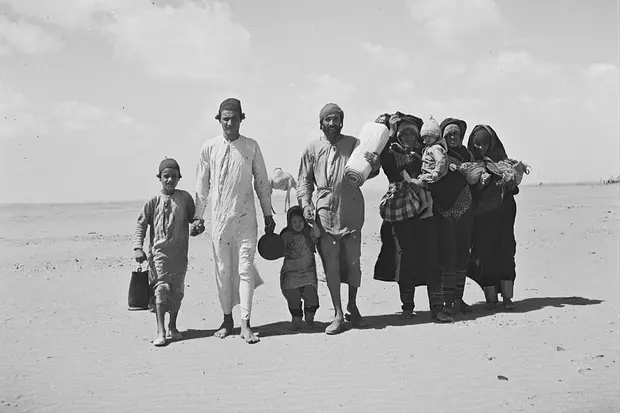
While the plight of 750,000 Palestinians displaced during the “Nakba” of 1948 is widely documented, less recognized is the fact that a similar number of Jewish refugees fled Arab countries and Iran, leaving behind homes and possessions, erasing entire communities.
The flight of 850,000 Jews is commemorated on Nov. 30, designated by the Israeli Knesset 12 years ago as Yom HaPlitim (Jewish Refugee Day).
Almost a million Jews once lived in Arab nations and Iran, but by the 1970s around 95% had fled, never to return. Many had businesses and property confiscated, escaping only with their lives. Others were less fortunate.
For Israeli speaker and author of “The Wrong Kind of Jew,” Hen Mazzig, the refugees' plight is personal. Mazzig, cofounder of the Tel Aviv Institute, has roots in Tunisia on his father’s side and Iraq on his mother’s. His grandparents were all chased out of their respective countries in the 1950s.
“People didn't really care about the 850,000 Jews that were forced out from the Middle East and North Africa. We were just dismissed because we are an inconvenient truth to so many people who have an agenda when it comes to this,” he said. "I always make sure to commemorate this day because it's the only day in the year that I have to remember what happened to my grandparents and to be a voice for them because they can't speak for themselves."
Although Congress submitted a resolution to recognize Jewish Refugee Day in the U.S. last year, the event has not yet received much global attention. Mazzig considers this all the more reason to talk about it.
“Every year, I commemorate it,” Mazzig told ALL ISRAEL NEWS. “A few years ago, I was invited to speak at the Babylonian Jewish Heritage Museum in Israel, in Or Yehuda. There are ceremonies happening throughout the world. People are noticing it now. Our story was never told.”
For those who survived the Nazis, Jewish communities across North Africa and the Middle East hoped life would improve, but instead they faced new waves of attacks.
The day after Israel’s declaration of independence on May 15, 1948, the New York Times warned: “Jews in Grave Danger in all Moslem Lands” with the subtitle, “Nine Hundred Thousand in Africa and Asia Face Wrath of Their Foes.”
These Mizrachi Jews, Jews of the East, had lived in Muslim lands for many generations and knew no other life. According to Isaac Yomtovian of Haifa University, there are Jewish gravestones in Iran dating back to the first century B.C.
Jewish communities lived in Tunisia since 200 B.C., in Libya since the third century B.C. and in Syria since 500 B.C., and many of these communities settled in Arab lands long before Islam.
“My family lived in Iraq for 2,600 years,” said Mazzig. “They lived there when it was Babylon. They lived in Baghdad,” he added, confirming that at one point a third of Iraq’s capital was once Jewish. “It was a very Jewish city. We need to remember that there were 150,000 Jews living in Iraq, most of them in Baghdad and in Basra, and they got there with the prophet Ezekiel.”
“They lived there as a community for such a long time and were such a big part of influencing Babylon and Iraq,” he said. “My family doesn't describe themselves much as Iraqi Jews, but more as Babylonian Jews. They were in Babylon more than 1,000 years before Islam existed. Nobody can call them colonizers of this place because they lived there since the time of Daniel.”
In a BBC documentary on the subject, Canon Andrew White, known as the Vicar of Baghdad, also explained that while Babylon had been a center of Jewish learning for centuries, everything changed in the 1940s.
“Nazism, Arab-nationalism and anti-Zionist feeling created a wave of anti-semitism. Violent pogroms flared up, young Jewish men were publicly hanged, Jews were forced from jobs,” he said. “By the 1970s nearly all had left, many in 1951 when 110,000 people were flown to safety in Israel.”
Mazzig’s own grandmother witnessed the horrors of the “Farhud” riots which erupted in Iraq on June 1, 1941, a violent response to a British victory over the pro-Nazi government of the time. Mazzig likened the event to Kristallnacht, a pivotal moment signaling the beginning of the end for the Jews of Iraq.
“There were two days of violent attacks against the Jews,” he said. “ My grandmother was a teenager then, and she saw her best friend being raped and mutilated in the streets of Baghdad because she was Jewish. Hundreds of Jews were killed and thousands were injured.”
In the same year, the government in Tunisia implemented anti-Jewish laws, banning Jewish cultural groups and associations.
“Jewish sports teams were dismissed, then the rabbinical council was dismissed,” said Mazzig. “There were a lot of acts of violence against the Jewish community and 10 years later my grandparents managed to get on a boat and sail to Israel.”
Mazzig’s Iraqi ancestors also decided to flee to the new Jewish state, hoping that they would at last be safe.
“When they saw that Israel was established, they were thrilled,” he continued. “My grandmother says that they saw themselves as the Jews by the rivers of Babylon, weeping and hoping to go back to Zion. My great-grandfather was working in the court in Iraq, and they came to Israel with a suitcase and nothing else. Everything was taken from them; even the gold necklaces that my grandmother brought with her were taken from her at the airport. They arrived in Israel with nothing but the clothes on their backs.”
While Iraq had initially prevented its Jewish population from escaping to Israel in 1948 in an attempt to foil its establishment, in 1951 the Iraqi government passed a law encouraging Jews to give up their Iraqi citizenship and move to Israel. Mazzig describes the legislation as simultaneously being a polite invitation and a threat. His ancestors did not wait to be asked twice.
The trauma, loss and displacement that Mazzig’s family experienced were replicated in hundreds of thousands of Jewish families throughout the entire Middle East. Despite their long history and often close relationships, Jewish communities across the Middle East have been decimated and most have disappeared from Arab lands forever.
“The Jews of Iraq went from 150,000 people to zero,” stated Mazzig. “That is the textbook definition of ethnic cleansing.”
However, many Mizrachi Jews had a rough landing in Israel. Though more than half of Jews in Israel today came from the Middle East and North Africa, they were not assimilated well when they arrived in the nascent state.
”Almost 1 million Jews came speaking Arabic, the language of the countries that were attacking Israel while the country was just being built, so it wasn't such a warm welcome,” he admitted, saying that families like his have faced discrimination and racism in Israel despite being the majority.
While acknowledging that it is important to remember the difficulties Mizrachi Jews historically faced in Israel, Mazzig says that today the situation is different and that most of his own generation have a mixed heritage of Mizrachi and Ashkenazi roots.
“I think the fact that Eisenkot might be the first Mizrachi prime minister, a Moroccan prime minister, is a testament to how far we have come,” he said.
Popular article:

interview Easter message of resurrection hope amid war at Jerusalem's Garden Tomb

biblical commentary Let my people go: a Passover message for today

4 IDF soldiers killed, 2 wounded in fighting in southern Lebanon, as Israel eliminates dozens of Hezbollah terrorists

Receive latest news & updates
A message from All Israel News
Help us educate Christians on a daily basis about what is happening in Israel & the Middle East and why it matters.
For as little as $10, you can support ALL ISRAEL NEWS, a non-profit media organization that is supported by readers like you.
Latest articles:
Worship on the Mt of Olives: Christian pilgrims, artists gather overlooking Jerusalem

Iranian-linked terror operations in Europe increasingly target Jews – report

Israeli envoy Danon accuses UN humanitarian chief of misrepresenting Gaza aid deliveries

The story behind IHRA definition of antisemitism, now adopted by 48 countries

Somaliland’s first ambassador to Israel outlines vision for strategic partnership in trade, technology, security