










THE ROSENBERG REPORT Palestinian Muslim analyst notes growing ‘shift’ in Gaza away from Hamas
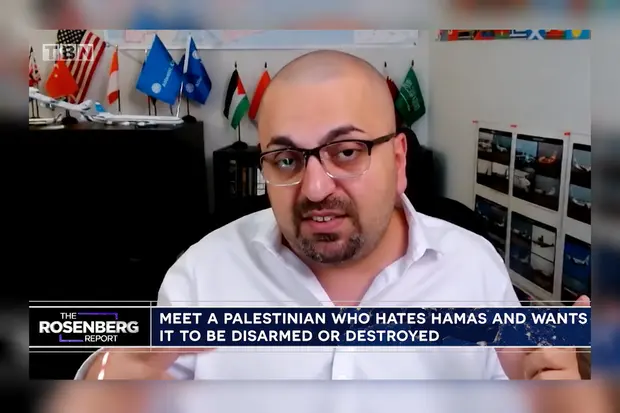
Palestinian Muslim political scientist Ahmed Fouad Alkhatib says he is seeing growing disillusionment with Hamas rule in the Gaza Strip and a willingness among Palestinians to move away from armed resistance and consider a different future built around coexistence with Israel.
“There's a shift. There is something that I have not seen in Palestinian society in Gaza," Alkhatib told Joel Rosenberg during an interview last month on THE ROSENBERG REPORT.
He described the shift as a window of opportunity. "I believe there's a willingness to go for something fundamentally different that moves Gazans away from the armed resistance narrative toward the nation-building agenda to ensure that this is Gaza's last war – ultimately, in pursuit of the peace and coexistence reality that we seek.”
Alkhatib, who was born and raised in Gaza and now works with the Atlantic Council in Washington, D.C., published a book earlier this year titled “Hamas and Its Two Million Hostages.”
“The Palestinian people in Gaza are fed up with Hamas. They're tired of endless wars,” he told Rosenberg, describing how the group's 20 years of rule have held back Palestinian development, wasted billions of dollars and resulted in the deaths of tens of thousands of Palestinians.
Rosenberg described Alkhatib as a “rare voice” among Palestinians speaking out against Hamas. Alkhatib responded, "I might be a rare voice in how expressive and outspoken I am. But at the same time, there are many Palestinians who are very, very much so on the same page."
Alkhatib believes Palestinians must take responsibility for their own political failures rather than placing the blame for the conflict entirely on Israel.
“While there are legitimate grievances that the Palestinian people have towards the Israeli policies and Israeli actions over the decades and over the recent years, there's plenty of space for Palestinian agency, responsibility and accountability,” he said.
“A lot of people don't want to discuss Palestinian mistakes, historic and contemporary, the failure of Palestinian leadership, how Hamas and other leaders before it have consistently, time and again made decisions that resulted in the perpetuation of the conflict rather than the resolution of it,” he added.
Alkhatib believes the current situation in Gaza must be addressed before meaningful progress can be made in the wider Israeli-Palestinian conflict.
Hamas rule demonstrated the dangers of putting an armed movement in control of government, he said.
“I believe that we need to reverse that. We need to correct that before we can hope to address that, either in the West Bank or in the broader conflict, so that there can be peace and coexistence between Israelis and Palestinians,” he said.
Rosenberg and Alkhatib addressed allegations that Israel committed genocide in Gaza. Alkhatib acknowledged the devastation of the war, saying he has lost dozens of family members in Israeli airstrikes, including very young children.
“Do I believe, however, that despite the horrendous what I believe were atrocities and war crimes, including the killing of dozens of my own family members? Do I believe it was the official policy of the state of Israel to commit genocide in Gaza? I don't know,” he said.
Alkhatib also criticized specific Israeli military and government decisions during the war, including the concentration of civilians in southern Gaza and the Al-Mawasi humanitarian zone, the failure to make sufficient use of cleared areas in northern Gaza, and problems with Israeli military discipline and coordination.
“There were horrendous mistakes. There were horrendous calls and decisions that were made throughout the war,” he said.
Rosenberg asked how much support Hamas still has in Gaza. Alkhatib estimated that only about 10% of Gazans still support the group ideologically, while emphasizing that this was his own estimate, not a polling figure.
Alkhatib said the loss of support was not only a reaction to the devastation caused by the Oct. 7 attack and Israel's military response. Hamas' own behavior during the war, including stealing humanitarian aid, torturing Palestinians and hiding among civilians, had further alienated people, including some who had previously supported the group.
He said the shift presents an opportunity to move Gazans away from armed resistance and toward building a different society. However, he cautioned that the process would take time, describing it as a journey of “transformation” that will include “deradicalization.”
He views deradicalization as "a form of empowerment, uplifting, opening up horizons, access to new opportunities. So that's going to take a little bit of time."
Alkhatib noted that about 70% of Gaza’s population has never left the Strip and that its population has nearly doubled under Hamas’ 20-year rule. An entire generation has grown up knowing only about eight hours of electricity a day and experiencing four or five major destructive wars with Israel.
"If we want to actually understand Gaza – if we want to be constructive builders and creators and agents of change for what this territory is going to be in the future – then we have to understand that and resist...as tempting as it is, resist the urge to think, 'Oh, they're all just Hamas. They all just want to kill Jews. And they just... they hate Western civilization and these people are hopeless.'"
Despite the challenges, Alkhatib said Gaza has significant untapped human potential, pointing to Palestinian society’s high literacy rates and the large number of people with advanced degrees. “Imagine if we can unlock that human potential, that human capital […] Gaza is one of the most densely populated areas in the world. Well, imagine if that density can actually be tapped as endless human potentiality for building, for construction and for a peaceful future.”
Click here for Ahmed Fouad Alkhatib's book, “Hamas and Its Two Million Hostages.”
THE ROSENBERG REPORT airs Thursday nights at 9 p.m. EST and Saturday nights at 9:30 p.m. EST on the Trinity Broadcasting Network (TBN), the most-watched Christian television network in the United States.

Support our independent, on-the-ground reporting from Israel. Become a $5/month Ally.
Popular article:

interview Easter message of resurrection hope amid war at Jerusalem's Garden Tomb

biblical commentary Let my people go: a Passover message for today

4 IDF soldiers killed, 2 wounded in fighting in southern Lebanon, as Israel eliminates dozens of Hezbollah terrorists

Receive latest news & updates
A message from All Israel News
Help us educate Christians on a daily basis about what is happening in Israel & the Middle East and why it matters.
For as little as $10, you can support ALL ISRAEL NEWS, a non-profit media organization that is supported by readers like you.
Latest articles:

Iran reportedly used Musk's Starlink satellite system to support attacks on US forces

Israel's political leadership reportedly prevented IDF action against Hezbollah tents before Oct 7

Former Amnesty UK coordinator accuses organization of ignoring Iranian regime’s human rights abuses amid anti-Israel bias

Balloons, drones emerge as new smuggling threat along Israel’s Egyptian border

‘Hamas tried to erase us’: Former hostage Yarden Bibas fights to preserve family home in Nir Oz