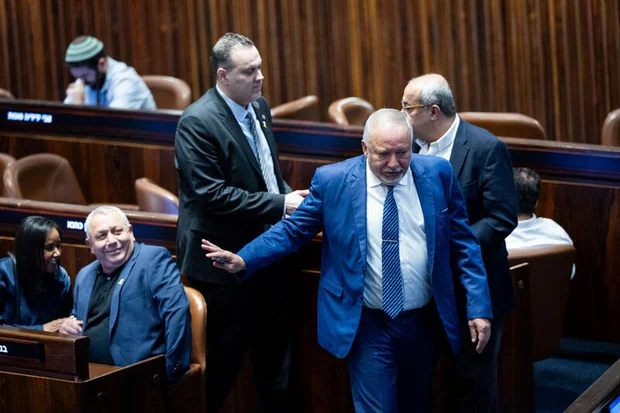
US stresses opposition to any policies that would undermine ‘two-state solution’
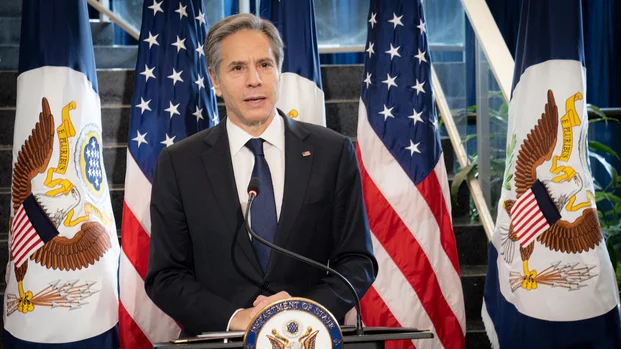
The United States on Monday stressed to Israel’s foreign minister that it is opposed to any policies that would undermine the future establishment of two states for two peoples in the resolution of the Israeli-Palestinian conflict.
The opposition was communicated by U.S. Secretary of State Antony Blinken during his first call with Israel’s new foreign minister, Eli Cohen.
“The Secretary emphasized the continued U.S. commitment to a two-state solution and opposition to policies that endanger its viability,” stated a readout from the phone call, published by U.S. State Department spokesperson Ned Price.
The U.S. position is not new and was reiterated several times, both before and after Israeli Prime Minister Benjamin Netanyahu’s government was sworn in last week.
The U.S. is concerned about the new government’s promise to build more settlements in the West Bank – Judea and Samaria – and to legalize existing settlement outposts.
The Six-Day War in 1967 resulted in Israel gaining control over Judea and Samaria from its rival, Jordan, which had occupied the areas for 19 years.
The new Israeli government made it clear that it considers every part of the Jewish state as belonging to the Jewish people.
“The Jewish people have an exclusive and inalienable right to all parts of the Land of Israel,” state the governing coalition’s guiding principles, which were published at the end of December.
The guidelines also made it clear that Israel will expand its settlements throughout the historically delineated land of Israel and not just within what is commonly known as “the green line.”
“The government will advance and develop settlements in all parts of Israel – in the Galilee, the Negev Desert, the Golan Heights and Judea and Samaria,” the coalition vowed.
In 2019, former U.S. President Donald Trump recognized Israel’s sovereignty over the Golan Heights, a mountainous region Israel won in the Six-Day War after being attacked by Syria. Syria infamously targeted Israeli farmers from military bunkers in the region and Israel considers the Golan Heights important to its security.
The European Union still considers the territory “disputed” and does not recognize Israel’s sovereignty there. The current U.S. administration also has not endorsed Trump’s recognition of the Golan Heights, but it also has not withdrawn the recognition.
Working towards annexation of large parts of Judea and Samaria was part of the deal Netanyahu made with the Religious Zionism party, a key coalition faction, but in practice, the prime minister was given the veto over any such plans. It seems unlikely that annexation will go forward, as Netanyahu has expressed eagerness to reach a normalization agreement with Saudi Arabia, which is staunchly opposed to such a move.
Another possible cause for concern for the Biden administration are the comments of Israel’s new minister of tourism, Haim Katz, who vowed to invest in tourism in “our local Tuscany in Judea and Samaria” and other areas “that may not have received sufficient support to date.”
One official told the Times of Israel that “the Biden administration is particularly focused on maintaining prospects for a two-state solution by preventing further Israeli expansion in the West Bank, but that there is also unease regarding the impact the next government might have on Israel’s Arab and LGBTQ communities.”
Some American Jews join the Biden administration in its concern about the policies of Israel’s government. On Monday, dozens of American Jews protested outside the Israeli embassy in Washington. A left-wing group known as Americans for Peace Now organized the protest.
“We protested against the felons, fascists and fundamentalists who make up the current Israeli government,” the group tweeted. “We are for an Israel that respects democracy, pluralism and religious diversity. We are for an Israel where there is peace, justice and equality for all citizens. And we are for an Israel that lives in peace, and with justice and equality, with its Palestinian neighbors.”
Two unnamed Israeli and U.S. officials said that the Biden administration’s “red lines” include any moves by Israel toward annexing territory, including where modern Israeli cities or Israel’s archaeological or biblical heritage exist.
Popular article:

interview Easter message of resurrection hope amid war at Jerusalem's Garden Tomb

biblical commentary Let my people go: a Passover message for today

4 IDF soldiers killed, 2 wounded in fighting in southern Lebanon, as Israel eliminates dozens of Hezbollah terrorists

Receive latest news & updates
A message from All Israel News
Help us educate Christians on a daily basis about what is happening in Israel & the Middle East and why it matters.
For as little as $10, you can support ALL ISRAEL NEWS, a non-profit media organization that is supported by readers like you.
Latest articles:

editorial Evangelical Christians, please vote: The future of the US-Israel alliance is on the line
Breaking silence, Liberman annouces he will support Eisenkot for PM, Lapid for Knesset speaker

Israel's Christian ambassador warns against support for Muslim Brotherhood candidates

Eisenkot slams Likud for ‘malicious attempt to deny election results’ amid foreign interference probe

Maronite community forgives vandals who targeted historic church in Nahariya