‘Streets are full of blood’: Iranian regime kills at least 500 protesters under cover of darkness & internet blackout
Estimates of true death toll say at least 2000, likely much higher number have been killed, tens of thousands arrested





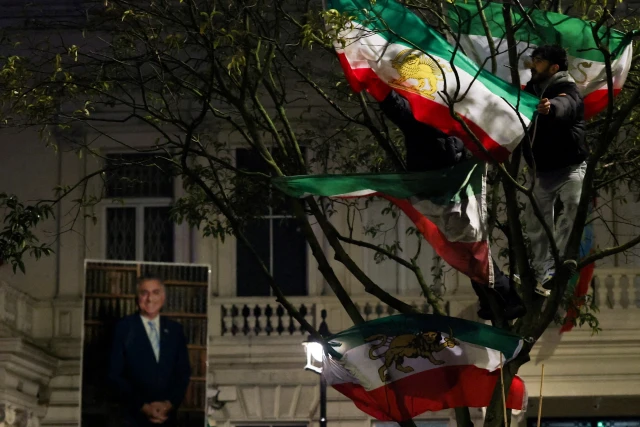
After over two weeks of protests against the regime in Iran, and over three days of an internet shutdown, the scale of the protests and the murderous response by security forces are hard to discern.
However, human rights groups collecting and verifying reports of killings say that at least 500 protesters have been killed so far, with the true numbers likely much higher. Opposition-aligned outlet Iran International said that “most conservative estimates indicate that at least 2,000 people have been killed across Iran over the past 48 hours.”
In addition, some 10,000 people have been arrested as regime officials have threatened the death penalty for "rioters."
According to the monitor NetBlocks, the internet shutdown has lasted over 84 hours, and the volume of footage and eyewitness accounts of what is happening on the streets of Iran has dropped significantly.
ویدیوی رسیده به ایراناینترنشنال نشان میدهد شامگاه یکشنبه به رغم سرکوب و قطع اینترنت مردم تهران در منطقه پونک تجمع کرده و آتش روشن کردند و شعار اعتراضی دادند. pic.twitter.com/gq6DPYIdj4
— ايران اينترنشنال (@IranIntl) January 11, 2026
Nevertheless, Iran International reported that demonstrations continued in Tehran on Sunday evening.
The regime has tried to exploit the cover of actual and metaphorical darkness to crack down on the protests while signaling “business as usual” to the outside world. Foreign Minister Abbas Araghchi, who just returned from a visit to Lebanon, said on Monday that “the situation has come under total control.”
He made his comments on the Qatari Al Jazeera network, which has been allowed to keep broadcasting in Iran despite the internet shutdown.
Iranian state TV also covered a planned pro-government demonstration in Iran’s Enghelab Square at 2 p.m. local time on Monday, estimating it would have 100,000 attendees.
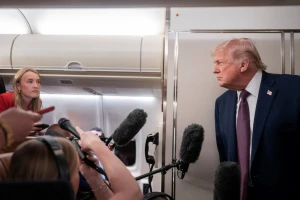
U.S. President Donald Trump said on Sunday he would turn to billionaire Elon Musk to try and find solutions to restore internet access. Israeli media had reported over the weekend that the regime managed to jam connections to Starlink’s satellites using Russian know-how.
“They are shooting at people. Help us,” a protester shouts in English on the streets of Mashhad in northeastern Iran in a video sent to Iran International, appealing for help from the United States. pic.twitter.com/XGd5Ork3XT
— Iran International English (@IranIntl_En) January 11, 2026
The violent crackdown had begun even before the regime cut off internet access but was at first accompanied by conciliatory remarks from “reformist” regime figures like President Masoud Pezeshkian, who expressed understanding for the protesters’ economic hardship.
However, video footage showing riot police breaking into a hospital treating wounded protesters in the western province of Ilam already emerged on Jan. 4. At the time, Pezeshkian called for an investigation into alleged ill-treatment by security forces.
But this conciliatory tone has not been heard for several days now, as authorities have accused protesters of murdering security forces, and threatened the death penalty for those not killed in the streets.
Araghchi published video footage on 𝕏, commenting that “police officers are being executed by actual terrorists overseen by what [former CIA chief] Mr. Pompeo has openly called Mossad agents.”
A scene of the Iranian security forces opening fire directly into the crowd of protesters nearby. https://t.co/eNn4i5Gqui
— مهدی یحیینژاد Mehdi Yahyanejad (@mehdiy_fa) January 12, 2026
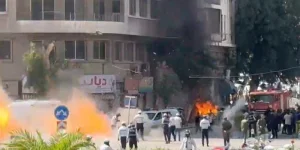
Under the cover of the information blackout, reports suggest that the regime unleashed its security forces to crack down without mercy.
The BBC reported that several hospitals have been overwhelmed with dead or wounded protesters in recent days.
"Things here are very, very bad,” a source in Tehran told the BBC on Sunday. “A lot of our friends have been killed. They were firing live rounds. It's like a war zone, the streets are full of blood. They're taking away bodies in trucks.”
A health worker in a Tehran hospital told the outlet, “around 38 people died. Many as soon as they reached the emergency beds... direct shots to the heads of the young people, to their hearts as well. Many of them didn't even make it to the hospital.”
A demonstrator said snipers were firing at crowds in the capital’s Tajrish Arg neighborhood and that he saw “hundreds of bodies” in the streets.
More than 544 people killed, 10,681 arrested, and protests recorded in 585 locations across all 31 provinces as Iran’s nationwide protests enter day 15.
— HRANA English (@HRANA_English) January 11, 2026
Check out HRANA’s full report:https://t.co/hWBlLjbxmo pic.twitter.com/f0GRspEW6n
BBC Persian verified that 70 bodies were brought to one hospital in the northern city of Rasht on Friday night, as many reports appear to suggest that the regime is cracking down even harder in smaller cities than in the capital, where some people appear to be able to find internet connections.
A journalist from the city of Mashhad, the home of leader Ali Khamenei, told the British Guardian on Thursday that security forces were “charging at crowds in vans and bikes. I have seen them slowing down and deliberately shooting at people’s faces. Many have been injured. The streets are full of blood.”
Another protester from the western city of Kermanshah told the Guardian on Wednesday, “They are shooting at anyone and everyone.”
On Sunday, state television channel IRIB broadcast footage from the Kahrizak Forensic Medical Center, a morgue in South Tehran, showing large numbers of body bags stacked inside and in a courtyard. The channel claimed the bodies belonged to the victims of “rioters.”
Michael Doran, senior fellow of the Hudson Institute, wrote on 𝕏 that “Telegram channels have circulated horrific videos from Iran showing rows of bodies at makeshift morgue facilities.”
“In previous rounds of protests, the regime has withheld and ‘ransomed' bodies, demanding families pay exorbitant fees and agree to no funerals or memorial services, lest these turn into protests. The regime also forces families to publicly affirm the regime's fabricated accounts of the deaths. It typically claims the dead were terrorists or killed by terrorists, or victims of accidents.”
One of Iran’s biggest mosques burned during uprising.
— Masih Alinejad 🏳️ (@AlinejadMasih) January 10, 2026
Don’t panic. This isn’t chaos.
It’s 47 years of rage.
For 47 years, after every Allahu Akbar from these minarets, innocent Iranians were executed by an Islamist regime. pic.twitter.com/oHtMpPjHQA
The protesters also appear to have turned not just against the regime’s forces, but also against the ruling ideology of radical Islamist Shiism, which the Islamic Republic's founder, Ruhollah Khomeini, had called Velayat-e Faqih - the Guardianship of the Islamic Jurist.
Saeid Golkar, an Associate Professor of Political Science at the University of Tennessee, wrote on 𝕏 that “Over the past two nights in Tehran, protesters set fire to more than 25 mosques. Many Western observers struggle to comprehend this, but it highlights deep-seated anti-clerical sentiments among Iranians, driven by the repressive dictatorship led by the Ayatollah.”
He explained that “Mosques in Iran serve more than just as places of worship; they also house Basij militia bases in every neighborhood. These act as local repression centers and exemplify what I refer to as the Theo-security regime.”
You might also like to read this: