





Netanyahu presents new security doctrine in first Israeli press briefing since Oct 7
Prime minister warns of ‘tragedy for generations’ if opposition wins election



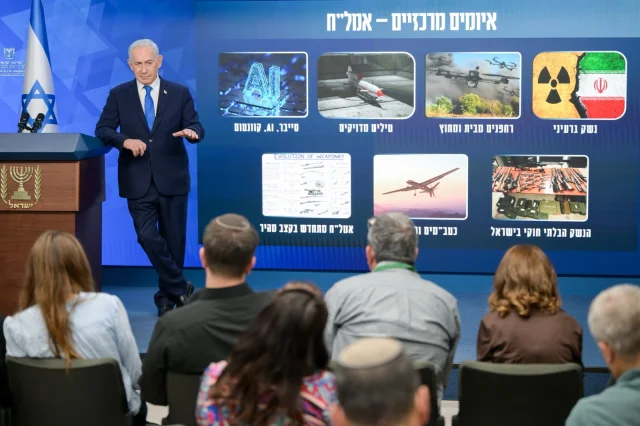
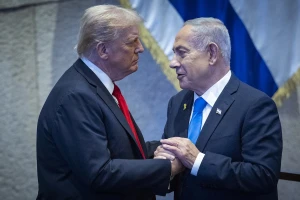
Prime Minister Benjamin Netanyahu presented his new national security doctrine on Sunday, in his first in-person press conference with Israeli media since the Oct. 7, 2023, Hamas terror attack.
The document outlines a major shift in Israel’s security strategy, moving away from the policy of containment described in a 2018 strategy document, issued during Netanyahu’s previous term as prime minister, toward pre-emptive action against threats, particularly from the Shi’ite-led axis of Iran and its regional allies.
Netanyahu said the recent multi-front war had prompted a reassessment of Israel’s traditional security concepts. The new approach prioritizes prevention and offensive action over containment and defense, greater independence in arms production, maintaining technological superiority, combating global antisemitism and building new regional and international alliances.
He identified the core threats facing Israel as the Shi’ite Axis; nuclear and advanced weapons, such as precision-guided ballistic missiles and drones; Palestinian terrorism and domestic security threats, including weapons smuggling; delegitimization and isolation attempts; and artificial intelligence and other technological threats.
Netanyahu placed the Islamic Republic of Iran and its proxies at the top of threats to Israel, telling the gathered journalists that he intends to topple the Iranian regime.
Prime Minister Benjamin Netanyahu Issues Israel's National Security Doctrine to the Public: "The October 7, 2023 attack compelled Israel to wage a fierce war. Through continuous combat – from Gaza to Yemen, from Lebanon to Iran – Israel warded off an imminent existential nuclear threat and removed the chokehold of the Iranian axis. The Government and the Security Cabinet made well-considered decisions, the IDF and security branches struck with immense force, and the civilian home front stood firm. The War of Redemption necessitated an upgrade of fundamental principles within the traditional national security doctrine, among them: giving priority to prevention and offense over containment and defense, including launching preemptive strikes to thwart evolving threats; strengthening home front defense against new threats; cementing Israel's status as a regional power; building maximum independence in munitions; ensuring superiority in the most advanced technologies; and intensifying the fight against global waves of antisemitism. Concurrently, opportunities have been created for forging new alliances in our region and beyond." The Prime Minister's security doctrine was formulated with the assistance of the National Security Council (NSC) and NSC Director Shmuel Ben Ezra.
— Prime Minister of Israel (@IsraeliPM) October 18, 2026
“The regime must fall, and I will bring it down,” Netanyahu stressed. “Our plan is a very comprehensive and very determined plan to bring about the fall of the regime. That is my plan. That is the directive I have given all the security agencies, and that is what will happen,” he added.
He also said that the goal of toppling the Iranian regime does "not depend on American agreement.”
“As long as necessary, we will act independently,” Netanyahu stated. “We have done so already, and if necessary, we will do so again.”
Regarding the war against the Hamas terrorist group in the Gaza Strip, Netanyahu said Israel would not allow the reconstruction of infrastructure until full military demilitarization was achieved, while arguing that if Iran is defeated, Hamas would collapse “on their own."
He said his government had approved an “Emirati enclave,” a designated area in Gaza where the United Arab Emirates (UAE) would help establish temporary housing and infrastructure for displaced Palestinians, in territory currently controlled by the IDF.
“We will not allow reconstruction in any part of Gaza before Hamas is disarmed,” Netanyahu said. “We agreed to an Emirati enclave adjacent to our security zone. The mission of eliminating Hamas will fall to us. If Iran collapses, they will fall on their own.”
The prime minister expressed doubt that either Hamas in Gaza or Hezbollah in Lebanon would be disarmed by any means other than Israeli military action.
As part of this new security doctrine, Netanyahu called for increasing the defense budget by nearly NIS 450 billion ($145 billion), to be used for increasing Israel’s weapons independence.
“Our international partners should depend on us, not on them,” Netanyahu said.
Regarding core material threats, the prime minister placed Iranian nuclear weapons at the top of the list. "We are prepared to take the initiative," he said. "We must prevent the enemy from delivering the first blow.”
He ranked drones, particularly fiber-optic drones and drone swarms, as the second-greatest threat, ahead of ballistic missiles. He warned that such weapons could be used to strike critical infrastructure and political and military leaders.
Below those threats, Netanyahu ranked ballistic missiles, followed by artificial intelligence and quantum computing technologies, which he warned could be used to develop systems capable of paralyzing critical infrastructure ahead of a traditional military attack.
Netanyahu also warned of a growing axis aligned with the Muslim Brotherhood and led by Turkey, which he said could replace Iran as a regional threat. He described the threat as a shared concern that was driving greater regional cooperation.
Israeli media largely viewed the press briefing as a political event, given that it came just eight days before the election.
During the briefing, Netanyahu warned that if his political opponents won the election, Israel’s ability to win the conflict would be in jeopardy.
“I fear for the future of the state,” Netanyahu told reporters, saying a victory by the opposition would be “a tragedy for generations.”
He repeatedly insisted that the completion of his new security doctrine depends on his coalition remaining in power after the election.
Netanyahu also addressed recent violent incidents in Judea and Samaria involving Jewish settler activists targeting Palestinians. While arguing that international media have exaggerated the scale of the phenomenon, he condemned the attacks.
"I think the real danger is that we’re actually facing a major propaganda campaign surrounding these young rioters, who really are causing us enormous damage,” he said, adding: “That is why I brought in the Shin Bet for the first time, and we will employ additional measures to root this phenomenon out completely."
Netanyahu promised to renew the State Comptroller’s investigation into the Oct. 7, 2023, Hamas massacre and work toward establishing a national commission of inquiry composed of representatives from both the coalition and opposition.
He said only such a commission would be trusted by the majority of Israelis.
Some media outlets boycotted the briefing over Netanyahu’s failure to engage with Hebrew-language media following the Oct. 7 attacks and reports that several journalists known to be critical of the prime minister had not been invited.
Support our independent, on-the-ground reporting from Israel. Become a $5/month Ally.
You might also like to read this: