









Major Houthi offensive collapses in Yemen amid intense fighting against gov’t & Saudi forces
Houthis suffer hundreds of casualties as government thwarts offensive aimed at Bab el-Mandeb strait
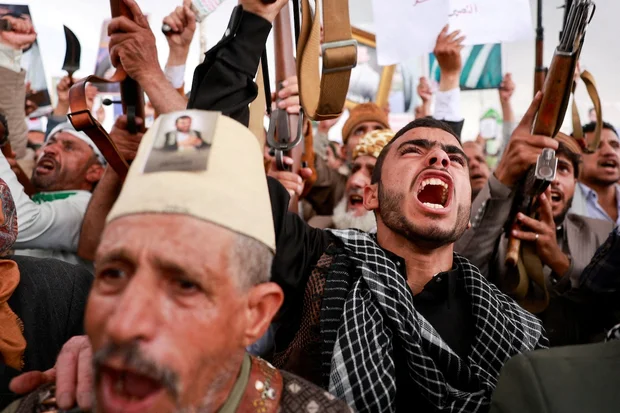
The Yemeni Houthi terrorists have largely refrained from launching attacks against Israel in recent months, as the Iran-backed group has been preoccupied with newly erupted fighting against forces aligned with Saudi Arabia and Yemen’s internationally recognized government. The fighting has reportedly claimed the lives of hundreds of fighters as well as civilians.
On Thursday, the Houthis launched a new offensive south of Hodeidah port, where Israel has conducted several airstrikes in recent years. However, the offensive faltered over the weekend, according to the Asharq Al-Awsat newspaper, as government forces pushed back with drone and fighter-jet strikes against Houthi reinforcements south of the Al-Jarahi district. The government forces also disrupted Houthi supply lines by capturing several strategic hills in southeastern Taiz.
Military sources told Asharq Al-Awsat that the Houthis suffered casualties during the three days of fighting, with hundreds reportedly killed or wounded. According to AFP, the death tally from the fighting since Thursday reached more than 300 combatants, along with some civilians.
In July, an Israeli security expert had warned that the Iranian regime was increasing its military assistance to the Houthis in preparation for a renewed confrontation with Saudi Arabia.
Yoni Ben Menachem, senior researcher at the Jerusalem Institute for Foreign Affairs and Security, said Iran's support for the Houthis was a key part of its efforts to restore its proxy network that was significantly weakened by Israeli and U.S. strikes over the past years. “Yemen is Saudi Arabia’s backyard,” he warned.
The last Houthi attacks against Israel came in June, when the terrorists and their Iranian backers fired dozens of missiles, prompting the Israeli Air Force to strike targets in Iran. As the fighting threatened to widen across the region, the Trump administration pressed Israel and Iran to halt their attacks and helped to broker a ceasefire aimed at preventing a broader escalation.
The Houthis have reportedly been using the subsequent pause in fighting to improve their missiles for future attacks against Israel.
In July, a fragile truce between the Houthis and the government of Yemen fell apart after the rebels welcomed an Iranian plane to the capital Sanaa, breaking a Saudi embargo and setting off a spate of attacks.
The Houthis also announced a maritime blockade of Saudi Arabia and have begun targeting its ships and territory.
The fighting reached a new level in recent days, amid large-scale offensives by the Houthis. Two military officials of the Saudi-backed Yemeni government forces told AFP that they had lost 84 soldiers since midday Saturday, mostly in missile attacks, while four Houthi military sources said 57 terrorists had been eliminated in the same period.
Houthi rebels aimed to cut off and capture the government-held port city of Mokha and bolster its control of the area around the strategically crucial Bab el-Mandeb strait, which controls the southern entrance to the Red Sea.
Since the Iranian regime largely closed off the Strait of Hormuz by attacking ships trying to traverse it, the Bab el-Mandeb strait has risen further in importance as an alternative outlet for oil exports from Saudi Arabia.
A military official told AFP that, following a counter offensive, government forces “were able to establish positions for themselves north of Hays after advancing in the area,” an area that is less than 30 kilometers (18.6 miles) inland from the Red Sea coast.
Rashad Al-Alimi, chairman of Yemen’s Presidential Leadership Council, which heads the government, asserted that his forces would not allow the regime to take control of the Bab el-Mandeb Strait through its Houthi proxies.
He also warned of the dire humanitarian consequences of the fighting, including the displacement of hundreds of families from their homes.
Last week, reports said that at least 158 families were forced to flee their homes after the Houthis attacked civilians in residential areas in Yemen’s western Hodeidah Governorate.
In August 2025, Israel eliminated several senior Houthi leaders in precision airstrikes, including Houthi Prime Minister Ahmad Ghaleb al-Rahwi. At the time, senior Houthi official Mahdi al-Mashat announced the “martyrdom” of al-Rahwi and several of his ministers, whom he said were killed in an Israeli strike.
Although the Houthis and their Iranian patron have been significantly weakened, both remain intact, with no immediate end in sight to Yemen’s civil war or the broader conflict involving Iran and its regional proxies.
Popular article:

interview Easter message of resurrection hope amid war at Jerusalem's Garden Tomb

biblical commentary Let my people go: a Passover message for today

4 IDF soldiers killed, 2 wounded in fighting in southern Lebanon, as Israel eliminates dozens of Hezbollah terrorists

Receive latest news & updates
A message from All Israel News
Help us educate Christians on a daily basis about what is happening in Israel & the Middle East and why it matters.
For as little as $10, you can support ALL ISRAEL NEWS, a non-profit media organization that is supported by readers like you.
Latest articles:
Hamas openly threatens Israel with ‘more Oct 7 attacks’ as intelligence shows terror group is rearming

More than 1,300 antisemitic posts blame Israel, Jews for French riots – report

Thailand turns to Israeli anti-drone technology to counter growing battlefield threat
Israeli fighter jets flew to Iranian border in ‘power projection,’ deterrence exercise ahead of elections next week

Israel targets nuclear fusion leadership as AI drives soaring energy demand