Israeli startup H2Pro takes green hydrogen technology to Europe



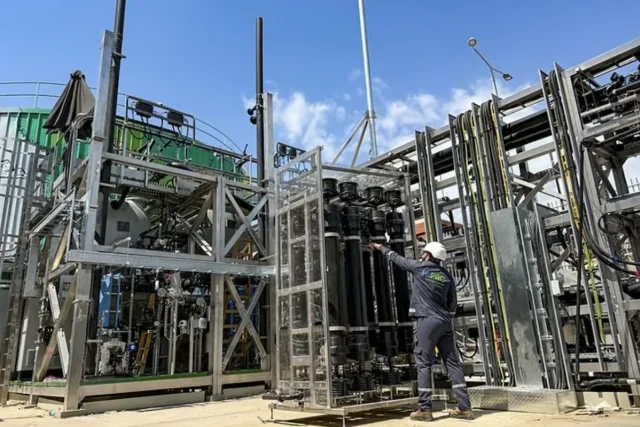
The Israeli startup H2Pro is working to make green hydrogen more affordable. Founded in 2019 by hydrogen experts Dr. Hen Dotan, Prof. Gideon Grader and Prof. Avner Rothschild at the Technion – Israel Institute of Technology, the company has raised more than $100 million to develop a new approach to water electrolysis. Following an Israeli pilot project, H2Pro is now seeking to scale its technology through large-scale hydrogen projects in Spain and potentially elsewhere in Europe.
Most of the world’s hydrogen is still produced using fossil fuels. Green hydrogen is produced by using renewable electricity, such as power from wind and solar, to split water into hydrogen and oxygen. However, the cost of producing green hydrogen has remained a major obstacle to its wider adoption. H2Pro aims to address that challenge by making the production process more efficient and less expensive.
The researchers began exploring ways to improve water electrolysis in 2012. Their approach centered on a fundamental question: Do hydrogen and oxygen need to be produced simultaneously? Their research eventually led to a technology that separates the production of hydrogen and oxygen into two stages.
“We succeeded in alternately changing the chemical composition of the anode,” Grader said. He explained that the process produces hydrogen in the first stage and oxygen in the second chemical process.
H2Pro subsequently secured an exclusive license to commercialize the technology. The company has received funding from Breakthrough Energy Ventures, a climate-focused fund established by Bill Gates, as well as companies and investment groups including Yara, ArcelorMittal, Temasek and Sumitomo.
H2Pro now employs around 100 people and operates pilot and research facilities in Israel.
In 2026, the company began pursuing larger-scale projects in Europe. In March, H2Pro signed an agreement with Doral for a project in Spain that will initially use a five-megawatt DWE system powered by a solar facility. The project could eventually expand to 50 megawatts.
In June, H2Pro signed a memorandum of understanding for a second, larger project in Spain, this time in the Tarragona region. The project is expected to begin at 25 megawatts and could potentially expand to 150 megawatts by 2032.
“The ability to operate on intermittent renewable energy, with start-stop cycles and high efficiency even at partial loads, is critical to reducing the cost of green hydrogen,” H2Pro CEO Tzahi Rodrig said after the Doral project was announced.
H2Pro’s technology separates the two stages of the conventional water-splitting process, an approach the company says could reduce the cost of producing green hydrogen. If successfully deployed at scale, the technology could contribute to efforts to use renewable energy to produce hydrogen as a fuel and energy source.
Affordable green hydrogen could also provide a way to store renewable energy and transport it to locations where electricity infrastructure or renewable resources are limited.
You might also like to read this: