northern front Israel eliminates most senior Hezbollah commander since Oct 8
Taleb Abdallah was responsible for attacks against Israel since at least 2006
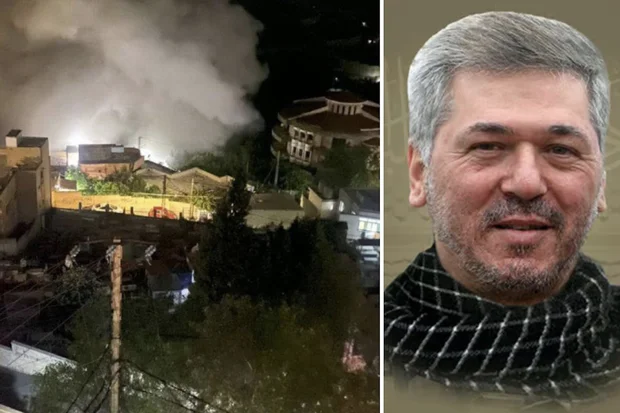
A top Hezbollah commander was eliminated in an airstrike attributed to Israel in southern Lebanon on Tuesday night.
Taleb Abdallah, also known as Hajj Abu Taleb, is the most senior Hezbollah terrorist to be killed since Hezbollah began targeting Israel on Oct. 8, the IDF said. He was in charge of Hezbollah’s Nasser Unit, located in the eastern part of southern Lebanon up to the Litani River.
Abdallah was eliminated in the headquarters of the unit, together with three other senior Hezbollah terrorists in an airstrike in the village of Jouaiyya, located about 15 km (9 miles) from the Israeli border.
IAF aircraft eliminated Sami Taleb Abdullah, the commander of the Nasr Unit in the Hezbollah terrorist organization, last night. This was part of a strike on a Hezbollah command and control center in the area of Jouaiyya in southern Lebanon, which was used to direct terrorist… pic.twitter.com/DE4qKnC7Mk
— Israel Defense Forces (@IDF) June 12, 2024
Hezbollah confirmed that Abdallah was killed “on the road to Jerusalem,” the terror group's term for its operatives who are killed in Israeli airstrikes.
"The attack in southern Lebanon was aimed at the Hezbollah leaders' security meeting. This is the harshest blow since the beginning of the war," the Saudi channel Al Hadath reported.
On June 11, during the night hours, the commander of the Nasser unit and three other senior members of the unit were killed at their headquarters in the village of Jouaiyya in southern #Lebanon. Details and meanings in an article that we will publish soon. #Hezbollah pic.twitter.com/lpa0b8xGSp
— Israel-Alma (@Israel_Alma_org) June 12, 2024
According to the IDF, Abdallah is the most senior commander killed so far. He served as commander of the Nasser Unit since 2016 and was seen as a capable and experienced commander.
He was responsible for Hezbollah's launches of heavy Burkan rockets and commanded the terror group's attacks at Kiryat Shmona, the Upper Galilee, and the Golan Heights over recent months, the IDF said.
In addition, he was responsible for a kidnapping attempt in Ghajar in 2005, commanded Hezbollah forces during the Second Lebanon War in 2006, and led Hezbollah's retaliation after the elimination of its senior terrorist Jihad Moughniyah in 2015, which killed two IDF soldiers.
Hezbollah responded to the elimination of its top commander and other senior operatives by launching a massive 215-rocket barrage at northern Israel throughout Wednesday.
"Northern Israel is under massive attack from Iranian proxy Hezbollah," former Israeli government spokesperson Eylon Levy wrote on 𝕏.
"Following the sirens that sounded in northern Israel a short while ago, approximately 90 projectiles were identified crossing from Lebanon," the Israeli military announced in an official statement Wednesday morning.
"A number of the projectiles were intercepted and others fell in several locations in northern Israel. As a result, fires broke out in a number of areas. The details are under review," the military added. There are currently no reports of Israeli casualties.
Hezbollah began launching attacks on northern Israel targets on Oct. 8, the day after Hamas' invasion and massacre in southern Israel. The IDF has responded by attacking Hezbollah forces across southern Lebanon and beyond.
Some 80,000 Israelis have been forced to leave their homes due to Hezbollah’s constant shelling of northern communities.
Ten Israeli civilians and 15 IDF soldiers have so far been killed in the ongoing conflict with Hezbollah. The Iranian-backed terror group reported 341 operatives who have been killed in the conflict since Oct. 8, however, Israeli officials believe the true number of Hezbollah fatalities is significantly higher and the terror group is downplaying its losses in order to keep up the morale among its forces.
Israel has also eliminated dozens of Hezbollah commanders. In addition, dozens of Lebanese civilians and members of other terrorist organizations have also been killed in southern Lebanon.
Hezbollah recently claimed to fire, for the first time, Iranian-made Falaq-2 rockets at an Israeli military base in Beit Hillel. With a range of 7 miles (11 km) and a 130-lb (60 kg) warhead, the Falaq-2 poses a significant threat to Israeli civilians and military bases close to the Lebanese border.
Last week, Israeli President Isaac Herzog recently urged the international community to support Israel's right to defend itself.
“Israel has been attacked daily, for many months, by Iran’s arms in Lebanon, in flagrant violation of all international agreements and resolutions. The world needs to wake up and realize that Israel has no choice but to protect its citizens and don't be surprised when it does so ever more strongly and firmly, and don't complain when the situation is out of control!” Herzog stated.
“This is not the time to stand by and let the area escalate. This evil terrorist aggression must be curbed and stopped.”
Popular article:

interview Easter message of resurrection hope amid war at Jerusalem's Garden Tomb

biblical commentary Let my people go: a Passover message for today

4 IDF soldiers killed, 2 wounded in fighting in southern Lebanon, as Israel eliminates dozens of Hezbollah terrorists

Receive latest news & updates
A message from All Israel News
Help us educate Christians on a daily basis about what is happening in Israel & the Middle East and why it matters.
For as little as $10, you can support ALL ISRAEL NEWS, a non-profit media organization that is supported by readers like you.
Latest articles:

1969 Dutch Eurovision winner Lenny Kuhr moves to Israel – cites antisemitism, family ties

Israel bars French far-left leader Mélenchon in response to France's entry ban on settlement leader
Change Bloc divided over coalition with Arab or ultra-Orthodox parties after week of negotiations

Huckabee fires back as Senate Democrats target US-Israel intelligence ties: 'Shocking!'
Israeli blood test detects early breast cancer with 95% accuracy, assesses recurrence risk