Israel condemns eastern Libya’s approval of contentious eastern Mediterranean maritime agreement with Turkey
Libya-Turkey deal seen as attempt disrupt cooperative defense network between Israel, Greece, Cyprus
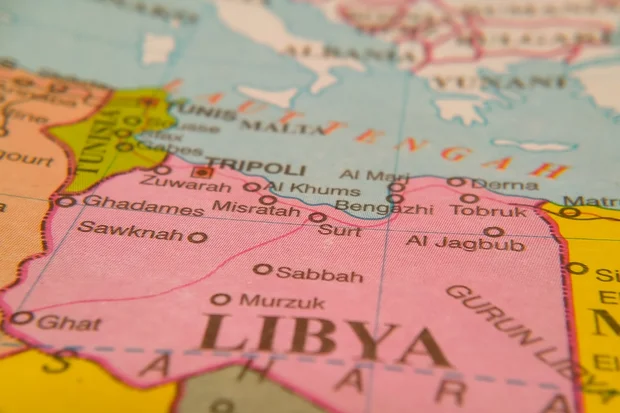
The parliament of eastern Libya unanimously approved a previously signed maritime agreement with Turkey on Tuesday, provoking condemnation from Israel, Egypt and Greece.
The maritime agreement establishes a framework for demarcating maritime boundaries in a section of the Mediterranean believed to contain significant natural gas reserves. At the same time, it establishes a maritime corridor which would separate Greece from Cyprus, disrupting mutual defense planning between Israel, Greece, and Cyprus.
The countries have recently begun cooperating to limit Turkey’s Mavi Vatan (Blue Homeland) project, which seeks to establish great Turkish maritime control in the Mediterranean Sea.
The agreement was made with the Benghazi-based government of eastern Libya, controlled by forces loyal to Field Marshal Khalifa Haftar.
Haftar’s administration has grown closer to Turkey in recent years, as it seeks to exert more influence in the region.
The western section of Libya, whose capital is in Tripoli, is under the control of the internationally recognized government of Libya.
On Wednesday, the Israeli Foreign Ministry condemned the decision by the eastern Libyan House of Representatives.
“Israel strongly condemns the decision of the Libyan House of Representatives to ratify the Maritime Jurisdiction Memorandum between Turkey and Libya,” the ministry said in a statement, saying the agreement “infringes upon the sovereign rights of our close allies in the region.”
Israel strongly condemns the decision of the Libyan House of Representatives to ratify the Maritime Jurisdiction Memorandum between Turkey and Libya. This agreement infringes upon the sovereign rights of our close allies in the region. Regretfully, once again we see Turkey working to destabilise the east Mediterranean region.
— Israel Foreign Ministry (@IsraelMFA) October 21, 2026
“Regretfully, once again we see Turkey working to destabilize the east Mediterranean region,” the ministry added.
The Egyptian government also opposed the announced agreement as “Absolutely null and void.”
“Egypt rejects the Libyan House of Representatives’ ratification of the memorandum of understanding with Türkiye on the delimitation of maritime jurisdiction areas,” a statement released by the General Information Authority said.
The Egyptian government said the agreement “violates international law,” a reference to the UN Convention on the Law of the Sea (UNCLOS), which Turkey, Libya, and Israel are members of.
The Greek government appeared to focus more on mobilizing a European diplomatic effort, condemning the ratification of the agreement.
A joint statement issued by all 27 European Union member stated the EU’s rejection of the agreement, reaffirming its previous position on the memorandum, first proposed in 2019.
“The EU’s position regarding this Memorandum is firm and clear,” the statement said, referring to conclusions adopted by the European Council in December 2019 and reaffirmed in June 2025.
After a meeting with Turkish Foreign Minister Hakan Fidan on Wednesday, EU foreign policy chief Kaja Kallas said that she expressed Europe’s disapproval of the agreement and "stressed that it infringes upon the sovereign rights of third states.”
Israeli analyst Shay Gal told ALL ISRAEL NEWS, ״Libya's ratification of the maritime agreement with Turkey advances Ankara's bid to dominate the Eastern Mediterranean's strategic corridors.”
Gal said that agreement is part of an attempt by Turkish President Recep Tayyip Erdoğan “to erase Greece's maritime rights, squeeze Egypt and encircle Israel.”
He called the move by Turkey “a national security threat” for Israel, saying, “Seaborne commerce accounts for roughly 98% of its foreign trade by volume. Its gas platforms, subsea cables and planned electricity interconnector with Cyprus and Greece depend on secure maritime access.”
Gal pointed to Turkey's consistent antagonistic stance towards Israel in recent years, noting that it has turned occupied northern Cyprus into “a forward base for air, naval and intelligence operations.”
He pointed to the presence of Turkish troops and bases in Syria and the Horn of Africa which “constitute a Turkish perimeter of bases, dependencies and contested claims surrounding the region's economic lifelines.”
He pointed Israel’s history fighting to ensure freedom of navigation in the surrounding waters.
“In 1956, Israel fought the Sinai War partly to break Egypt's blockade of Eilat. In 1967, Egypt closed the Straits of Tiran, helping precipitate the Six-Day War,” Gal noted. “Israel has twice gone to war against Egypt in conflicts in which freedom of navigation was a central issue. Seventy years after Suez, Jerusalem and Cairo face a common Turkish maritime threat. Egypt, once responsible for blocking Israel's sea lanes, could now become its partner in reopening them.”
“Israel fought Egypt to break a maritime blockade. Ankara should reckon with the possibility that Israel and Egypt may fight together to break a Turkish one,״ he concluded.
Popular article:

interview Easter message of resurrection hope amid war at Jerusalem's Garden Tomb

biblical commentary Let my people go: a Passover message for today

4 IDF soldiers killed, 2 wounded in fighting in southern Lebanon, as Israel eliminates dozens of Hezbollah terrorists

Receive latest news & updates
A message from All Israel News
Help us educate Christians on a daily basis about what is happening in Israel & the Middle East and why it matters.
For as little as $10, you can support ALL ISRAEL NEWS, a non-profit media organization that is supported by readers like you.
Latest articles:
analysis A people dwelling securely? Israel’s strategic standing, 3 years after Oct 7
Hamas on wheels: What I found in Dearborn reveals a troubling history and a battle over Israel

Hamas openly threatens Israel with ‘more Oct 7 attacks’ as intelligence shows terror group is rearming

More than 1,300 antisemitic posts blame Israel, Jews for French riots – report

Thailand turns to Israeli anti-drone technology to counter growing battlefield threat