IDF seeks technological solutions amid spike in soldier suicides



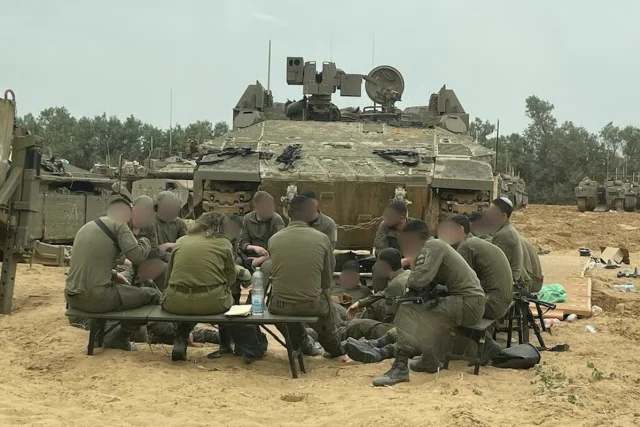
The Israel Defense Forces is developing new technology to help identify soldiers in mental distress and is exploring ways to prevent personal weapons from being used in suicide attempts as it responds to a recent increase in soldier suicides.
A senior IDF official told reporters that the military is expanding efforts to identify warning signs among soldiers, improve access to mental-health professionals and train service members to recognize distress in their comrades. The measures come as the IDF seeks to address suicide during a prolonged period of wartime service.
The official explained that mental-health difficulties can become more visible when the intensity of battlefield activity decreases.
“A period when the war declines in intensity is a period when distress can surface,” he said.
“People can be in two different states, doing or being. When we have a role, we have clear missions and objectives. When that changes and we return to a kind of routine, the sense of purpose is less clear and there is time to turn inward. Emotions, thoughts and memories emerge that we did not have time to deal with while we were occupied with doing. When a person chooses to take their own life, it almost always comes from a place of illness,” he explained.
He cautioned, however, against interpreting an increase in the numbers as necessarily indicating a linear trend, noting that each case has its own circumstances.
“Every case is deeply distressing, but this is a statistical distribution. It does not accumulate in a linear way,” he said.
The official said the Military Police Criminal Investigation Division investigates every suicide to determine the circumstances surrounding the death and identify lessons that could help prevent future tragedies.
One lesson identified by the IDF is that soldiers contemplating suicide rarely seek help directly from military mental-health professionals. As a result, the military is placing greater emphasis on identifying changes in behavior and attitudes that could signal distress.
The IDF is also preparing to deploy specially designed AI-powered software to help identify soldiers who may need attention.
“The person who saw him was his commander, the people serving alongside him in the unit,” the official said. “That is why we are investing heavily in practical tools for identifying distress and conducting a conversation. There is a gap between how capable people think they are of having this kind of conversation and what they actually do in practice.”
The military is also emphasizing direct access to professional help.
“If these people reach those who can help them, there is a high probability that we can prevent the tragic outcome,” the official said.
Soldiers can call a 24-hour helpline at *6690 to speak with a mental-health professional. The IDF now has 1,500 career personnel, reservists and civilian military employees dedicated to the issue, according to the official. Appointment wait times have been reduced to a few days, while soldiers in acute distress receive the highest priority.
The IDF is also introducing a new military specialty for mandatory-service soldiers who will serve as mental-health assessment specialists. Their role will be similar to medical “triage,” identifying soldiers in distress and helping ensure they receive priority treatment.
Another area of focus is reducing access to weapons. The military is examining technology that could potentially prevent a personal weapon from being fired in circumstances indicating an attempted act of self-harm.
“That is an inherent complexity in the IDF, all the more so during wartime,” the official said. “We are examining whether technological measures can intervene in the weapon itself so that it will prevent gunfire intended for self-harm. Such gunfire has certain physical characteristics, such as the angle and the way the weapon is held. It is a very significant technological challenge, and we are still working on it.”
The technological effort builds on an established IDF policy of limiting the number of personal weapons that soldiers take home when they go on leave. The practice dates back to 2006, when a review concluded that reducing access to weapons would likely lower the number of soldier suicides.
“Soldiers in rear-echelon positions, for example, stopped taking their weapons home,” he said. “Reducing exposure to weapons to the minimum necessary is essential.”
The official also addressed the way suicide and mental distress are covered in the media, saying that responsible public discussion can encourage people to seek help.
“I support public discussion of mental distress and suicide,” the official said. “It helps because it gives people in distress legitimacy to see that they are not unusual. The fact that the media discusses the phenomenon is positive, provided that it is done professionally.”
However, he warned that detailed or sensationalized coverage can also have the opposite effect.
“A service member who sees the picture and identifies characteristics similar to their own can conclude that if this person chose that particular solution, perhaps that is the solution for me as well. Often, the story also takes on a tragic, heroic dimension. That is very dangerous and can encourage additional suicide cases.”
You might also like to read this: