Houthis continue offensive against Saudi-backed forces in Yemen after Trump cancels airstrikes at last minute
G7 foreign ministers call Houthis to stop attacks, urge Iran to stop support for terror group

The troops of the Houthi terrorists in Yemen have continued a steady advance against the Saudi-backed forces over the past few days, undeterred by reports that the U.S. was about to launch large-scale airstrikes against them over the weekend.
According to NBC News, the strikes were called off by the White House just three hours before the planes were due to take off on Sunday afternoon, amid concerns from U.S. President Donald Trump that U.S. involvement could cause fighting to escalate and engulf the wider region.
Such an escalation could also involve Israel, whose military is cautiously eyeing developments in far-off Yemen without intervening directly so far. The Israeli military is reportedly transferring intelligence on Houthi targets through the U.S. military’s Central Command (CENTCOM).
Israeli experts and commentators have urged the government to use the current situation to improve recently cooled ties with Riyadh, and Jerusalem's Ambassador to the UAE, Yossi Shelley, recently described the situation as “an opportunity.”
U.S. reparations to launch strikes reportedly came after Saudi crown prince Mohammed Bin Salman (MBS) had renewed his pleas to Trump, following the latest Houthi offensive that threatened the oil-rich city and region of Marib.
The newly erupted fighting has reportedly killed thousands and displaced over 100,000 people, exacerbating an already bad humanitarian situation in the country. Fighting since Sunday alone has killed over 150 people, according to statistics from both sides.
NEW: US President Donald Trump reportedly decided to refrain from striking Houthi targets in Yemen “for the time being” on September 20. (1/2)
— Institute for the Study of War (@TheStudyofWar) September 22, 2026
Other Key Takeaways:
The Islamic Revolutionary Guards Corps (IRGC) is reportedly supporting Houthi efforts to develop infrastructure in… pic.twitter.com/xZgAB5ji87
While the U.S. continues to withhold military support, Saudi Arabia has received more diplomatic backing in recent days.
After a meeting on the sidelines of the United Nations General Assembly, the G7 foreign ministers in a joint statement urged the Iranian regime to “end its arming of and support for the Houthis,” condemning “in the strongest terms the unacceptable continued strikes carried out by the Houthis in Yemen and against the Kingdom of Saudi Arabia.”
“We call on the Houthis to immediately cease all military actions, all threats and attacks against civilian shipping, and to return to the political process in good faith.”
British Prime Minister Andy Burnham also revealed that the Royal Air Force would begin providing air-to-air refueling of Saudi planes for at least several weeks.
On Thursday, the US State Department approved the sale of 48 advanced F-35 stealth fighter jets to the kingdom. The deal, worth $24.3 billion, is intended to help Riyadh “deter current and future threats,” the State Department said.
Nevertheless, Trump decided to cancel the planned strikes against the Houthis on Sunday, despite having assured the head of Yemen’s internationally recognized governing body, Rashad al-Alimi, of his support in a recent phone call, a source in Alimi’s office told AFP on Monday.
NBC News reported that “Some military leaders are making the case within the Pentagon and to Trump administration officials that opening another military front in the region is a bad idea amid concerns about the Pentagon’s dwindling supply of defensive and long-range weaponry, while noting that the Houthis are not striking U.S. ships.”
The Houthis have reportedly assured the U.S. that American vessels in the Bab el-Mandeb strait would not be targeted. Other officials reportedly cited concerns that a strike against the Houthis could trigger more attacks against U.S. assets in the region, which have already been damaged by recent Iranian strikes.
The U.S. and the Houthis signed a ceasefire agreement in early 2025, after two months of intense U.S. strikes against the terror group.
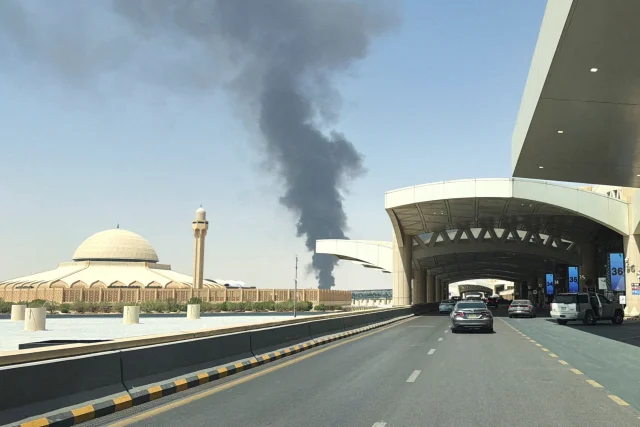
The Houthis on Saturday launched a ballistic missile at the Saudi capital of Riyadh, the first such attack in years. Saudi Arabia’s air force “successfully intercepted and destroyed a ballistic missile” launched at the city, coalition spokesman Turki al-Malki said on X.
Another Houthi strike targeted oil facilities in the kingdom’s strategically important port city of Yanbu, on the Red Sea, while other strikes targeted “civilians and civilian infrastructure in Bisha, Taif, Farasan, and Yanbu,” according to Turki.
By Monday, the Houthi troops had advanced east, trying to capture strategic heights held by Saudi-backed troops that are adjacent to the Red Sea coast, which was largely overrun by Houthis over the past several weeks.
Five Yemeni military sources told Reuters that the terrorists are attacking positions in the Kahboub Mountains across the Taiz and Lahij provinces, which separate the Red Sea coast from the government-held southern areas.
You might also like to read this: