Hijab-free women run 10K race in Tehran defying Islamic Republic





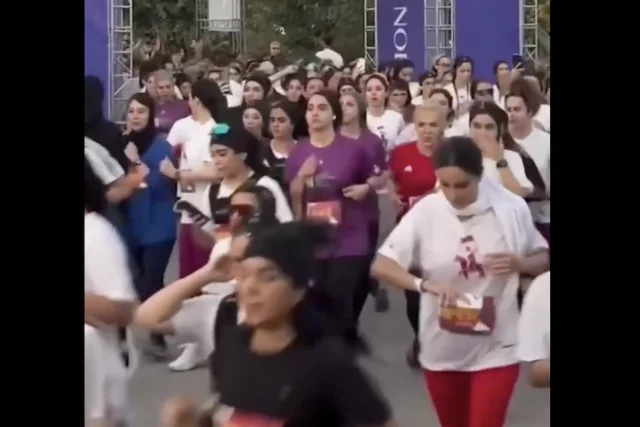
Footage of multiple women running a 10K race without hijabs in Iran’s capital city last weekend has gone viral. The large number refusing to wear the compulsory head covering is another indication that the popular resistance against the regime is far from over.
The race took place on Friday at Velayat Park in Tehran, and the defiance against the strictly mandated head coverings was noted by several minor news outlets, the largest of which was Al Jazeera.
Video footage began circulating after award winning athlete, Parisa Arab, posted online, thanking spectators for their encouragement and support during the race.
Arab, 33, has competed internationally and achieved her personal best of 34:46 minutes in a 10K competition in Dubai three years ago, according to World Athletics. Despite being an accomplished athlete, Arab says she is virtually unknown due to Iranian regime policy.
“I am an Iranian runner holding 3,000, 5,000, and 10,000-meter national records yet hardly anyone knows me due to public media policies hiding women’s achievements in Iran,” she wrote in the San Francisco Marathon questionnaire.
The decision by so many to run hijab-free is particularly notable given the criticism and repercussions following a similar women’s race on Kish Island on Dec. 5 last year, which led to legal action against the organizers. Removing the hijab remains illegal under Iranian law.
Iranian dissident Masih Alinejad wrote that the sight of women running freely in Iran was a “dream come true” but her post received a backlash as many pointed out that women are not free but are risking their lives with that simple act of defiance.
Six months ago, I filmed women running freely in the New York Marathon and dreamed of seeing this in Iran. Today, that dream is coming true. One day, a free Iran will too.
— Masih Alinejad (@AlinejadMasih) September 18, 2026
Four years ago, Mahsa Jina Amini was killed in the custody of Iran’s morality police for wearing… pic.twitter.com/dwS9UJssgm
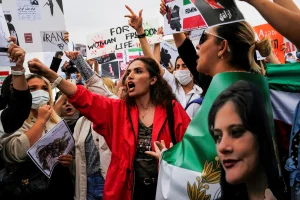
Many have linked scenes from the race to the “Women, Life, Freedom” movement, in which many women discarded their hijabs to protest the death of Mahsa Jina Amini, who died in Iranian custody in 2022 after being detained over her alleged violation – showing a tiny amount of hair.
“They wanted Mahsa’s death to frighten women back into silence. Instead, her name became a symbol of a generation that refuses to disappear,” wrote Alinejad on 𝕏. “You can police a woman’s hair. You can arrest her. You can threaten her. But you cannot imprison courage.”
Refuting suggestions that the regime was reforming and allowing women more freedom, Alinejad emphasized, “Iranians were never “given” these freedoms. Women of Iran have continued walking unveiled despite arrests, intimidation and pressure. The Islamic Republic has not abolished compulsory hijab.”
Alinejad’s feed on 𝕏 is peppered with images of women, and even men, with one eye bandaged, shot by the Islamic Revolutionary Guard Corps (IRGC) for the “crime” of protesting the head covering laws.
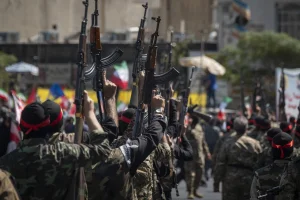
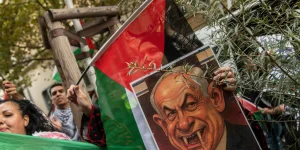
On the same day as the women’s race on Friday there was a separate men’s race and significantly a Janfadayan-e military rally (meaning 'Those who sacrifice their lives for...') organized by the IRGC. The Revolutionary Guards, Basij members and other volunteers including delegations representing proxy groups from Hezbollah, the Houthis, and others marched while coffins with images of U.S. President Donald Trump and Israeli Prime Minister Benjamin Netanyahu were on display.
Despite claims that 300,000 participated in the protest, Iranian commentator Mahyar Tousi cast doubt on the show of force, pointing to the sparse numbers taking part in the parade.
Tousi has also suggested that rather than growing in strength, the regime is facing a “crisis of mass draft evasion” and that it is struggling to maintain its numbers after killing so many Iranian citizens. However, Sima Shine, senior researcher at the Institute for National Security Studies (INSS), is less optimistic, saying the numbers depending on the regime for their livelihoods makes change difficult.
Iranian exile and pastor, Reza Sotoudeh described the situation as “dire.”
“People are exhausted, the cost of living is skyrocketing, and prisons are packed with protesters. Four people are executed daily, most of whom are minors. The people have reached the end of their tether,” he told ALL ISRAEL NEWS.
“This regime is truly malevolent; they are armed. They may not be as strong as they once were, but they still receive support from Hamas, Hezbollah, and other terrorist groups outside Iran,” he added.
Despite some state-affiliated accounts capitalizing on the images of the women running freely to counter criticism of the regime’s treatment of women, Alinejad maintained that the regime was still harassing unveiled women in the streets.
“That is the real face of this 'reform,'" she insisted. “When I see a woman without hijab, I do not see permission from the government. I see someone who broke through the wall herself. I see a society that changed from below, because ordinary Iranians refused to wait for permission to be free.”
You might also like to read this: