Hezbollah fires dozens of rockets at Israel’s northern communities after IDF kills terrorist in Lebanon
Northern border appears to be heating up as Hezbollah and IDF trade blows
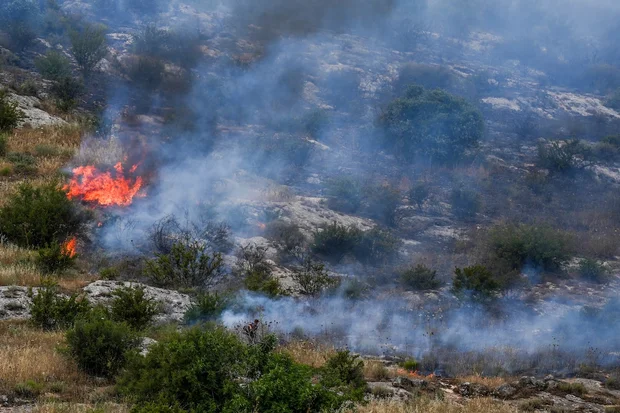
Hezbollah forces in Lebanon launched several volleys of rockets into Israel’s northern communities on Thursday afternoon, following the elimination of a weapons manufacturing operative in a drone strike.
Sirens rang out in several communities across Israel’s north, following the airstrike, including in the Galilee, from Yaron and Avivim near the Lebanese border to Ayelet Hashachar, which is about 10 kilometers (6 miles) from the border.
Israel Defense Forces reported that around 30 projectiles were fired from Lebanon, causing sirens to go off, but said there were no reported injuries. According to the IDF, some of the projectiles were intercepted, while others landed in open areas. The Iron Dome system is designed to intercept projectiles headed for populated areas. Projectiles headed towards unpopulated areas are not intercepted.
Firefighting crews were dispatched to extinguish a series of fires ignited by rockets from Hezbollah forces in Lebanon, which landed in dry fields and set the brush ablaze. The fires were reported in northern Israel’s Hula Valley, including near Ayelet Hashachar. Hezbollah took responsibility for the attack. The terror group said it fired Katyusha rockets, targeting a military base in northern Israel near the town of Safed.
The IDF said Israeli Air Forces (IAF) fighter jets attacked the launchers used in the attack. Videos on social media show rocket interceptions near Safed.
The Israeli military confirmed the killing of a Hezbollah operative in southern Lebanon this morning in an IAF airstrike.
The IDF reported that Hezbollah terrorist Muhammad Ali Nasser Faran, responsible for "the production of Hezbollah’s strategic and unique weapons," was killed by an IAF aircraft in the area of Nabatieh, southern Lebanon. Faran was killed in a drone strike in Kafr Dajjal, close to Nabatieh. Hezbollah had announced his death earlier but did not specify his role in the organization. His elimination is part of Israel's effort to disrupt Hezbollah’s build-up of weapons designated for use in attacks against Israeli civilians and communities.
IDF soldiers apprehended two suspects next to the security fence in the northern Golan Heights on Thursday afternoon. The suspects were observed by IDF troops and apprehended before crossing the security fence when they were transferred to security forces for further questioning.
Another volley of at least five rockets was launched from Lebanon at the Beit Hillel area in northern Israel early Thursday afternoon, the IDF reported.
One rocket struck near Maayan Baruch Junction near Kiryat Shmona. There were no reported injuries at the time of publication.
Just as this article was being published, Israeli Army Radio reported another barrage of about 15 missiles launched towards the Galilee finger, the area north of the Sea of Galilee between Safed and Kiryat Shmona.
Popular article:

interview Easter message of resurrection hope amid war at Jerusalem's Garden Tomb

biblical commentary Let my people go: a Passover message for today

4 IDF soldiers killed, 2 wounded in fighting in southern Lebanon, as Israel eliminates dozens of Hezbollah terrorists

Receive latest news & updates
A message from All Israel News
Help us educate Christians on a daily basis about what is happening in Israel & the Middle East and why it matters.
For as little as $10, you can support ALL ISRAEL NEWS, a non-profit media organization that is supported by readers like you.
Latest articles:

1969 Dutch Eurovision winner Lenny Kuhr moves to Israel – cites antisemitism, family ties

Israel bars French far-left leader Mélenchon in response to France's entry ban on settlement leader

Change Bloc divided over coalition with Arab or ultra-Orthodox parties after week of negotiations

Huckabee fires back as Senate Democrats target US-Israel intelligence ties: 'Shocking!'

Israeli blood test detects early breast cancer with 95% accuracy, assesses recurrence risk