Hamas holds secret elections to choose successor after Sinwar killed in Gaza War
Terror group faces many challenges – from assassination of leadership, to a weakened Iran



The Hamas terrorist organization is holding a secret ballot to select the next leader of its political bureau, replacing the five-member leadership council that has headed the group since the killing of Yahya Sinwar in October 2024.
The election will reportedly take place through a round of voting within the group's 69-member General Shura Council over the next few days, according to Hamas sources cited by Saudi outlet Asharq News.
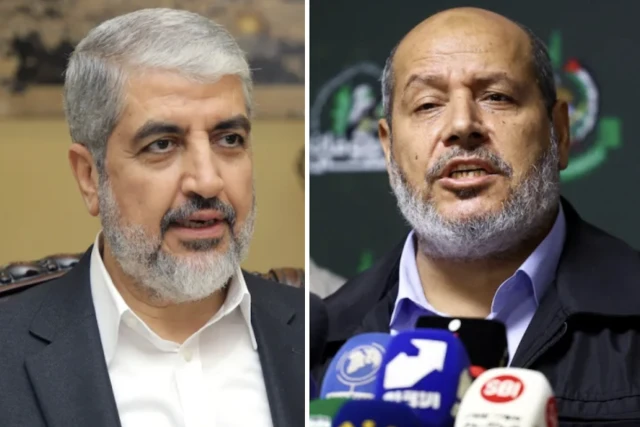
A Hamas official said the choice is between Khaled Mashaal, a former leader who has been living in Qatar for many years, and the current head of Hamas in the Gaza Strip, Khalil al-Hayya.
Mashaal previously served as Hamas' political leader before Ismail Haniyeh, who was assassinated by Israel in Tehran in 2024 while attending the inauguration of Iranian President Masoud Pezeshkian. Mashaal is reportedly in favor of strengthening Hamas' ties with Qatar and Turkey while reducing the group's reliance on Iran.
Al-Hayya is the de facto leader of Hamas in the Gaza Strip and has reportedly been leading negotiation efforts since Israeli forces assassinated Sinwar. Like Sinwar, al-Hayya reportedly supports continued partnership with Iran and a more militant approach.
The selection for the position was postponed several times since the end of Ramadan in March, despite internal elections taking place in the three major regions: the Gaza Strip, Judea and Samaria, and those living abroad due to regional developments.
According to two Hamas sources who spoke to Asharq, the elections were complicated due to the assassinations of political bureau members and prominent leaders within the movement during and after the Iran war. The elections held in May reportedly ended without producing a new leader, prompting Hamas to announce that another round of voting would be held within the General Shura Council.
The Izz ad-Din al-Qassam Brigades, Hamas’ military wing, only recently selected a representative to the political bureau after Israel assassinated its commander, Izz al-Din al-Haddad, in May, the sources said.
The IDF has been attempting to eliminate senior Hamas military leaders in Gaza despite the October 2025 ceasefire. Israeli forces killed al-Haddad’s successor, Mohammed Odeh, just days after eliminating al-Haddad.
A source familiar with the elections in Gaza told Asharq that the assassination of Haddad, a close ally of Haniyeh, could influence the elections. Another source said that the U.S. war on Iran could also impact the election, as al-Hayya supports cooperation with Iran.
Following Sinwar’s assassination in October 2024, Hamas formed a five-member leadership council, composed of leaders in Gaza, Judea and Samaria, and abroad, headed by the chairman of the General Shura Council, Muhammad Darwish, also known as Abu Omar Hassan.
Apart from Darwish, the identities of the council's other members were not disclosed in an apparent effort to prevent Israel from targeting them in assassination attempts.
While Hamas is expected to announce its new leader within the next week or two, some Palestinian social media accounts claimed to have seen leaked results from the internal vote, suggesting that al-Hayya is in the lead.
Jordan’s Al-Ghad TV reported on Saturday evening that al-Hayya is leading the elections within the Gaza Strip, while “the electoral process in the West Bank and abroad is expected to be completed in the coming days, in preparation for the announcement of the final results of the elections.”
However, social media accounts affiliated with Hamas cautioned against trusting reports from any source other than the organization's official channels.
The new Hamas leader will face challenging circumstances, including Israel's continued targeted assassinations of senior leaders, the widespread devastation in the Gaza Strip caused by the war, the transfer of administrative responsibilities to the National Committee for the Administration of Gaza (NCAG), and mounting international pressure on the group to disarm.
At the same time, the leadership abroad could also face significant changes, as Qatar is rumored to be pressuring the Hamas leaders to leave the Gulf state. While Turkey has reportedly welcomed Hamas leaders – and has proven to be a consistent ally for the terror group since the start of the Gaza War – it is unclear whether the political bureau would be willing to relocate its leadership in Qatar to Turkey.
According to Hamas sources, the group plans to restructure its negotiating committee, which is composed of senior leaders and political and military experts responsible for overseeing negotiations and setting the overall framework for any agreement. Hamas also reportedly intends to reorganize the leadership of its negotiating delegation, as well as establish new leadership and organizational committees and other governing bodies.
If al-Hayya is elected, Hamas is expected to maintain its current leadership structure in the Gaza Strip, with the group's center of gravity remaining in the enclave. A Mashaal victory, however, could signal a strategic shift, as he is reportedly seeking to strengthen ties with Qatar and Turkey while reducing Hamas' dependence upon Iran.
According to Arab media reports, several Hamas political bureau members in Judea and Samaria and abroad support Mashaal, hoping that a shift in alliances will improve the group's position.
The reports also say that military leaders in Gaza and Judea and Samaria, as well as some Hamas members held in Israeli prisons, prefer al-Hayya because of his more militant approach.
At the same time, the upcoming legislative elections within the Palestinian Authority, currently set for November, could bring Hamas back into the Palestinian Legislative Council, complicating Western efforts to reform the PA as part of a broader push to revive the two-state solution.
Hamas is currently expected to participate in the elections. However, it remains unclear whether a recently amended Palestinian election law – requiring parties to recognize the Palestinian Liberation Organization (PLO) as the sole legitimate representative of the Palestinian people and commit to its political and national platform – will be enforced.
You might also like to read this: