Want to understand the Bible better? Learn Hebrew, not Greek


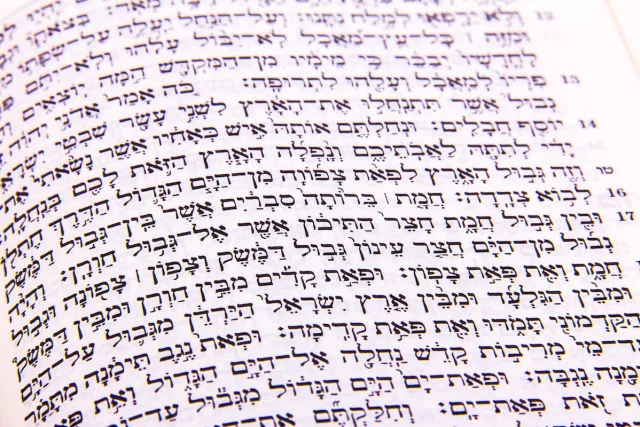
“What?” you might say. “But Greek is needed to read the original New Testament, which is the more important part of the Bible. The New Testament is where you read about Jesus, how the first apostles carried his message and his salvation to the ends of the world, and lots of important theological teaching by Paul and others. The very basic tenets of the faith are within those 27 short books, and they were all written in Greek! The Old Testament is merely the background; the New Testament is where the actual salvation is being taught.”
And yes, you’d be right – to an extent. Learning Greek will help you read the original words of Paul, Peter, and John, which they put down on paper. But if you want to go deeper and actually explore their thoughts, you need to get into their Jewish Semitic mindset. This is why Hebrew matters, even for the New Testament.
The New Testament wasn’t produced by Greeks sitting around discussing Plato. It was written largely by Jews, about a Jewish Messiah, constantly quoting Jewish scripture, using concepts formed over centuries in Hebrew. Christianity did not emerge out of Greek mythology or philosophy. It emerged from the story of Israel.
If you learn Greek, you get access to Plato, Homer, Euclid, and the New Testament – and that’s great. Paul was absolutely well-versed in that world, and understanding it will give you great insight. But it will still only scratch the surface. Because Paul was first and foremost a Jewish Pharisee, schooled by Rabbi Gamaliel, and though he was good at dressing his thoughts in Greek clothing, his underlying thinking was Hebraic.
Put another way: learn Greek and you’re putting yourself in the sandals of the people Paul tried to reach. Learn Hebrewand you’re putting yourself in the sandals of Paul himself.
Many major concepts in the New Testament arrive carrying Hebrew-Bible baggage. Christ is not Jesus’ second name; it’s the Greek translation of “Mashiach.” When Jesus speaks of the Kingdom of God, it’s not an abstract Greek philosophical concept; it grows from Old Testament ideas of God’s kingdom. When Jesus, at the Last Supper, spoke about the New Covenant, he was alluding to Jeremiah 31. When Jesus cries out, “Eli, Eli, lema shabatkani,” he is quoting Psalm 22.
Greek tells you what the New Testament says. Hebrew often tells you why those words carry so much weight. The New Testament authors constantly used words whose conceptual histories were formed in Israel’s Scriptures.
But it goes beyond mere language. It’s also an issue of culture. Jesus lived in a deeply Jewish society, speaking Aramaic while Hebrew played an important role in Scripture and Jewish religious culture. He discussed Sabbath observance with the Pharisees; he answered questions about the greatest commandment by quoting the Shema, and every single Scripture verse he used against Satan was taken directly from the Torah.
Many books in the New Testament, especially Matthew, Romans, Hebrews, and Revelation, assume from the start that their readers understand Israel’s history, institutions, and prophetic vocabulary. So learning Greek might bring you closer to the text the evangelists wrote. But learning Hebrew brings you closer to the world they were writing about.
At the time of King David, the only people who worshipped the God of Israel did so in Hebrew. Since Pentecost, it has spread to many languages and nations, and that’s wonderful, but Hebrew remains the original language of God. Greek and Latin became “holy languages” because they happened to be the international languages at the time of Jesus. They were languages of empires and armies. Even Aramaic appears in some parts of the Old Testament for the same reason. It was the lingua franca in a world where Israel had been conquered. But the original voice of God was always in Hebrew – and it’s still makes up two-thirds of the Bible. Even if the New Testament is in Greek, its operating system running in the background is still Semitic.
Studying Hebrew, even learning just a few words or the basic structure of the language, will bring you infinitely closer to the world of Jesus than Greek or Latin. Wordplay and alliteration in the Old Testament, the mere poetic sound of the Psalms and the wisdom literature and other poetic sections of the Bible, are simply things that don’t convey well in translation. When Matthew says that the Scriptures were fulfilled that “he would be called a Nazarene” (Matthew 2:23), he expects his readers to know the connection between the “branch” mentioned in Isaiah 11 as the “netzer” and why the city of Nazareth has the same name. When the author of Hebrews goes deep into the system of how the Tabernacle functioned, he stops himself at one point and says, “No need to go deeper on this” (Hebrews 9:5). He apparently expects his readers to be familiar with the daily and yearly rhythms detailed in the Torah.
Even the meaning of names matters. Matthew starts his gospel with a list of names, not because he thinks it might be funny to bore the average American Christian who gets hit with this list on the first page of his New Testament, but because he needed to establish Jesus’ Davidic lineage. The list is there to remind the original readers of all the stories they are already familiar with. For example, “Judah, the father of Perez and Zerah, whose mother was Tamar” (Matthew 1:3) is supposed to remind us of Perez, the one who paratz, broke forward, and passed his twin brother in the womb (Genesis 38:27-30), and remind us that the Messiah is expected to break forward and destroy the shackles of sin. “The son of Peretz” is still to this day a well-known Jewish nickname for the Messiah. Adding Rahab and Ruth by name to the genealogy is supposed to remind the Jewish reader that the Messiah is also a light for the Gentiles.
I recently met a Jewish man who had been ultra-Orthodox and turned to atheism, and he had read the entire New Testament and the Qur’an, maybe, on some level, as a rebellion against his old life. He said that reading the New Testament felt extremely familiar. “It’s just like all the other Jewish books and stories I grew up with,” he said. He immediately recognized it as a Jewish book. This is why entering into the world of Hebrew and Hebraic thought patterns will bring you much closer to the world of Jesus and the apostles.
Finally, I’d also like to put in a good word for two millennia of Rabbinic thought and scholarship on the Hebrew Bible, which Hebrew unlocks. They are not always right, but neither is Christian scholarship on the Bible. Why would you cut out millennia of deep thought and deliberation on the Bible? Especially considering that the rabbis were often far more familiar with the text, the original language, and its cultural circumstances than their Christian counterparts were.
None of this means Greek doesn’t matter. It does. Hebrew is not holier than any other language. But Hebrew opens the larger world in which the Bible makes sense. Greek lets you hear the words the apostles wrote. Hebrew lets you hear the Scriptures echoing behind those words: the Torah, the prophets, the Psalms, the promises, the names, the arguments, and the hopes that filled their minds. The New Testament may have come down to us in Greek, but it did not begin with Matthew 1:1. It is the continuation of a story that had already been unfolding in Hebrew for more than a thousand years. Learn Hebrew, and you begin to hear that story as one story again.
You might also like to read this: