Brandeis conference to examine sexual violence allegations stemming from Oct 7



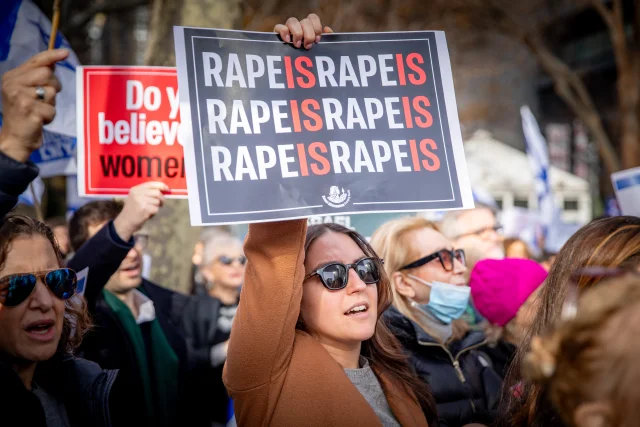
Brandeis University will host a conference this week bringing together scholars and experts to examine conflict-related sexual violence and its legal and societal consequences following the Oct. 7, 2023, Hamas-led attack on Israel.
Titled “Conflict Related Sexual Violence and the Legacy of October 7,” the conference is being organized by the university’s Hadassah-Brandeis Institute Project on Gender, Culture, Religion and the Law and Israel’s Dinah Project at Bar-Ilan University. The event will be open to students, university staff and the general public.
The keynote address will be delivered by Dr. Alice Edwards, who served as the United Nations special rapporteur on torture from 2022 to 2026.
Panels will examine the origins and application of legal frameworks governing war crimes in conflicts including the Israeli-Palestinian conflict and the war in Ukraine, denialism surrounding allegations of sexual violence against Israeli women, the role of radicalization in wartime sexual violence and potential legal responses.
The Dinah Project was founded following the Hamas-led Oct. 7 attack as the need became apparent to pursue justice for victims of sexual violence allegedly committed during the assault.
“CRSV (Conflict Related Sexual Violence) can happen everywhere, and we are hoping to create guidelines for authorities, institutions, and organizations internationally and nationally,” said Sharon Zagagi-Pinhas, director of the Dinah Project and a former IDF chief military prosecutor. “We’re trying to bring a roadmap with many stops and stations on how to collect evidence and then later on how to prosecute.”
“CRSV is a phenomenon that, in order to to intensify the harm to the community, is done in a lot of cases outdoors, in front of an audience for the community to see,” she added. “So you have witnesses for what happened. They can testify, so you have to know to look for these witnesses.”
Zagagi-Pinhas said investigations of sexual violence during armed conflicts present challenges that are generally not encountered by civilian police investigating crimes during peacetime.
She said victims of sexual violence in war zones are often killed after being assaulted, making it impossible for them to later testify about their experiences. Physical evidence such as DNA, blood samples and fingerprints can also be difficult or impossible to collect in active combat zones and may be destroyed during ongoing fighting.
“What we thought we knew regarding sexual violence nationally, domestically, perpetrated against the individual, is not the phenomenon of sexual violence as a weapon of war,” she said. “If you want to fight this with tools that are used domestically for sexual violence against individuals, then you will never get accountability.”
Zagagi-Pinhas also said perpetrators can deliberately conceal their intentions to commit sexual violence in order to avoid accountability for such acts later.
Perpetrators “tend to hide their intent to commit sexual violence, because later on they can’t portray themselves as freedom fighters,” Zagagi-Pinhas said. “When someone chose willingly and knowingly to be a part of an attack, and the base of the attack was to commit genocide, then he agreed to commit anything that was in this attack, whether it was murder or burning a house or sexual violence. He cannot say, ‘Oh, well, I just agreed to slaughter and just agreed to kill people and kill women and children,’ but they didn’t agree to commit sexual violence.”
The conference organizers also plan to address what they describe as efforts to deny or minimize allegations of sexual violence committed during the Oct. 7 attack.
The issue has been the subject of international controversy. United Nations Special Rapporteur on violence against women and girls Reem Alsalem stated last year that “No independent investigation found that rape took place on the 7th of October.”
American political commentator Hasan Piker, who has expressed support for Hamas, has also said, “It doesn’t matter if rape happened on October 7. It doesn’t change the dynamic for me.”
Zagagi-Pinhas acknowledged the difficulty of discussing the issue in an intensely polarized international environment while emphasizing the project’s stated goal of developing legal mechanisms that can be applied to cases of conflict-related sexual violence.
“The arena is difficult because people do not want to hear sometimes what happened on October 7, and sometimes they do not want to hear something that an Israeli says, but we are trying to bring an international message that is not politically related,” Zagagi-Pinhas said. “We have to make adjustments in order not just to have the law, but to have ways to implement the law, but it takes time.”
You might also like to read this: