Trouble in Gotham City
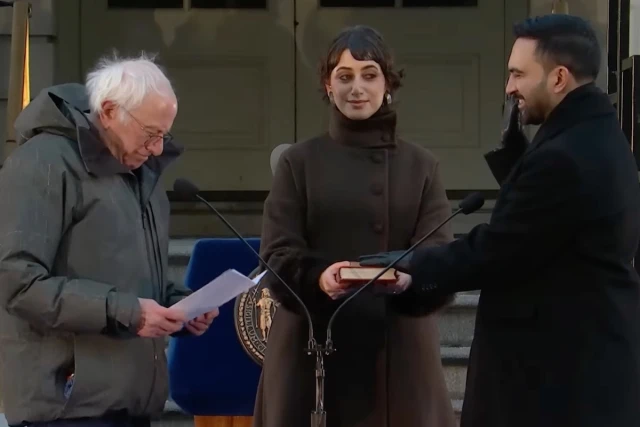
NEW YORK – In a swift and sweeping ideological purge, newly inaugurated New York City Mayor Zohran Mamdani has moved with lightning speed to dismantle the pro-Israel and antisemitism-fighting architecture painstakingly built by his predecessor, Eric Adams. In one of his first official acts, Mamdani, a self-described anti-Zionist politician, issued an executive order nullifying all executive actions taken by Adams since late September 2024, targeting policies that had made New York a national leader in confronting anti-Jewish hate.
The most consequential stroke of his pen erased the city’s adoption of the International Holocaust Remembrance Alliance (IHRA) working definition of antisemitism, a framework used by the U.S. federal government, 35 states, and countless local jurisdictions. This move, more than any other, signals a profound and controversial shift in how the city governing the world’s largest Jewish diaspora community will define, identify, and combat antisemitism.
The IHRA Axe: Erasing a Defining Framework
The revocation of Executive Order 52, which formally adopted the IHRA definition, is not a mere bureaucratic adjustment. It is the philosophical heart of Mamdani’s overturn. The IHRA definition, with its contemporary examples, recognizes that modern antisemitism often manifests as anti-Zionism, including “denying the Jewish people their right to self-determination” and “claiming that the existence of a State of Israel is a racist endeavor.”
For Mayor Adams, this definition was a non-negotiable cornerstone. His administration’s comprehensive 2025 report from the Mayor’s Office to Combat Antisemitism (MOCA) argued forcefully that “Jewish people should define the antisemitism directed against them,” and that the IHRA definition was an “essential educational and interpretive tool” for the city’s 300,000-plus employees. It provided clarity for agencies from the NYPD to the Department of Education in distinguishing between legitimate political discourse and hateful rhetoric that contributes to a climate of fear for Jewish New Yorkers.
Mayor Mamdani, however, has long criticized IHRA as a tool to silence criticism of Israel. His executive order now leaves the nation’s largest city without an official definition of antisemitism at a precisely moment of acute crisis. The Adams report notes that in early 2025, Jews, constituting 11% of the city’s population, were victims in over 60% of all reported bias crimes. The policy vacuum created by Mamdani is not abstract; it directly impacts how the city will interpret and respond to a torrent of anti-Jewish animus.
Dismantling the Adams Blueprint, Piece by Piece
The IHRA revocation is joined by the nullification of other key Adams-era policies. Executive Order 60, which barred city agencies from using procurement contracts or pension investments to support the Boycott, Divestment, and Sanctions (BDS) movement against Israel, has been scrapped. Mamdani is a longtime BDS supporter, and this action opens the door for city resources to potentially be weaponized in economically targeting the Jewish state, despite existing laws prohibiting discrimination in public contracts based on national origin.
Furthermore, the NYC-Israel Economic Council, established by Adams in May 2025 to foster business and innovation ties, has been effectively dissolved. Created via a mayoral declaration, it was not reinstated by Mamdani, signaling a deliberate cooling of municipal relations with Israel.
Yet, in a move of political nuance, Mamdani did not completely dismantle the physical infrastructure Adams built. His own Executive Order No. 2 explicitly retains the Mayor’s Office to Combat Antisemitism (MOCA), the first office of its kind in a major U.S. city. However, this retention rings hollow. The office’s future is shrouded in uncertainty. Its executive director, Rabbi Moshe Davis, a close Adams ally, stated he has had no contact from the new administration and does not know if he will remain.
More critically, without the IHRA definition, MOCA’s very mandate is neutered. The Adams report celebrated MOCA as an “architectural shift in government,” a permanent infrastructure item designed for “enforcement, coordination, and durability.” But what will it enforce? What will it coordinate? If the administration draws, as Mamdani insists, a “firm line” between anti-Zionism and antisemitism—a distinction rejected by the overwhelming majority of mainstream Jewish organizations—then MOCA risks being transformed from an action-oriented body into a symbolic shell, unable to address the primary vector of modern antisemitism as identified by its own creators.
An Ideological Chasm: Redrawing the Lines of Hate
This is the core of the seismic shift: Mamdani is engaged in a radical redefinition of terms. He has publicly condemned classic antisemitic tropes like swastika graffiti while defending anti-Zionist rhetoric that major Jewish groups equate with hate speech. Last week, after the Anti-Defamation League (ADL) highlighted ties between Mamdani appointees and extreme anti-Zionist groups, the mayor fired back, stating, “We must distinguish between antisemitism and criticism of the Israeli government… the ADL’s report oftentimes ignores this distinction.”
This framing stands in direct opposition to the moral philosophy of the departing administration. The Adams report championed “moral clarity without apology,” specifically rejecting “conditional condemnations” of antisemitism that pivot with a “but” to other political grievances. “Antisemitism is wrong, full stop,” the report asserted. Adams viewed the conflation of anti-Zionist activism with antisemitism not as a silencing tactic, but as a necessary recognition of reality, “linking anti-Zionist rhetoric to real-world violence against Jewish communities.”
The revocation of Executive Order 61, which directed the NYPD to strengthen protections for houses of worship after aggressive synagogue protests, further illustrates this ideological recalibration. While Mamdani issued a similar directive on protest management, the symbolic removal of the order specifically tied to synagogues is telling. For Adams, this was a targeted response to a specific threat. For Mamdani, it appears to be absorbed into a broader, less specific framework.
The Legacy on the Line and the Road Ahead
Eric Adams leaves office with a legacy on this issue that is, as his report articulates, a “municipal manifesto.” He advocated for and built: specialized government infrastructure (MOCA), clear definitions (IHRA), cross-agency coordination, unwavering moral messaging, and enforceable policies protecting spaces and resources. His report is a “replication blueprint” for other cities, a “serious, substantive, and impactful piece of public policy documentation.”
Mayor Zohran Mamdani, in his first days, has systematically deconstructed this blueprint. He has removed the definitional guidepost, undermined the economic and political partnership with Israel, and clouded the mission of the office created to lead the fight.
The implications are stark and immediate. The policy vacuum leaves city agencies adrift. The NYPD, school officials, and human rights enforcers now lack the city-sanctioned framework the Adams administration argued was essential for consistent training and response. At a time of heightened fear and record-breaking incident counts, the city’s Jewish community is left wondering if the new administration sees the threat in the same way, or through a lens that excludes what they experience as its most virulent modern form.
Mamdani has framed this as a “fresh start.” For New York’s Jewish community, and for observers of the fraught intersection of identity, politics, and safety, it is a profound and precarious experiment. The administration has drawn its line. The world is watching to see if that line will protect the most vulnerable, or if, in the name of political distinction, it will erase the clarity needed to confront an ancient hatred wearing a very modern mask. The substance of Mayor Adams’ symbolism has been scrapped. What Mayor Mamdani will build in its place will define not only his tenure but the safety and conscience of a global city.
You might also like to read this: