Iran’s mosaic defense

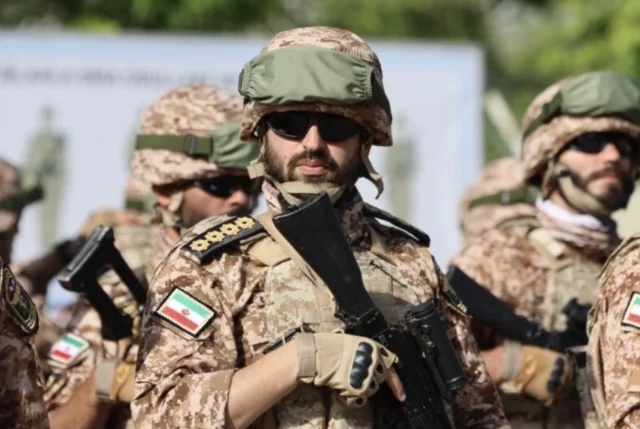
On the morning of 28 February 2026, American and Israeli aircraft flew toward Tehran with a single logic: decapitation. Supreme Leader Ali Khamenei was killed in his bunker. The commander of the Islamic Revolutionary Guard Corps was killed with him. By any conventional military theory, the chain of command should have snapped. The war should have begun to end.
It did not.
Within less than two weeks, Iranian ballistic missiles and drones began rising from multiple directions, multiple provinces, and multiple command nodes simultaneously. The Revolutionary Guard had been reorganized into 31 semi-autonomous combat units, one per province. When central communications were severed, provincial commanders did not wait for orders from Tehran. They had already been pre-authorized: launch missiles, deploy drones, conduct naval swarm tactics. Iran’s foreign minister, Abbas Araghchi, described it with something close to candor: “Our military units are now independent, to some extent isolated, and they act on the general instructions they were given in advance.”
This is “Mosaic Defense.” Its logic is simple and cold: if the enemy tries to eliminate the head, make the body no longer need one.
To understand why Iran chose this way of war, one must first understand a hidden clause in its constitution. Article 5 of the 1979 constitution stipulates that during the occultation of the Twelfth Imam, governance of the state belongs to the “just and pious faqih”—the Supreme Leader. The theological premise of this clause is that the true sovereign is not any living person, but the Imam who went into hiding in 874. The Supreme Leader is merely his proxy in the world.
This produces a subtle but critical political consequence. If the Supreme Leader’s legitimacy derives from his “representative relationship” with the Hidden Imam, then when that proxy is physically eliminated, the system does not automatically collapse—because the one being represented never disappeared and never died. All that is required is a new proxy. In March 2026, Mojtaba Khamenei was declared the third Supreme Leader. He did not appear in public. There was no video, only written statements. Western intelligence agencies waited for his “emergence,” as they would wait for a conventional politician to perform a conventional political ritual. They will wait in vain. Because in the grammar of Shia eschatology, an invisible leader is not a weakness but a deeper source of legitimacy. “Occultation” is not a foreign concept in this faith; it is the organizing metaphor of the entire faith.
What Mosaic Defense does is replicate this theological logic at the military level. If the Supreme Leader is the proxy node of the Hidden Imam, then every provincial Revolutionary Guard commander is a proxy node of the Supreme Leader. Decapitation eliminates nodes, not the network.
This structure has another operational consequence that Western observers frequently overlook it makes Iran’s behavior difficult to deter. Conventional deterrence logic assumes that the adversary’s unit of calculation is “cost-benefit.” But in a system that encodes the current war as “necessary chaos on the road to redemption,” costs are calculated differently. In Twelver Shia doctrine, the return of the Hidden Imam is not a random event, but a process paved by portents and catastrophes. The concept is known as “Tamhis”—a kind of divine sifting or purification. The road to redemption is strewn with “Fitna,” absolute chaos and unbearable trials. For the ideological core of the Revolutionary Guard, the current siege is not a sign of failure but a confirmation that the historical apex is approaching.
This means that Iran’s hard-core military-theological stratum experiences bombardment in a way fundamentally different from a secular state. You cannot bomb a civilization that believes “suffering accelerates sacred victory” into submission. Mosaic Defense’s decentralized structure operationalizes this view of time. If every provincial commander may be martyred in the “sacred struggle,” and martyrdom itself is encoded as fuel accelerating the Imam’s return, then the system’s resilience no longer depends on the survival of any single node.
Article 110 of the constitution stipulates that the Supreme Leader holds the exclusive power to declare war and make peace. This is the apex of political centralization. But what Mosaic Defense creates is a decentralized military system in wartime. The tension between the two is structural: the Supreme Leader can announce a ceasefire in Tehran, but a provincial commander operating anti-ship missiles on some island in the Strait of Hormuz may have already lost contact with the center, or may not believe the ceasefire applies to him.
The dilemma facing the United States in March 2026 is the direct product of this logic. President Trump’s four options—negotiate, withdraw, continue, escalate—none is attractive. Negotiation requires finding an interlocutor capable of representing Iran, but the entire structure of Mosaic Defense exists to make the act of “representing Iran” difficult. Withdrawal means control of the Strait of Hormuz remains in the hands of some provincial Revolutionary Guard commander. Escalation requires ground operations, and any ground invasion would face a network with pre-positioned defensive nodes in every province.
What Iran’s adversaries face is not an army that can be defeated, but a Theo-military organism that refuses to have a single head. Its constitution lodges sovereignty in an absent person. Its military doctrine disperses command among dozens of nodes that may act on their own initiative. Its eschatology encodes the current war as the necessary chaos on the road to redemption.
In such a system, the definition of “victory” needs to be rewritten.
The doctrine was formally created around 2005 by the IRGC’s Center for Strategy, headed by Brigadier General Mohammad Ali Jafari and chief strategist Hassan Abbasi. The catalyst was the 2003 American invasion of Iraq: watching Saddam Hussein’s centralized military and command structure collapse under overwhelming U.S. firepower provided a stark lesson. The conclusion Iranian strategists drew was that a conventional, centralized military could never defeat the United States or Israel. Instead, they designed a system where the regime could absorb a decapitation strike and continue fighting. The core idea was to make the country “impossible to decapitate or too expensive to occupy.” By 2008, the IRGC had restructured itself into 31 provincial commands, each with pre-delegated authority to operate autonomously if Tehran’s central command was destroyed.
While the strategy itself is modern, some commentators have drawn a parallel to an event from early Islamic history: the Battle of the Trench (Ghazwah al-Ahzab, circa 627 CE). In that battle, the Prophet Muhammad’s followers, on the advice of Salman al-Farsi, dug a defensive trench around Medina to stop a vastly larger confederate army. The trench was a defensive attrition strategy: it avoided direct confrontation, neutralized the enemy’s advantage in cavalry, and forced them into a prolonged, exhausting siege that ultimately broke their coalition through weariness and logistics, not a decisive battle. The parallel is that Iran’s Mosaic Defense is also a strategy of avoiding decisive battle and prolonging conflict to exhaust a technologically superior adversary. The “trench” is now a network of tunnels, dispersed missile bases, and autonomous command nodes.
The Axis of Resistance—Hezbollah in Lebanon, the Houthis in Yemen, the militias in Iraq—did not collapse when Iran’s leadership was decapitated. It adapted. And in adapting, it revealed what it always was: not a proxy network with Tehran at the center, but a distributed ecosystem of armed actors, each capable of operating with increasing autonomy, each designed to survive precisely the kind of campaign that was supposed to destroy it.
Hezbollah, long regarded as the “crown jewel” of Tehran’s network, has suffered significant losses since 2023. Leadership decapitation, territorial losses, and the destruction of roughly 90% of its rocket stockpile by Israel in September 2024 have degraded its capabilities dramatically. Yet Hezbollah has not collapsed. It has restructured itself to survive further decapitation. A Lebanese security source revealed that the group has pushed dozens of new commanders into military and security positions, deliberately keeping them anonymous, limiting each commander’s knowledge to only what is needed to manage his own unit. The Iranian Revolutionary Guard Corps sent approximately 100 officers to Lebanon after the November 2024 ceasefire to oversee this reconstruction, dismantling parts of the hierarchical structure built during Hassan Nasrallah’s era and returning to a more flattened, cell-based model reminiscent of the 1980s. Four deputies were appointed for each commander to ensure continuity if the primary leader is killed. This is Mosaic Defense applied to Lebanon: smaller units, compartmentalized information, redundant leadership, and a deliberate embrace of anonymity as a survival strategy.
The Houthis present a different case. Their internal structure had been characterized by extreme centralization, with leader Abdelmalek al-Houthi at the apex. But the war and Israeli strikes have forced a shift. Many leaders were forced into hiding. Communications became unreliable. The sudden prospect of losing leadership became a source of deep concern. The result has been wide-scale decentralization. The Houthis also expanded their General Mobilization Forces into a permanent, institutionalized system modelled on Iran’s Basij, training over one million people by mid-2026. Crucially, this force operates as a popular and ideological arm reporting directly to religious leadership rather than through conventional military chains. This creates a parallel structure that can function even if the formal military command is disrupted.
In Iraq, the war accelerated a shift that had already begun. Days into the conflict, an Iranian delegation arrived in Iraq’s Kurdish region with a blunt message: if militia attacks escalated near US military bases and diplomatic missions, Iraqi Kurdish authorities should not come to Tehran with complaints, as there was little they could do about it. “They said they’ve devolved authority to regional Iranian commanders,” a senior Iraqi Kurdish official said. This shift reflects lessons drawn from the June 2025 war, during which operations were tightly centralized. In its aftermath, greater autonomy was granted in the field. The various forces have been granted the authority to operate according to their own field assessments without referring to a central command.
This is the same logic that governs the rest of the Axis. Control is devolved, not because Tehran wants to lose control, but because centralized control is a vulnerability. A command node that must approve every operation is a command node that can be destroyed. Authority dispersed to the field is authority that survives decapitation.
The Islamic Republic was built so that its highest office could be vacant, invisible, or dead—and the system would still function. That is not a flaw. It is the design.