Enforced gun control in the Middle East


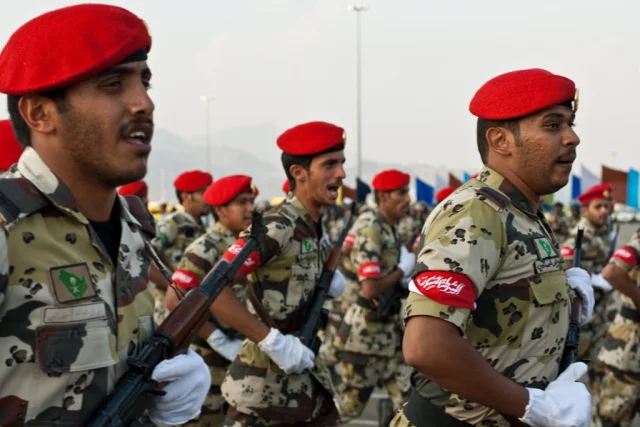
The peaceful Arab states have already proven that gun control works. Saudi Arabia, the United Arab Emirates, and Jordan have all accomplished something that Gaza, Lebanon, Syria, and Yemen have not: they have placed weapons firmly under state control, and they have done so without disarming law-abiding citizens or surrendering their security.
How the Peaceful Arab States Did It
Saudi Arabia accomplished this through a legal framework that draws a sharp line between possession and carry. Its Weapons and Ammunition Law requires separate licenses for each, confines licensed weapons to fixed, secure locations, and imposes severe penalties for violations. Using a licensed weapon for an unlicensed purpose carries up to a year in prison and a 5,000-riyal fine. Acquiring a personal weapon without a license brings eighteen months and 6,000 riyals. The law establishes a comprehensive list of prohibited places—the Two Holy Mosques, government buildings, military facilities, airports, schools, and public gatherings—where carrying is absolutely forbidden. The result is a society where private ownership exists under strict conditions, but public carry and discharge are effectively eliminated.
The United Arab Emirates went further. Under Federal Decree-Law No. 17 of 2019, licensing is restricted exclusively to UAE citizens. Expatriates—most of the population—are barred entirely from possessing firearms. The law permits only three firearms per licensed individual, with calibers capped at 9mm for pistols and .308 for hunting rifles. Firearms may be used only for self-defense, shooting competitions, or at licensed clubs and nature reserves. Carrying weapons is prohibited in military and government installations and vital facilities. This is a regime that treats civilian firearm ownership as a narrowly granted privilege, not a right.
Jordan has maintained its licensing system since 1952, requiring a prior license from the Interior Minister before any purchase. Carrying licensed weapons is explicitly prohibited at official celebrations, public parties, conferences, weddings, funerals, or any gathering exceeding ten people. The law imposes capital punishment for unlicensed manufacture or trade in automatic weapons—a penalty reflecting the seriousness with which the state treats any challenge to its monopoly on force.
These three countries share essential characteristics: state authority is intact, enforcement is consistent, and the legal framework is backed by real consequences. They permit private ownership but criminalize public carry and discharge. The result is not a disarmed society, but a disciplined one—where the state alone determines when and how force may be used.
Why They Succeeded
The peaceful Arab states succeeded because they never allowed armed actors outside the state to emerge in the first place. Their security apparatus remained unified. Their tribal and political structures were integrated into the state rather than allowed to operate parallel military capacities. And critically, they possessed the enforcement capacity to make their laws real—not merely aspirational.
How the Wild Nations Can Follow
Gaza, Lebanon, Syria, and Yemen face a different reality: weapons have already escaped state control. But the lesson from the peaceful states is that enforcement capacity must be built before disarmament can succeed.
For Gaza: The Board of Peace has already secured an agreement for complete disarmament of Hamas and all armed factions. Implementation must follow the Saudi model: licensing restricted to a national authority, carrying prohibited in public, and a verified registry of every weapon. The International Stabilization Force must have the authority to inspect, verify, and enforce—not merely observe.
For Lebanon: The phased plan already exists—south of the Litani first, then extending northward. But the Lebanese Armed Forces must be strengthened with the enforcement capacity that Saudi and Emirati forces possess. Hezbollah must not be permitted to retain independent military capacity while participating in political dialogue. The Yemen precedent—where armed parties entered negotiations without disarming and subsequently destroyed the process—must not be repeated.
For Syria: The transitional government has begun integrating factions into a national army, but disarmament remains uneven. A comprehensive demobilization and reintegration strategy must follow the Jordanian model: economic alternatives for former fighters, community acceptance, and a unified weapons registry that tracks every licensed and decommissioned weapon.
For Yemen: No disarmament can succeed while the state itself is fragmented. The international community must prioritize restoring a unified national authority capable of enforcing any future agreement. Local bans on celebratory gunfire—like those in Hadramout and Mahra—are a start, but they remain local. A national framework is essential.
How the International Community and UN Can Assist
The United Nations and international community can play a decisive role by providing what these states lack: enforcement capacity, technical assistance, and accountability mechanisms.
First, establish a regional disarmament framework modeled on the Board of Peace, with Saudi Arabia, the UAE, and Jordan—the states that have already achieved what others have not—leading the effort and sharing their legal frameworks and enforcement practices.
Second, provide technical assistance for weapons registries. No disarmament is sustainable without tracking. The UN should deploy experts to help establish unified registries in Gaza, Lebanon, Syria, and Yemen, drawing on the successful models of the peaceful Arab states.
Third, enforce arms embargoes effectively. The UN arms embargo on Libya has been "continuously violated" and "stripped of substantive impact." The same pattern risks repeating elsewhere. The international community must impose real consequences for violations, including sanctions on states and entities that supply weapons to non-state actors.
Fourth, fund economic reintegration programs. Disarmament will fail without alternatives. Former fighters need jobs, vocational training, and community acceptance. The peaceful Arab states' success rests not only on coercion but on the economic opportunities their citizens enjoy.
Fifth, deploy verification and monitoring missions with real authority. Observers who cannot inspect, verify, and report violations are useless. The International Stabilization Force in Gaza must have the mandate to enforce, not merely observe.
The enemies of peace understand something that too many diplomats do not: weapons are power, and power will not be surrendered voluntarily. The peaceful Arab states have shown that gun control works—but only when it is enforced. The international community must now commit to building that enforcement capacity in the wild nations, with monitors, sanctions, and consequences. The alternative is what we have now: an endless cycle of ceasefires broken, agreements violated, and innocent lives lost.
You might also like to read this: