Attempted flydubai hijacking sparks rare Israel-Saudi goodwill, but unlikely to change ties



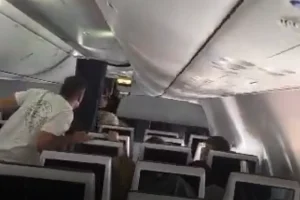
The attempted hijacking of a flydubai flight carrying mostly Israeli passengers to Tel Aviv on Wednesday produced an unusual moment of goodwill between Israel and Saudi Arabia, with passengers praising their Saudi hosts for the care and hospitality they received.
However, the incident is unlikely to significantly alter the relationship between Jerusalem and Riyadh, which remains unofficial despite years of reported security and intelligence cooperation.
Officials in Jerusalem and Riyadh are expressing relief and satisfaction that flydubai flight FZ1073 ended with the passengers safe and the wounded crew members able to receive the medical treatment they needed after the aircraft was safely landed at Prince Sultan bin Abdulaziz International Airport in Tabuk, northern Saudi Arabia.
“Passengers were provided with the necessary assistance at the terminal,” the airport said, adding that it was committed to adhering to international conventions and treaties concerning the safety of civil air navigation, passengers and crew.
Some of the Israeli passengers on the flight spoke to Arab News, the Saudi English-language media portal owned by members of the royal family, and expressed gratitude to the airport and the Saudi people, saying they were treated very well by their hosts, who gave them food, drinks and medical care and otherwise made sure they were comfortable in the terminal of the airport for the few hours they were on the ground there.
Almog Italie, owner of a digital marketing company, told Arab News that the airport staff “took care of us, and it was the best hospitality I ever experienced. I look forward to returning, and hopefully there will be peace.”
However, the Saudi government firmly refused a request, made through the Mossad intelligence agency, which was the main conduit of communication between the two capitals, for Israeli Air Force C-130 Hercules transport aircraft, or even an unmarked Mossad plane, to land at the Saudi airport to bring the Israeli passengers home.
The optics of such a move would have been perceived internationally as a tacit act of normalization in relations between Saudi Arabia and Israel, something that Riyadh is not prepared to do at this time.
In the end, the passengers agreed to board an ordinary passenger plane that flydubai sent to bring them the rest of the way to Israel and the situation was resolved.
“This also shows that Saudi Arabia, or at least Saudi public opinion, is still not ready for an overt Israeli presence or visible ties with Israel,” one Israeli intelligence official said. “The kingdom currently enjoys a security relationship in the form of a ‘mistress,’ paying no price for it and only benefiting. If Israel is smart, it will know how to leverage the security relationship and gain diplomatic benefits from it as well.”
In a more general sense, although the incident has generated some positive feelings between the two countries, diplomatic relations between them are unlikely to be affected in the short term. There have been reports for many years of unofficial intelligence and diplomatic cooperation between them, usually under American auspices and with frequent cooperation from Jordan and Egypt.
Most recently, Israel has provided intelligence support to Saudi Arabia in the battle against the Houthi rebels in Yemen, who have attacked Saudi Arabia in support of the regional agenda of Iran’s Islamic Revolutionary Guard Corps (IRGC) regime.
Still, Riyadh officially insists that further progress toward normalization will depend on an Israeli commitment to an irreversible path toward Palestinian statehood.
However, several popular Saudi social media influencers also spoke up regarding the day's events, saying that regardless of politics, the Israeli passengers on the plane were human beings who had been through a traumatizing experience and deserved to be treated with kindness and traditional Arab hospitality after their ordeal.
One Medina-based blogger even said he was “proud” of his government for the wisdom they had shown in the circumstances and that he wished the passengers well.
Similar expressions of gratitude and respect were made toward Saudi Arabia by many Israeli influencers on social media, as well as in traditional media outlets and government agencies.
You might also like to read this: