











After 2 weeks of talks: No coalition deal in sight as Eisenkot negotiates with Likud, ultra-Orthodox, Arab parties
Eisenkot wants to bring minority gov't to vote even if talks fail
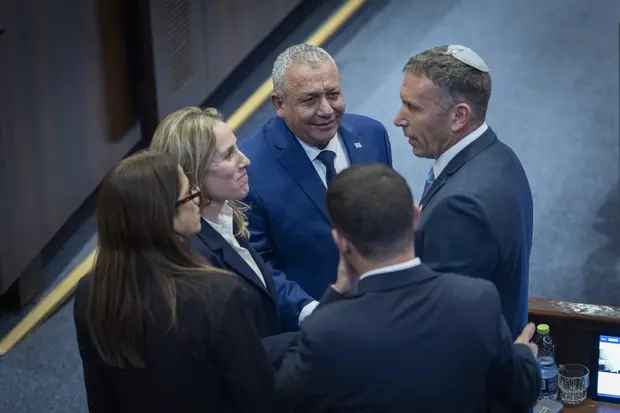
Two weeks after receiving the mandate to form Israel’s next government, Gadi Eisenkot continues to advance negotiations on three separate tracks, none of which appears particularly promising, as each of his Change Bloc allies favors a different option.
On Sunday, Eisenkot’s Yashar party held another meeting with the Likud party as part of ongoing talks toward forming a potential unity government, which Together (Beyachad) party leader Naftali Bennett reportedly supports.
In a joint statement, Yashar and Likud said they discussed “positions on a range of substantive issues” and that a follow-up meeting would take place.
Eisenkot’s initial 28-day window to form a coalition expires on Dec. 6, with the possibility of a 14-day extension. A stable government requires a 61-seat majority of the 120-seat Knesset, though a minority government can be established with fewer seats.
At the same time, Yashar and Avigdor Liberman’s Yisrael Beiteinu party continues talks with the ultra-Orthodox parties, while The Democrats’ party leader Yair Golan is calling to establish a minority government with support from Arab parties, Ra’am and the Joint List.
A minority gov't with Ra'am, backed by the Joint List, is the most popular option among voters of all four Opposition Bloc parties. But the level of support varies considerably – from 93% among Democrats voters to 31% among Yisrael Beteinu voters. via aChord, Nov. 8–16 https://t.co/2q3Hr2fmyM
— Israel Elects (@israel_elects) November 20, 2026
Ahead of the Jewish Sabbath, Eisenkot published a lengthy statement regarding the status of the coalition talks, framing the situation as an “extremely dangerous period” and emphasizing that replacing Prime Minister Benjamin Netanyahu remains the most important goal.
He cited the danger to “our democracy, and our standing and position in the international arena” caused by Netanyahu’s “violent campaign of delegitimization” against the Arab parties, warning that the distance to “actual violence could also be very short.”
Referring to the tense situation with Iran, he repeated his warning that Netanyahu could mix “operational interests” with “political interests.”
“Serious discussions” are being led with the ultra-Orthodox parties, Eisenkot said, stressing that they aim to find “solutions… that will strengthen the IDF, meet security needs, and preserve the status of Torah scholars, as we promised during the election campaign.”
The four Change Bloc parties had heavily campaigned on the promise to enforce universal military conscription with harsh sanctions against draft dodgers, but have softened their position in recent weeks.
There's an issue with the question design here: three of these four scenarios aren't viable on their own. Neither a Change Bloc–Ra'am nor a Change Bloc–UTJ alliance would have a majority. Which additional party joins could make a big difference to respondents' answers, yet that's left open to interpretation.
— Israel Elects (@israel_elects) November 20, 2026
On Saturday, the ultra-Orthodox Kikar Hashabbat news site reported that the United Torah Judaism party is waiting for a new proposal on formalizing draft exemptions for yeshiva (rabbinical education) students. An earlier proposal with to exempt 3% of each conscription cohort was reportedly rejected by senior rabbis.
Regarding talks with Likud, Eisenkot said Yashar is making “sincere and genuine efforts” to work together but pointed to “a considerable gap between the rhetoric and the actual actions and willingness of Likud.”
“Nevertheless, I intend to give this track another opportunity,” Eisenkot said.
Meanwhile, the Likud published a statement with its own demands, including an end to “all personal attacks and incitement” and political “boycotts” against Netanyahu.
However, the party did not explicitly specify that Netanyahu must remain prime minister. According to Ynet News, the issue was not discussed on Sunday, as Likud insists that Netanyahu serve first in any rotation agreement, a condition the Change Bloc categorically rejects.
The discussion instead reportedly focused on a new IDF draft law, judicial reform, and a state commission of inquiry into the failures of Oct. 7, Israeli media outlets reported. Yashar also reiterated its opposition to joining a government with Israeli National Security Minister Itamar Ben Gvir.
The only reported agreements concerned two relatively peripheral issues: affirming that Israel is the nation-state of the Jewish people, and rejecting a Palestinian state, a position that could harm Yashar’s parallel talks with Arab parties.
Following the meeting, Netanyahu published again criticized the Arab parties. Responding to a news report that senior Joint List lawmaker Tibi met with Jordanian MPs who openly support Hamas, he wrote, “A government with Ahmad Tibi must not be formed.”
Yair Lapid, No. 2 in Bennett’s Together party, has openly rejected a coalition with Netanyahu. After Sunday’s meeting, Lapid charged, “Netanyahu voted 771 times together with these ‘terror supporters’. In 2021, he desperately courted Mansour Abbas. When they need their votes, they are not terror supporters.”
Despite reportedly favoring a unity government with Netanyahu’s Likud, Bennett said on Friday that he remains “committed to ensuring that Netanyahu will not be the next Prime Minister of the State of Israel, and that my party will not work with him or join his bloc under any circumstances.”
“As part of the initiative I intend to advance, we will soon know whether the path toward unity is genuine, or whether it is merely an attempt to squander the 29 days remaining in Gadi's term. We must not allow them to do that,” Bennett said.
Meanwhile, Democrats leader Golan claimed that coalition talks had shown “no real progress.”
“A minority government is the only realistic alternative. A unity government with Netanyahu would be a stab in the back to voters,” he said.
If talks with Likud and the ultra-Orthodox parties fail, Eisenkot reportedly plans to put a minority government to a Knesset vote, relying solely on the Change Bloc’s 48 seats, according to Ynet.
The plan assumes that the Arab Ra’am party would lend its support from outside the coalition, bringing the total to 56 votes, while hoping the Joint List would abstain, allowing the government to secure a relative majority in the Knesset.
Eisenkot said as much in his Friday statement: “If the genuine efforts I am leading to establish a broad government do not come to fruition, I intend to establish a national emergency government, which I will work to expand either before its swearing-in or afterward.”
Popular article:

interview Easter message of resurrection hope amid war at Jerusalem's Garden Tomb

biblical commentary Let my people go: a Passover message for today

4 IDF soldiers killed, 2 wounded in fighting in southern Lebanon, as Israel eliminates dozens of Hezbollah terrorists

Receive latest news & updates
A message from All Israel News
Help us educate Christians on a daily basis about what is happening in Israel & the Middle East and why it matters.
For as little as $10, you can support ALL ISRAEL NEWS, a non-profit media organization that is supported by readers like you.
Latest articles:

Pro-Israel German politician Karoline Preisler kicked to ground at anti-Israel protest in Berlin

Lebanese president condemns Iranian interference, calls for Hezbollah disarmament, withdrawal of Israeli forces

Israel watches as Turkey expands military presence in Horn of Africa

Amid heightened tensions, Iranian regime unveils ‘missile city,’ claims to damage U.S. higher jet

‘Friendship is no insurance policy’: Jewish leaders warn of rising antisemitism in Romania