











First success: Change Bloc appoints Matan Kahana as new Knesset speaker, takes control of parliament
Ultra-Orthodox UTJ party votes against, signaling that breakthrough in coalition talks remains far off
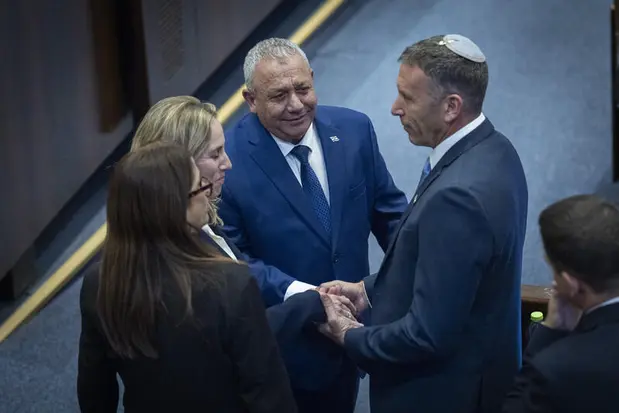
Matan Kahana, No. 5 on the Yashar party slate, was elected to be the new 'Speaker of the Knesset' on Tuesday evening, with 66-52 votes, overcoming hours of filibustering by Prime Minister Benjamin Netanyahu’s bloc.
The Change Bloc, led by Yashar chairman Gadi Eisenkot, celebrated Kahana's appointment as its first tangible success toward building a new government coalition.
Capturing the speakership gives the bloc significant control over the parliament’s legislative process. This could allow it to advance bills rolling back several controversial laws passed by the outgoing government, while also introducing new laws that could harm the Netanyahu bloc’s chances in a future election.
However, Israeli media outlets reported that the Change Bloc said it had agreed to hold off attempts to repeal judicial reform laws until next Monday, as part of a deal to end the filibusters and allow Tuesday’s vote to proceed.
🇮🇱 PASSING THE GAVEL: A NEW CHAPTER IN ISRAEL'S KNESSET After four years as Speaker of the Knesset, Amir Ohana steps down from the podium, making way for his successor, Matan Kahana. A symbolic changing of the guard at the heart of Israeli democracy. https://t.co/QltTHKOuas
— Mossadil Commentary (@MOSSADil) November 18, 2026
In his inaugural speech, Kahana said he hoped a new government would advance “necessary corrections to the system of checks and balances between the three branches of government” while also vowing that, under his leadership, “the Knesset of Israel will unquestioningly obey the court’s rulings.”
Kahana began his first speech with the final verse of Psalm 29: “The Lord will give strength to His people; the Lord will bless His people with peace.”
“The Knesset is the home of all citizens of the State of Israel, regardless of religion, race, or gender,” Kahana continued. “And I intend to be the speaker for all of them.”
He also noted that Israel’s lawmakers have repeatedly caused embarrassment to the people of Israel in recent years, noting that the Knesset is responsible for moving away from the “extremism, hatred, and division” that fill social media and embracing the Jewish school of thought of the House of Hillel, whose followers “made a concerted effort to understand those with whom they disagreed.”
Kahana is viewed as a well-respected veteran lawmaker and former minister of Religious Affairs. He began his political career in Naftali Bennett’s Yamina party in 2020 and is also known as a friend of Evangelical supporters of Israel.
The 66 votes in favor of Kahana's appointment came from the Change Bloc parties – Yashar, Yisrael Beitenu, Together (B'Yachad) and The Democrats – as well as the Arab parties, Ra’am and Joint List.
The Likud party, led by Netanyahu, strongly condemned the election with votes from the Arab parties, calling it a “low point in the history of the Knesset.”
Meet Israel’s new Knesset Speaker, Matan Kahana, a rare fusion of elite warrior and statesman. Born in Haifa in 1972 and raised in a religious Zionist home, Kahana served nearly three decades in the IDF, rising to the rank of colonel. He began as a combat soldier in the legendary Sayeret Matkal. He then waived into the Air Force, becoming an F-16 fighter pilot and squadron commander who flew combat missions in the Second Lebanon War and multiple Gaza operations. What makes him unique? He is the only soldier to complete Sayeret Matkal’s grueling path and went on to command fighter jets. A religious man who served as Minister of Religious Services and pushed reforms, Kahana has long bridged military toughness with pragmatic politics. Now Speaker of the 26th Knesset, he brings that rare combination of battlefield discipline, aerial leadership, and public service to one of Israel’s highest offices.
— Uri Pilichowski (@RationalSettler) November 18, 2026
In a strongly worded statement, Netanyahu said, “An eternal disgrace. This evening, a Knesset Speaker was appointed unilaterally, with the votes of terror supporters… The people of Israel oppose handing over the keys to power in the country to those who dishonor the national anthem. The people of Israel yearn for unity. Eisenkot, Bennett, and Liberman chose terror supporters over national unity today.”
Since the elections, which saw a record high Arab voter turnout, Likud has alleged that the elections were “stolen,” while trying to delegitimize any cooperation by the Arab parties in a future government.
After the vote, the Joint List demanded that Kahana use his new powers “to put an end to statements such as ‘terror supporters,’ ‘saboteurs,’ and ‘terrorists’ being directed at Arab MKs.” Kahana reportedly declined to comment.
Notably, the ultra-Orthodox United Torah Judaism (UTJ) party refused to vote for Kahana, instead supporting Likud candidate Ofir Katz, signaling that coalition negotiations with the Change Bloc have not yet reached a breakthrough.
UTJ appeared to signal that it remains open to offers from both sides, while insisting on its central demands regarding mandatory military service in the IDF.
Celebrating Kahana’s election, Eisenkot said it marked “a new chapter of statesmanship, respectful and substantive dialogue, and a Knesset that fulfills its role as a strong and effective oversight body.”
He also backed Kahana’s call to “turn over every stone to bring about a government that will unite us,” but stressed that unity should not come at the expense of making decisions while treating the minority with “respect and responsibility, and in a statesmanlike manner.”
Meanwhile, Eisenkot is facing criticism from parts of his base over the Change Bloc’s decision to postpone establishing a state commission of inquiry into the Oct. 7 failures, despite the issue being a central campaign promise. The delay reportedly reflects the bloc’s assessment that it cannot pass the necessary legislation during the transitional period, while the caretaker government remains opposed to a commission.
Establishing a state commission would require either the caretaker government’s approval, which remains unlikely, or new legislation. Ynet News reported Sunday that the bloc believes it cannot pass the necessary laws during the transitional period, prompting the decision to delay the issue.
Popular article:

interview Easter message of resurrection hope amid war at Jerusalem's Garden Tomb

biblical commentary Let my people go: a Passover message for today

4 IDF soldiers killed, 2 wounded in fighting in southern Lebanon, as Israel eliminates dozens of Hezbollah terrorists

Receive latest news & updates
A message from All Israel News
Help us educate Christians on a daily basis about what is happening in Israel & the Middle East and why it matters.
For as little as $10, you can support ALL ISRAEL NEWS, a non-profit media organization that is supported by readers like you.
Latest articles:

Czech delegation visits Israel to explore Arrow missile defense as Netanyahu warns Iran threatens Europe

UK, Australia unveil new sanctions over E1 construction, 'illegal settlement expansion’ in Judea and Samaria

Israeli Arab charged with spying for Iran, citing ideological motives

3 Israelis injured, 1 Palestinian woman killed in violent incident outside new Jericho settlement

Israel rises to world's 25th-largest economy despite war, boycott calls