47 Persian Jews from NY make aliyah together, citing impact of Oct 7 in diaspora



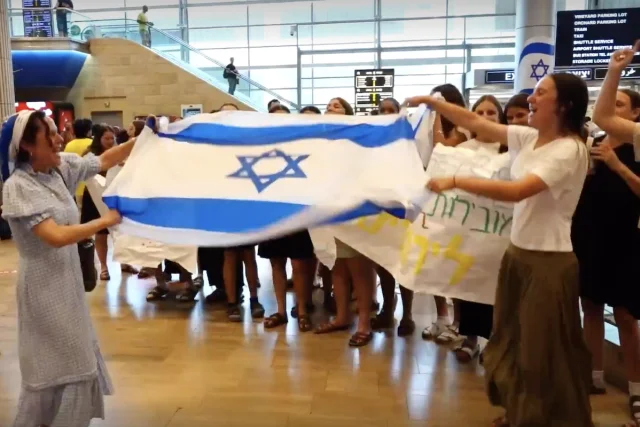
A group of 47 new immigrants from New York’s Mashhadi Jewish community arrived in Israel on an aliyah (immigration) flight last week. The community traces its roots to Persian Jews whose families left Iran following the 1979 Islamic Revolution. The group, which includes families with children, has taken up residence together in the city of Ra’anana, near Tel Aviv.
Upon arrival, the new immigrants were greeted by representatives of Israeli organizations that assisted with their aliyah, including Nefesh B’Nefesh, Israel’s Ministry of Aliyah and Integration, the Jewish Agency for Israel, Keren Kayemet LeIsrael and the Jewish National Fund-USA.
Among the new immigrants was Jordan Karmily (42), who made aliyah with his wife and six children.
“I’m feeling every emotion right now,” said Karmily. “All my life, my family talked about doing this and it always seemed far away. But we reached a point where we could no longer avoid the desire to move to Israel. We felt that either we do it together as a community or we stay in exile and complain…it excites me to think that I will raise my family in Israel as Jews. All Jews need to understand that the exile is over and it is time to come home.”
Noya Hankin, who was among those who greeted the new arrivals, said, “They’re incredibly excited about the aliyah. I think the awakening came after the war, and I’m so happy this day has finally arrived because we spoke to them about this for years. I can barely breathe from excitement.”
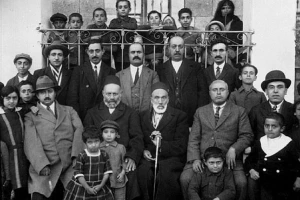
The new immigrants are part of a larger community of Persian Jews who fled Iran in 1979, when the Islamic Revolution overthrew the secular government of Shah Reza Pahlavi, which had allowed them to live in relative freedom. While many Iranian Jews who left the country immigrated to Israel, larger numbers settled in New York City, where they remained close to one another as they established new lives in the United States.
Ariel Dilamani, who was among the group that arrived on the flight, described the move as a return from exile.
“You could say we have returned from the Babylonian exile,” said Dilamani. “Once you understand that Israel is the home of the Jewish people, you understand that you need to make aliyah.”
Karmily said he had visited Israel many times before deciding to make it his home.
“I visited Israel many times,” added Karmily. “But I never made it my home, and that was a hole in my heart for years. It became a hole that could not be filled unless we made aliyah.”
He said that although he believes antisemitism is growing in the United States, it was not the primary factor motivating his decision to make aliyah. Instead, he cited a sense of solidarity with fellow Jews and a desire to join them in Israel.
“Did October 7 show me, at least, that people from my nation could be sitting in shelters while I lived my life in New York? Yes. That felt wrong to me,” he said. “Deep down, I think these three years of war actually helped bring us to the decision to make aliyah.”
Karmily said members of the community encouraged one another to make the move together.
“Everyone in the community helped everyone else prepare for aliyah,” Karmily added. “In the past, individuals from the community moved here, but this time everyone pushed one another and eventually we did it together. We would say to the person next to us, ‘If you can do it, then I can do it too.’"
He acknowledged that moving to Israel meant leaving some family members behind in the United States.
“It certainly wasn’t easy, for example, to separate grandparents from their grandchildren. Some people told me at first that it was irresponsible, and I understand what they mean. But in life, you have to make decisions while thinking ahead.”
Karmily said the community's Zionist identity also played a role in the decision.
“We are very Zionist in our community, and I understand that when the moment actually arrives, something new can be frightening,” he said. “But we felt we had to do it – it is a privilege for us to live here and, as I have said before, we are just a small part of the chain that began with Abraham.”
You might also like to read this: