WATCH VIDEO: I’m in the UAE and have learned 5 ways Emiratis are seriously advancing peace with Israel, the Gulf, and Palestinians
Evangelicals, take note: Iran’s October 7th strategy did not blow up the Abraham Accords




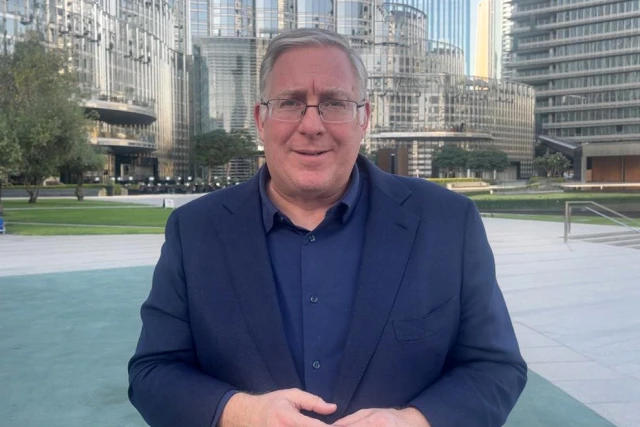
DUBAI — For the first time since the October 7th War exploded in Israel and the Iranian regime began attacking the Jewish state on seven different fronts, I’ve come back to the United Arab Emirates.
Why?
To have meetings with senior UAE government officials, as well as with Muslim and Christian leaders in both the political capital of Abu Dhabi and the commercial and financial capital of Dubai.
The key question I came to ask is this: Did Iran’s October 7th war strategy effectively blow up the Abraham Accords?
And I have to tell you, I’m very encouraged by the answer I’m hearing over and over again.
“ABSOLUTELY NOT.”
In fact, I’ve learned at least five facts that I consider proof that the Abraham Accords have endured during the war.
I share some of what I’ve learned in this video we shot in front of the iconic Burj Khalifa – the tallest building in the world (and yes, the tower that Tom Cruise famously ran around the outside of in the film, "Mission Impossible: Ghost Protocol") – here in the heart of downtown Dubai.
But let me share more with you in this column.
FACT #1
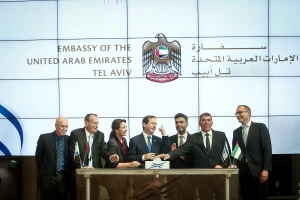
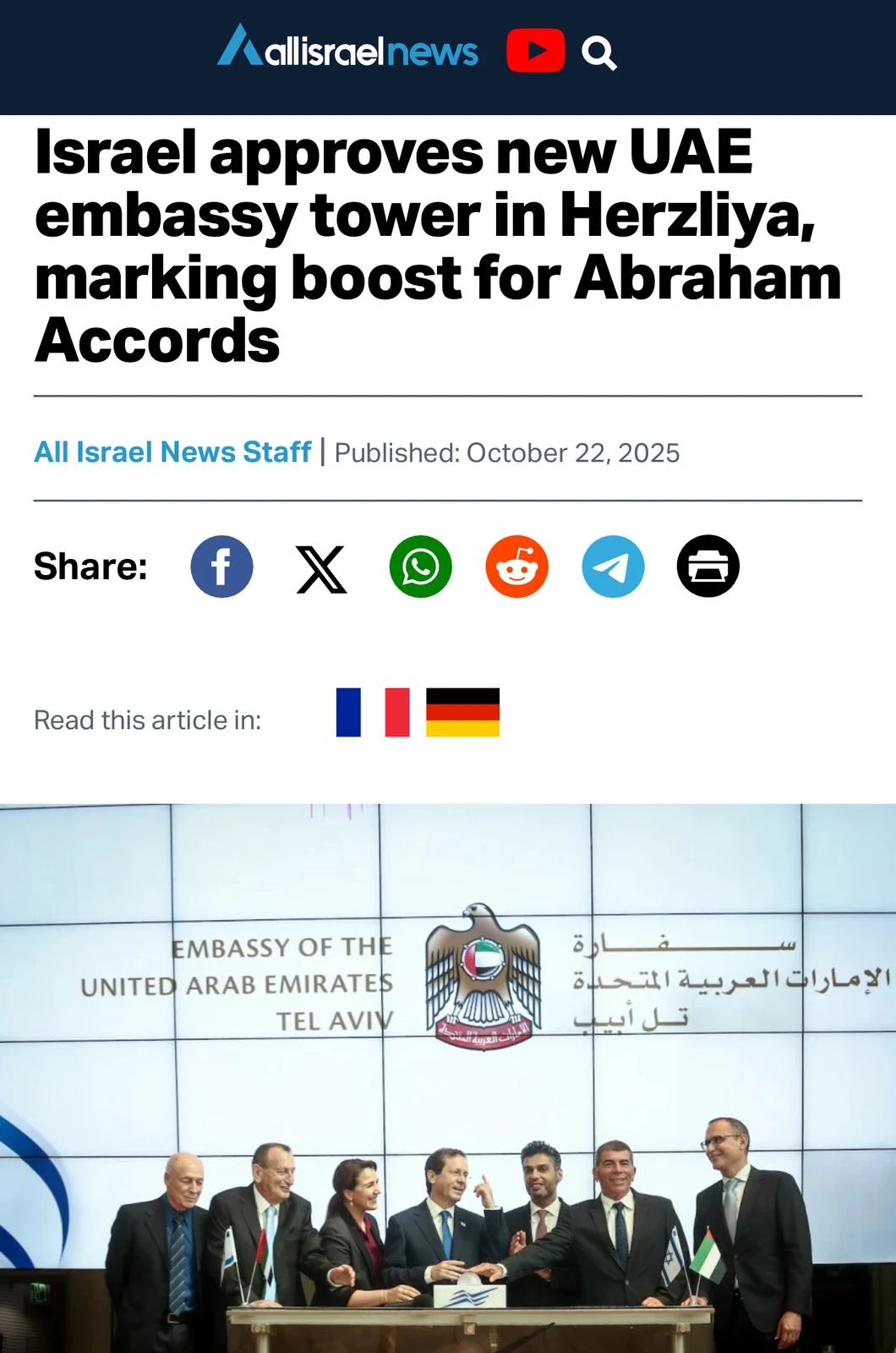
Never once after October 7, 2023, did the UAE government shut down its embassy in Israel or recall its ambassador.
FACT #2
From the very beginning of the war to this moment, UAE airlines – such as FlyDubai, Emirates, and Etihad – continued to fly back and forth from Dubai and Abu Dhabi to Tel Aviv. In fact, these airlines are currently operating 18 direct flights a day between this Arab nation and Israel.
By contrast, there are no direct flights between Jordan and Israel or between Egypt and Israel. For many Israelis, UAE planes had the only seats available to get in and out of Israel during the war because all American and European carriers canceled their flights and the planes of Israel’s national carrier, El Al, were often completely booked out (and very expensive).
Several times during the war, Lynn and I took the UAE airlines to travel to other places in the world, including the United States.
FACT #3
Even as fighting escalated in the first year of the war between Israel and her enemies in Gaza, the West Bank, Lebanon, Yemen, Syria, Iraq, and Iran, commercial relations between the UAE and Israel actually grew by double digits.
Remarkably, trade between the UAE and Israel grew by 11% between 2023 and 2024, a nearly miraculous testament to the increasingly close ties and business interests between these two innovative and dynamic countries.
FACT #4
What’s more, we’re not talking about a few million dollars of trade between the UAE and Israel – or even hundreds of millions. We’re talking about billions.
Indeed, trade between the Jewish state and the UAE topped $3.2 billion in 2024 alone, up from essentially nothing prior to 2020.
FACT #5
Meanwhile, Emirati officials are working closely with U.S. President Donald Trump, other moderate Arab countries, and Israel to figure out how to create an entirely new Gaza Strip.
Not only is the UAE government ready to invest billions of dollars in rebuilding Gaza’s housing and infrastructure, UAE officials and experts are also helping the Trump team develop plans to de-radicalize Gaza’s mosques, schools, and media – drawing on decades of experience they have in banning the Muslim Brotherhood from operating anywhere in the Emirates and de-radicalizing their own society from Brotherhood and other radical Islamist influence.
UNDERSTANDING THE BOLD, VISIONARY LEADERSHIP OF MBZ
Is it a hard road ahead in Gaza?
Absolutely.
Does Gaza have to be demilitarized – and Hamas disarmed – first?
Absolutely.
None of this will be easy, but I’m encouraged.
You should be, too.
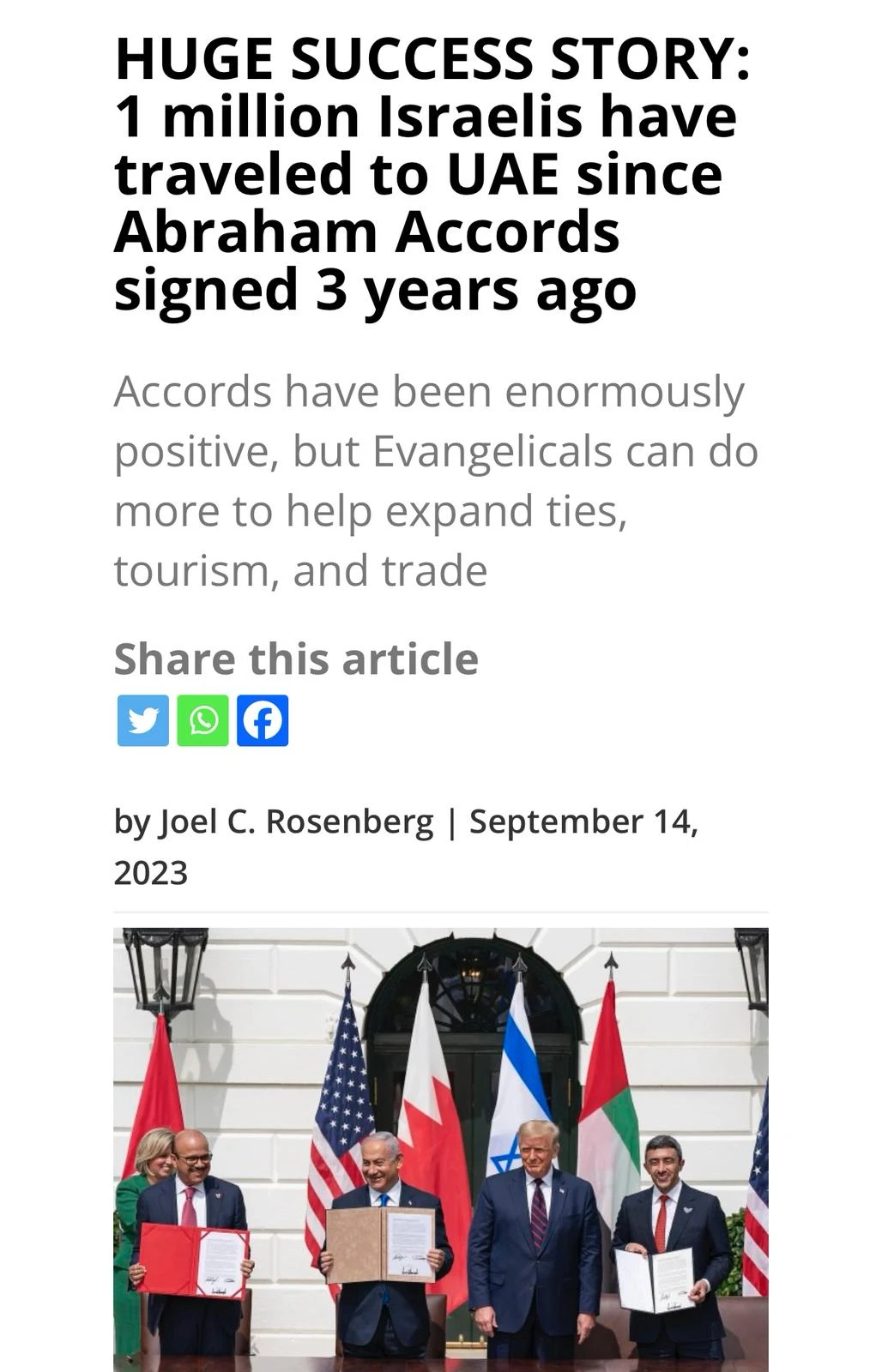
Remember, the United Arab Emirates was the first Arab country to join the Abraham Accords back in August 2020.
Their bold step set into motion four Arab countries normalizing relations with the state of Israel.
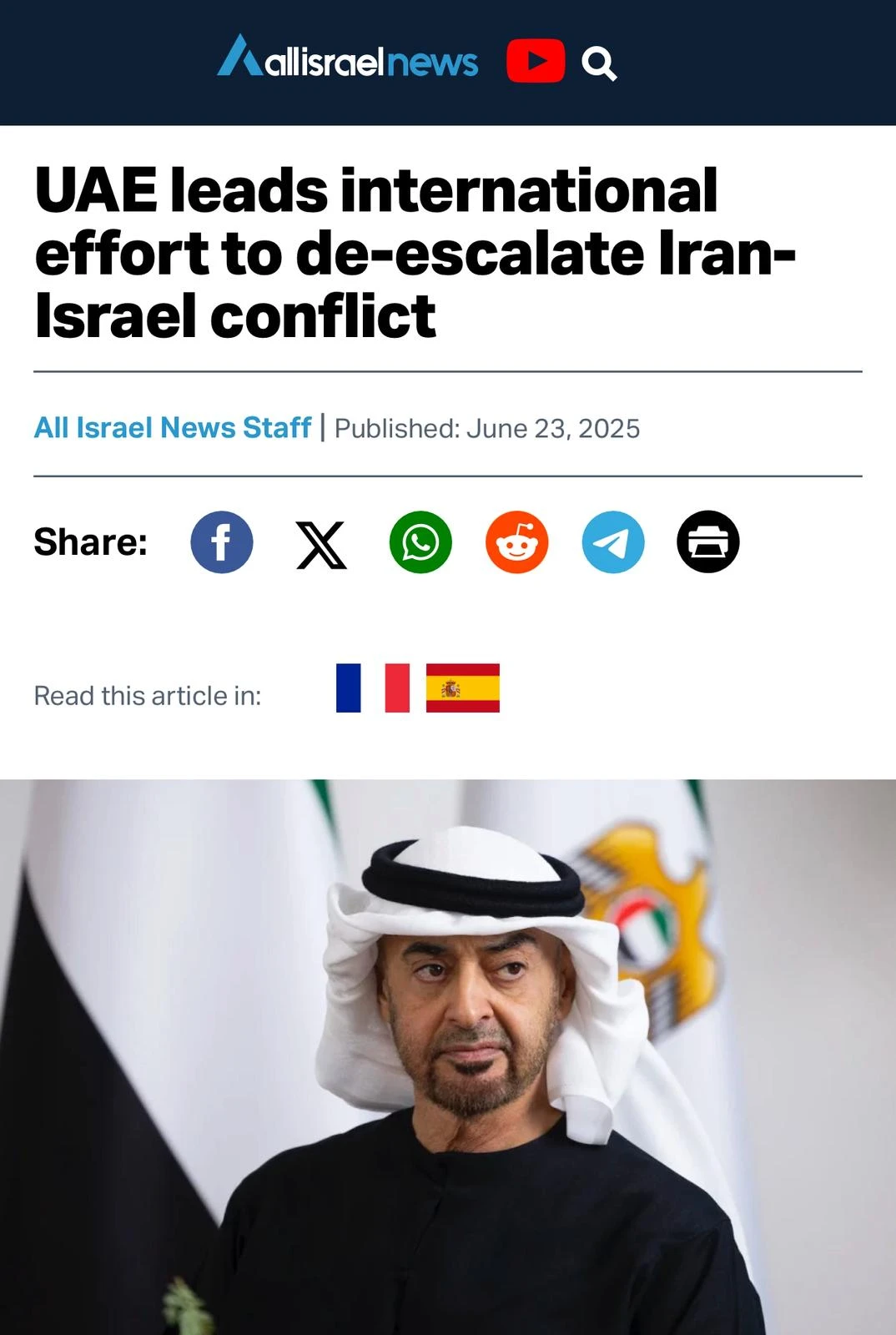
And all this comes from the bold and innovative leadership of President Mohammed bin Zayed al-Nahyan, affectionately known across the region as “MBZ.”
MBZ and his government are vehemently determined not to allow the Iranian regime – or anyone else – to blow up or destroy the Abraham Accords.
This bitter and painful war has certainly tested the Accords.
Strained them.
But definitely not broken them.
WHAT DID EVANGELICAL LEADERS HEAR IN ABU DHABI TWO YEARS BEFORE THE ABRAHAM ACCORDS?
Back in 2018, then-Crown Prince Mohammed bin Zayed invited me to bring the first-ever delegation of Evangelical leaders to Abu Dhabi to meet with him and other senior officials.
At one point in our meeting, I said, “Your Excellency, we’re praying about who is going to be the next Arab leader to make peace and normalize relations with Israel.”
MBZ shocked me and all of us by replying, “Well, Joel, it’s going to be me.”
We didn’t expect a concrete answer.
We just wanted to share with him three principles about peace that we hold because of the teachings of the Bible.
WHAT DID EVANGELICALS TELL MBZ?
First, we as Christians deeply love Israel and the Jewish people. We stand with Israel and seek to bless Israel because the Bible commands us to do so. This is a theological position – not a political one. It is non-negotiable.
Second, we love the Palestinians. We don’t know the best way to make peace between Israelis and Palestinians, but we want to be clear: we are not against them – we’re for them. We want to bless them. We want to serve and encourage them. Jesus commands us, “love your neighbor” and “love your enemies.” This is not easy, but it’s what God wants, and we want to please our Father in heaven.
Third, we pray faithfully for the peace of Jerusalem – that is, peace between Israel and all of her neighbors – just as we are commanded in Psalm 122:6.
This is what we said to him.
Though we were genuinely shocked when MBZ said he would be the next Arab leader to make peace with Israel and was looking for the right moment to do so, we were also deeply encouraged as he explained why. It was a fascinating conversation.
I detail this conversation in my non-fiction book Enemies and Allies.
And I explain that almost exactly two years later, in August 2020, MBZ did, in fact, announce – with President Donald J. Trump and Prime Minister Benjamin Netanyahu – the dawn of the era of the Abraham Accords.
Sure enough, Mohammed bin Zayed proved to be a man of his word.
IT’S TRUE THAT OCTOBER 7TH SEVERELY STRAINED THE ABRAHAM ACCORDS
True, in the days after October 7th, many Israelis thought:
“Okay, this is the beginning of a bitter, terrible war. Hamas has slaughtered our people. Now Palestinians are dying. We’re fighting with everybody in our region, it feels. This is probably going to blow up the Abraham Accords. These Arab countries aren’t going to stick with Israel. Why would they? But what else can we do? We have to defend ourselves.”
But clearly, the UAE didn’t abandon the agreement.
To the contrary, they proved deeply serious about forging a long-term, lasting, and durable peace.
They were never interested in simply signing a piece of paper and holding a ceremony or a photo op.
Make no mistake: the Emiratis are not happy with this war.
Don’t think UAE officials haven’t had criticisms of Israel – they have plenty.
Indeed, the UAE has expressed sharp criticisms of the IDF, Israel’s government, policies and Prime Minister Benjamin Netanyahu.
Obviously, they’re not the only Arab country that has had severe criticisms of Israel and her leaders – and vocalized them.
But the UAE did not break the Abraham Accords.
And this is a very big deal.
WHAT’S THE NEXT STEP IN THE TRUMP PEACE PLAN – AND WHAT ROLE DOES THE UAE WANT TO PLAY?
Once the body of the last hostage is returned to Israel in the coming days, Emirati officials believe the region will move to Phase Two of President Trump’s 20-point plan.
Phase One was about bringing all of the hostages home.
Phase Two is about:
• Demilitarizing Gaza
• De-radicalizing Gaza
• Stabilizing Gaza
• Laying the groundwork for reconstruction
Clearly, there are many critical questions to answer in the days and weeks ahead.
And I’m grateful that the Emiratis want to be at the heart of efforts to set the people of Gaza on a much better course.
The Emirati leadership does not want to see Hamas remain in power.
They do not want to see weapons in the hands of bad actors.
They want to see Palestinians liberated from the torture and tyranny of Hamas.
And they want to build upon the peace they established with Israel in 2020 – and expand the number of countries joining and participating in the Abraham Accords.
They’re under no illusions that this will be easy.
Nor am I.
But my meetings here have greatly encouraged me that this relationship is real, resilient, and worth building upon.
This article originally appeared on ALL ARAB NEWS and is reposted with permission.
You might also like to read this: