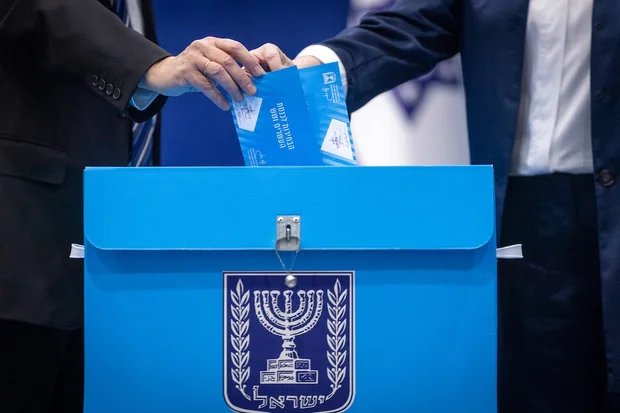
'Shocked' Eisenkot bloc scrambles to form gov't as key player Liberman rules out almost all possible coalitions
Coalition talks thrown into question by shocking revelation of Shin Bet investigation of election interference
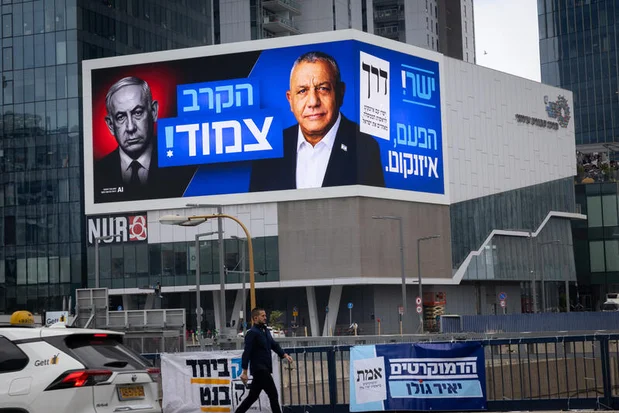
Two days after the elections and against the background of the stalemate they produced, Israel’s party leaders have begun careful maneuvering toward finding potential coalitions – though these efforts were quickly thrown into question by Thursday’s revelation that the Shin Bet is investigating potential foreign interference in the record-high Arab voter turnout.
The vote count continued with the double envelopes early on Thursday, though the results are no longer expected to shift significantly. At the time of publication, the Netanyahu bloc led Eisenkot's bloc 53-48, with Arab parties receiving a historic 19 combined seats.
This leaves no side with a viable coalition and a unity government or new elections as the most likely scenarios.
The much-discussed possibility of a minority government led by Yashar chairman Gadi Eisenkot with support from the Islamist Ra’am was already made unlikely by the bloc’s disappointing performance but rendered even more unlikely by the Shin Bet investigation.
Prime Minister Benjamin Netanyahu is widely expected to attempt to pry off a party or parts of several parties in the opposition to form a unity government under his leadership, potentially citing the ongoing tensions with Iran as a justification for breaking pre-election promises.
🇮🇱2026 Election Results Dashboard - 5.6% of Votes Remaining https://t.co/6TUGKZhymu
— Israel Elects (@israel_elects) October 29, 2026
Meanwhile, many analysts have pointed to hawkish Yisrael Beitenu leader Avigdor Liberman as a key figure whose projected seven seats could determine the chances for a unity or minority government.
However, following the revelation of the Shin Bet’s bombshell investigation on Thursday, he doubled down on his pre-election promises.
“We will not sit with Bibi or with Tibi,” he said, mimicking a popular Likud slogan. However, he only mentioned Ahmad Tibi, leader of the Joint List’s Balad faction, ostensibly leaving open the possibility of some arrangement with the Islamist Ra’am party.
In a follow-up statement, he effectively ruled out any viable coalition that is currently seen as possible, indicating he wants new elections.
"Everything I said before the election remains true afterward. We will not sit with Bibi or Tibi, not with [Haredi leaders] Goldknopf or Deri, not with [Ra'am MK] Yasser Hujirat or the other supporters of terror, neither directly nor indirectly," Liberman said.
"The only coalition that makes sense is a complex coalition, but one made up exclusively of Zionist parties, with the entire Likud party included, but without Bibi [Netanyahu]. The first decision of the next government must be to establish a state commission of inquiry, and the first law must be a universal conscription law. A coalition in which these two items are not front and center from the outset is irrelevant to us."
🇮🇱Preliminary Knesset Results - by Bloc (94.4% counted) 🔵Netanyahu Bloc: 53 🔴Opposition Bloc: 48 🟢Arab Parties: 19 https://t.co/3g22BVWEq6
— Israel Elects (@israel_elects) October 29, 2026
Meanwhile, the self-declared “Change Bloc” appears to be in shambles after its surprisingly weak performance. Channel 12 reported that senior officials in the bloc were left “shocked” and “speechless” at the results on Wednesday.
“There couldn’t have been a worse result for us. All our options are abysmal. For all of them we would have to pay a large price, in addition to the price we already paid,” one official told the channel.
Shortly before the first exit polls were published, officials in the bloc had told Walla that the election was a once in a lifetime opportunity to replace Netanyahu.
“All the stars aligned in this election campaign," the source told Walla. “After October 7, with the haredi issue that hurt the right-wing parties and shifted voters away from them, we managed to create a united bloc of people from the Right, the Center and the Left. Four tightly knit parties, with surplus-vote agreements, while the Right failed to get organized and wasted votes.”
“We brought people from abroad especially to vote; we made an enormous effort to reach maximum voter turnout; we activated all the systems. Now we need to form a government… Whoever needs to break promises, let him break them; whoever needs to swallow his pride, let him swallow it. There's no choice. It's now or never,” the source said.
Yashar leader Eisenkot, whose party came in second place with only 21 seats, said he had spent Wednesday with “meetings, conversations, and preparations to ensure the will of the voters is carried out,” in a first statement since the elections.
He sounded a defiant note, vowing to strive for a government that would replace Netanyahu, despite the disappointing results.
“We are focused on the heavy task entrusted to us: bringing change to Israel and forming a Zionist government that enforces military conscription. This is the will of the people, who expressed no confidence in the government of October 7 and draft evasion, and in the draft-dodging bloc as a whole,” he argued.
According to Channel 12, Liberman largely cut off contact with his colleagues in the Change Bloc and dodged calls from Eisenkot and Together (Beyachad) chairman Naftali Bennett.
Liberman is skeptical about a reported plan to replace Knesset Speaker Amir Ohana and start legislating laws before forming a government.
Sources close to Liberman say he is “choosing to lie in wait” for now, preferring to observe developments in the tense situation with Iran that could open more opportunities for realignment.
On the other side, Channel 14 News reported Wednesday evening that Netanyahu, who hasn’t addressed the public since his speech on Tuesday, attempted to reassure his far-right partners, Jewish Power’s Itamar Ben Gvir and Religious Zionism/Zehut leader Bezalel Smotrich, amid reports the U.S. pushes for a unity government without their participation.
“We are together and we are staying together,” Netanyahu reportedly told them. He also planned to speak with the leaders of the ultra-Orthodox parties later.
The premier was also due to speak with the leaders of the Haredi parties, United Torah Judaism and Shas, later, according to the reports.
Shas’ disappointing performance has triggered serious tensions within its leadership. Channel 13 reported that Rabbi Yitzhak Yosef, who is seen as leaning toward cooperation with the Eisenkot bloc, is trying to take over the party and oust its leader, Aryeh Deri, who is seen as a close confidant of Netanyahu.
Deri reportedly hasn’t left his home since the election. Shas fell from 11 to only seven seats.
However, Channel 12 reported that figures in Netanyahu’s bloc had also reached out to lawmakers from the Arab Ra’am and Joint List to inquire about their positions on laws a minority government could potentially legislate to harm Netanyahu before a repeat election.

Please take a moment and join others who are praying for Israel at this very moment by adding your light on the live prayer map with a simple click at prayforisrael.live.
Popular article:

interview Easter message of resurrection hope amid war at Jerusalem's Garden Tomb

biblical commentary Let my people go: a Passover message for today

4 IDF soldiers killed, 2 wounded in fighting in southern Lebanon, as Israel eliminates dozens of Hezbollah terrorists

Receive latest news & updates
A message from All Israel News
Help us educate Christians on a daily basis about what is happening in Israel & the Middle East and why it matters.
For as little as $10, you can support ALL ISRAEL NEWS, a non-profit media organization that is supported by readers like you.
Latest articles:

Restored biblical-era fortress opens to visitors in Israel's Guvrin Forest

NYPD reopens bidding for Israeli surveillance technology after pressure from Mamdani allies

Tel Aviv approves plan to add 14,000 apartments as immigration interest grows
Shin Bet to investigate suspicions of bribery and foreign interference in Israeli elections
'We will cut out your tongue': Gazan teacher was threatened after questioning anti-Jewish education in UNWRA school