Poll reveals 89% of Arab world opposes Israel normalization amid ongoing Hamas war
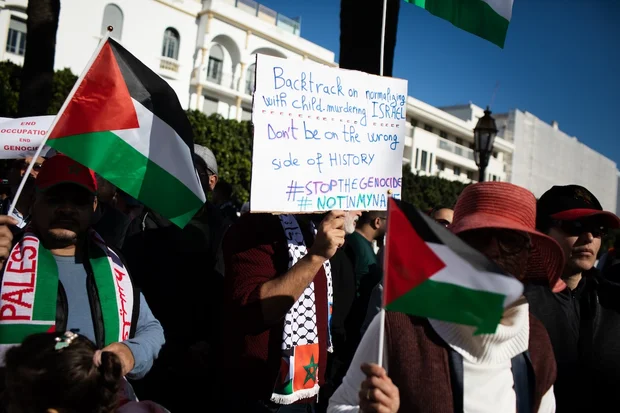
A large majority in the Arab world are opposed to normalizing ties with Israel, according to a fresh poll that surveyed roughly 8,000 individuals across 16 Arab states since Oct. 7.
A whopping 89% of the respondents reportedly said they are opposed to, or at least very skeptical of, normalizing relations with Israel, according to the poll conducted by the Arab Center in Washington, D.C. (ACW), in collaboration with the Arab Center for Research and Policy Studies (ACRPS)
The survey was conducted following the Hamas terror organization's massacre of Israel's southern border communities on Oct. 7 and the ongoing war in the Gaza Strip.
“As people in the Arab world watched Israel’s devastating war on Gaza, with the full support of the United States, we sought to conduct a survey to gauge our public opinion of the war, and of the U.S. position towards the war, and its impact on U.S. policies, interests and relations in the region,” said Tamara Kharroub, deputy executive director and senior fellow at the ACW. Kharroub did not mention that Hamas initiated the war with its surprise invasion and brutal attack of Israeli and foreign civilians, including women, children and elderly.
The new poll further suggests that opposition to normalizing ties with Israel is particularly on the rise in Arab states that have either established or are in the process of formalizing ties with the Jewish state.
In Morocco, a country that signed an Abraham Accords peace agreement with Israel in 2020, some 78% of the surveyed individuals now oppose relations with Israel, compared to 67% in 2022.
In Sudan, another state that formalized its ties with Jerusalem in 2020, opposition to relations with Israel increased from 72% to 81%.
In addition, Egypt and Jordan, the first Arab states to sign peace agreements with Israel, in 1979 and 1994 respectively, also reported an increase in opposition to normalized relations with the Jewish state.
In Saudi Arabia, the recent survey indicated that nearly 7 out of 10 (68%) oppose the normalization of relations with Israel. This marks a significant shift from 2022, when only 38% expressed opposition, representing almost a doubling in the level of opposition.
In Saudi Arabia, a recent survey indicates that nearly 7 out of 10 respondents (68%) oppose the normalization of relations with Israel. This marks a significant shift from 2022, where the opposition stood at just 38%.
The poll reinforces the notion of a wide gap in perceptions toward Israel within the Arab world and between governments and their citizens.
Last month, Saudi Ambassador to the United Kingdom Khalid bin Bandar Al Saud told the BBC network that Saudi Arabia is still interested in normalizing ties with Israel.
“Absolutely, there’s interest, there’s been interest since 1982 and before, Al Saud said.
However, the Saudi envoy stressed that the normalization of relations with Israel hinges on the implementation of the two-state solution.
Popular article:

interview Easter message of resurrection hope amid war at Jerusalem's Garden Tomb

biblical commentary Let my people go: a Passover message for today

4 IDF soldiers killed, 2 wounded in fighting in southern Lebanon, as Israel eliminates dozens of Hezbollah terrorists

Receive latest news & updates
A message from All Israel News
Help us educate Christians on a daily basis about what is happening in Israel & the Middle East and why it matters.
For as little as $10, you can support ALL ISRAEL NEWS, a non-profit media organization that is supported by readers like you.
Latest articles:

editorial Evangelical Christians, please vote: The future of the US-Israel alliance is on the line
Breaking silence, Liberman annouces he will support Eisenkot for PM, Lapid for Knesset speaker
Israel's Christian ambassador warns against support for Muslim Brotherhood candidates
Eisenkot slams Likud for ‘malicious attempt to deny election results’ amid foreign interference probe

Maronite community forgives vandals who targeted historic church in Nahariya