New estimate suggests as many as 12,000 Iranians have been murdered by regime so far, as protests continue to rage
Killing operation approved by Khamenei and three gov't branches, according to Iran International





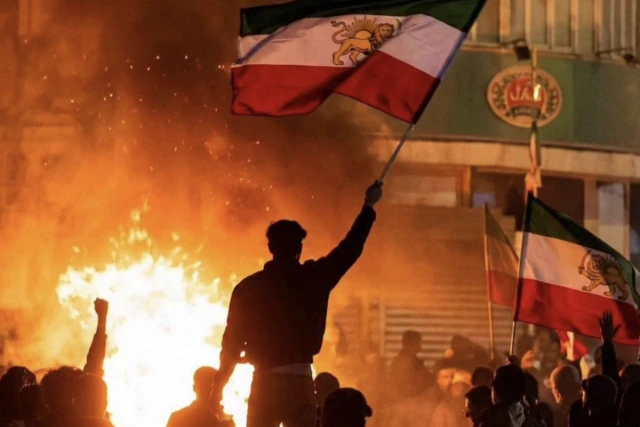
Iranians continued to protest and revolt against the regime across the country on Tuesday, despite a bloody crackdown and a broad information blackout implemented by regime forces days ago.
On Tuesday, an Iranian official confirmed to Reuters that at least 2,000 people have been killed so far but blamed this on “terrorists,” in the first official information about the protests’ death toll so far.
Human rights groups based outside the country have confirmed tolls as high as around 650 dead.
However, the Norway-based group Iran Human Rights (IHR) said that estimates put the death toll at around 6,000.
The opposition-aligned outlet Iran International on Tuesday published an editorial arguing that regime forces had killed at least 12,000 people “in the largest killing in Iran’s contemporary history – carried out largely over two consecutive nights, Thursday and Friday, January 8 and 9.”
The outlet said this number was based on the review of “information received from a source close to the Supreme National Security Council; two sources in the presidential office; accounts from several sources within the Islamic Revolutionary Guard Corps in the cities of Mashhad, Kermanshah, and Isfahan; testimonies from eyewitnesses and families of those killed; field reports; data linked to medical centers; and information provided by doctors and nurses in various cities.”
Geolocation of this video of Iranian protestors clash with security forces in the city of Urmia in West Azerbaijan province.
— Mehdi H. (@mhmiranusa) January 13, 2026
37.5457, 45.0670 @GeoConfirmedhttps://t.co/ej6TA8T0RB pic.twitter.com/76o6kNN0TH
The massive number of deaths was reportedly caused mainly by forces of the IRGC and its affiliated volunteer militia, Basij, through a “fully organized” operation.
Iran International cited information from the Supreme National Security Council and the presidential office indicating that the mass murder was carried out “on the direct order of Ali Khamenei, with the explicit knowledge and approval of the heads of all three branches of government, and with an order for live fire issued by the Supreme National Security Council.”
“Under a communications blockade and without direct access to information, confirming a final figure will require further, detailed documentation. Experience in recent years shows that security institutions have consistently withheld information and avoided recording and announcing accurate figures for those killed,” the outlet noted.
Despite this unprecedented killing, Iranians continued to gather across the country into Tuesday.
Exiled Prince Reza Pahlavi said thousands of military and police personnel had not shown up for work to avoid taking part in the crackdown on protesters, in a video message posted on social media. pic.twitter.com/qz8NK5HHxS
— Iran International English (@IranIntl_En) January 13, 2026
Exiled Crown Prince Reza Pahlavi, one of the most important opposition voices, claimed in a post on 𝕏 that thousands of military and police personnel had refused to take part in the crackdown in recent days.
“Because of your steadfastness and resistance, thousands of military and police personnel have not shown up for work so they would not have to take part in the repression,” Pahlavi said.
“The regime, through severe repression, killing, and cutting off communications, is trying to instill fear and terror in you, and to make you despair of continuing the movement and struggle,” he added, calling on communication specialists to “Target the regime's information infrastructure so that our compatriots' connection with the world can be restored again.”
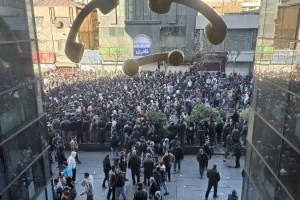
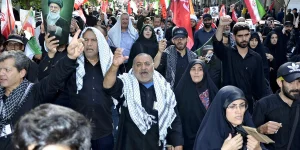
On Monday, the regime distributed footage from large pro-government rallies in several cities, including the capital Tehran, in an effort to counter the ongoing protests.
State television covering the rallies echoed the regime line that the anti-regime protesters were being incited by “foreign” actors and “armed terrorists.” It also showed crowds chanting the regime’s infamous chorus of “Death to America!” and “Death to Israel!”
Others shouted, “Death to the enemies of God.” Iran’s attorney general warned this week that Iranians arrested during the protests would be charged with being an “enemy of God,” which is an official offense in the Islamic Republic’s law code with the possibility of a death penalty.
📹 شکوه حضور مردم تهران در میدان انقلاب
— خبرگزاری تسنیم 🇮🇷 (@Tasnimnews_Fa) January 12, 2026
pic.twitter.com/WULl0RJPnT
The U.S.-based HRANA (Human Rights Activists News Agency) has reported that at least 10,700 people were arrested during protests over the last two weeks. It also said that some 130 of those killed were security force members.
Meanwhile, authorities have continued to enforce an information blackout, trying to counter temporary holes in the blanket shutdown in place since January 8 by going house-to-house to confiscate satellite dishes.
Eyewitnesses who were able to speak to the Associated Press (AP) said security forces were raiding buildings with satellite dishes in northern Tehran as part of a crackdown on secret Starlink terminals, which had enabled some internet connectivity in recent days.
100 hours. pic.twitter.com/m8kw6ilZDO
— NetBlocks (@netblocks) January 12, 2026
According to the AP, several people in Tehran managed to call its bureau on Tuesday for the first time in days, describing some of the scenes in the capital, where the regime has tried to uphold a semblance of daily life by forcing shopkeepers to open.
“Witnesses described a heavy security presence in central Tehran, burned-out government buildings, smashed ATMs and (only a) few passersby,” according to AP.
They said heavily armed anti-riot officers stood at major intersections, while Basij members armed with guns and batons, as well as plainclothes officials were also present.
Protesters had burned several banks and government offices, witnesses said, confirming some of the footage that was seen in recent days.
On Tuesday, security forces forced shopkeepers in Tehran’s Grand Bazaar, the scene of some of the first protests at the end of December, to open their stalls, according to one witness.
You might also like to read this: