Knesset hearing reveals 1,240 aircrew members from countries without diplomatic ties entered Israel in past year



A Knesset security hearing on Tuesday revealed that approximately 1,240 aircrew members from countries that do not have diplomatic relations with Israel entered the country over the past year, including citizens of Syria, Lebanon and Oman.
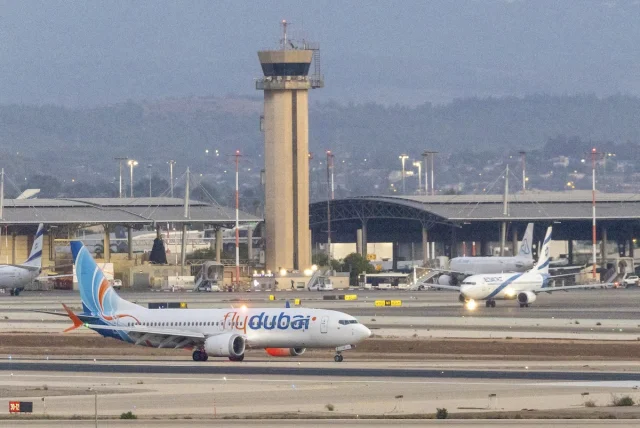
The figure emerged during a closed-door meeting of the Knesset Foreign Affairs and Defense Committee’s Subcommittee for Intelligence and Secret Services, which was convened following last week’s attempted hijacking of flydubai flight 1073 en route from Dubai to Tel Aviv. The Omani co-pilot, Hamam al-Hammami, reportedly attacked the flight captain, Smit Machchhar, stabbing him with an axe, and attempted to take control of the aircraft before passengers and crew subdued him. UAE authorities have conducted an investigation and described the incident as a terrorist attack.
The disclosure has prompted discussions about additional screening of foreign aircrew and passengers arriving in Israel, particularly those holding passports from countries that do not maintain diplomatic relations with the Jewish state.
During the deliberations, it was proposed that Israel's National Security Council (NSC), in cooperation with the Mossad and Shin Bet intelligence agencies, compile a list of countries considered high-security threats. Airlines operating flights from those destinations would then be required to submit the names and nationalities of passengers and aircrew to Israeli security authorities 48 hours before departure for review and approval. Another layer of screening would involve the Population and Immigration Authority (PIBA) providing the Transportation Ministry’s Security Division with lists of passengers and aircrew members holding passports from countries that do not maintain diplomatic relations with Israel.
Transportation Minister Miri Regev has separately submitted an urgent request to NSC head Shmuel Ben Ezra for “immediate measures” to prevent a recurrence of the circumstances surrounding the attempted hijacking. Regev said the measures should remain in place until the investigation into the incident is completed.
“Several proposed measures have been raised at the Transportation Ministry, but since the authority does not lie with the ministry, I am asking you to instruct the relevant ministries,” Regev wrote.
Among the measures proposed by Regev is the creation of a one-time aviation visa procedure or another document acceptable to the PIBA, for all passengers and aircrew arriving in Israel on foreign or Israeli airlines, including charter flights.
Under the proposal, the document would be completed 48 hours before departure and approved by the PIBA. Implementation would begin Sunday, with responsibility assigned to the Interior Ministry and PIBA authorities.
Regev also proposed obtaining a list of destinations considered to pose a security threat from the Mossad (foreign) and Shin Bet (domestic) security agencies. Airlines operating flights from those destinations would provide the names of passengers and aircrew to the Transportation Ministry’s Security Division 48 hours before departure. The division would then forward the information to the Mossad or Shin Bet for approval before the flight. The intelligence agencies would be responsible for providing the list of high-security-risk destinations, while the NSC chief would determine which agency would receive the passenger and crew manifests for review.
The Transportation Ministry’s Security Division would then issue the directive to airlines operating flights to Israel, with implementation scheduled to begin Sunday.
The recommendations follow instructions issued by the Security Cabinet earlier this week as the government examines the circumstances that allowed al-Hammami, an Omani national, to serve as co-pilot on a flight to Israel despite Oman and Israel having no diplomatic relations. Israel has come under scrutiny over how foreign airline crews are vetted, with reports indicating that information about the nationalities of foreign crew members was available to Israeli authorities but that questions remain over how it was reviewed.
Regev has also met this week with representatives in the United Arab Emirates in an effort to ensure that Israeli security concerns are addressed.
Shin Bet has participated in the UAE investigation into al-Hammami. According to Israeli reports, the co-pilot told interrogators that he had planned the attack in advance and was motivated by a desire to retaliate against Israel over its war against Hamas in Gaza. Reports have also indicated that investigators believe he had formulated plans to attack a flight bound for Israel before joining flydubai.The investigation remains ongoing.
You might also like to read this: