‘It’s a marathon’: Israel confronts lasting trauma 3 years after Oct 7


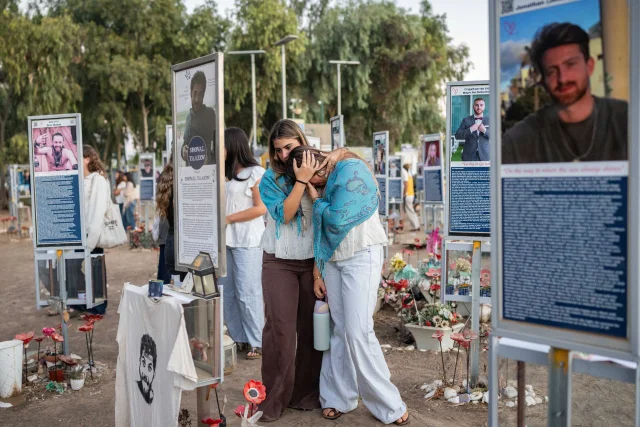
Almost three years after the Oct. 7, 2023, Hamas-led terror attack, Israel is fighting a battle that cannot be measured: the long-term psychological impact of the trauma that Israelis and all who were in the land faced that day.
For Talia Levanon, CEO of the Israel Trauma Coalition (ITC), the challenge is not focusing on and treating Israelis who develop post-traumatic stress disorder (PTSD). It is helping an entire society learn to live with vulnerability while continuing to function and providing them the tools to cope.
“We feel vulnerable…even more so than we did on the 7th of October, but on the other hand we’re doing our best to cope and, in many ways, doing well with coping,” Levanon said.
Levanon has worked with terror-related trauma since the Second Intifada began in 2001. She said the psychological effects of terrorism are very different from mental-health challenges that arise under ordinary circumstances.
“What we do is terror-related trauma, which is different than mental health trauma,” she said.
The distinction is important as Israel approaches the third anniversary of Oct. 7, when Hamas terrorists killed some 1,200 people and abducted 251 others into Gaza, triggering a massive multi-front war and years of repeated exposure to rocket and missile attacks, military mobilization, displacement of border community members, loss and uncertainty.
A nationwide prospective study published in the journal Molecular Psychiatry found that the percentage of Israeli adults screening positive for probable PTSD nearly doubled in the weeks following the attack, rising from 16.2% before Oct. 7 to 29.8% five to six weeks afterward.
Probable depression increased from 31.3% to 44.8%, while probable generalized anxiety disorder increased from 24.9% to 42.7%. The study followed 710 Israeli adults and included measurements taken before the attack, providing researchers with a rare baseline for comparison.
More recent research suggests that some of that acute distress has eased over time, but has not simply disappeared.
A six-wave prospective study published in 2026 followed 680 Israeli adults from before the Oct. 7 attack through 27 months afterward. It found that the proportion screening positive for probable PTSD rose from 16.1% before the attack to 29.8% one month afterward, before gradually declining to 19.7% at the final measurement.
Probable depression similarly rose from 30.5% to 43.1% before declining to 23.3%, while anxiety increased from 22.1% to 40.1% before reaching 21%. The researchers described the pattern as long-term adaptation characterized by both stabilization of symptoms and increasing post-traumatic growth.
Levanon cautions against assuming that everyone experiencing trauma symptoms will develop PTSD.
“For PTSD, you have people with symptoms and people without symptoms; 85% will heal spontaneously, others will need some help,” she said.
“There’s a continuum. Trauma can be dormant and then pop out spontaneously. There’s a lot of work to be done on this continuum,” she said.
The Israeli State Comptroller found significant levels of psychological distress six months after the attack. In an April 2024 survey of 1,010 Israeli adults, 34% reported moderate-to-severe post-traumatic symptoms, 32% reported moderate-to-severe depressive symptoms and 21% reported moderate-to-severe anxiety symptoms. About 38% reported moderate-to-severe symptoms of at least one of the three.
Those figures describe symptoms, however, and should not be interpreted as millions of Israelis having clinically diagnosed PTSD.
The State Comptroller also found a significant gap between psychological need and treatment. About 90% of survey participants had not sought psychological treatment at the time of the survey. Among the reasons cited was the length of the wait for appointments through Israel’s health maintenance organizations, which averaged about six and a half months.
For Levanon, the answer is not to put every Israeli into therapy.
“We’re concerned with the issue of direct care. Everyone in Israel doesn’t need therapy but everyone needs to understand how to cope,” she said.
That philosophy is what has shaped the ITC's work since long before Oct. 7. The organization was founded in 2001 and helped develop Israel’s resilience-center model, which was established in 2005 and is designed to provide support before, during and after emergencies.
There is a three-tiered approach. The centers combine clinical care, community resilience and emergency preparedness. When Oct. 7 struck, that infrastructure was put to its greatest test.
“Before Oct. 7, we built a network to go from routine care to emergency response and back and forth,” Levanon said. She pointed out that although the country was caught off guard that October day, they were prepared to step in immediately.
According to Levanon, the ITC went from working with five centers on Oct. 6 to more than 300 locations immediately following the attack. Its network expanded from 210 therapists to 1,300 within two weeks.
"On Oct. 15, the coalition established a center serving people evacuated from the southern communities, which totaled approximately 19,000 people and another 2,300 survivors of the Nova music festival massacre," she said.
The organization has since expanded its work to universities, establishing 22 resilience centers on various campuses throughout Israel.
“Our work is done before, during, and after emergencies. We’re always working in this state of mind: before, during, and after,” Levanon said.
That long-term approach is increasingly important because Oct. 7 was not a single traumatic event followed by a return to normal life. Israelis have spent nearly three years coping with what Levanon describes as a “shared reality.”
“Anger and uncertainty. Being exposed to trauma. It’s a marathon. It’s a battle against the impact of exposure,” she said.
The psychological burden can be especially complicated for people who have experienced repeated trauma. Someone may cope successfully after one event, only to find that symptoms emerge after another period of intense stress.
“They cope again and again and again. It can build both resilience and vulnerability,” Levanon said.
The ITC therefore focuses heavily on identifying strengths rather than defining people by their trauma.
“Our approach is that every person has strength. The role of the therapist is helping every person heal by helping him find his or her strength,” Levanon said.
The organization is also concerned about what prolonged exposure to trauma could mean for future generations.
“Early childhood, Arab society, how will we pass this to the next generations? They’ll be ill-prepared to cope,” Levanon said.
The concern comes as Israel continues to see thousands of people formally recognized for psychological injuries. The National Insurance Institute reported in 2026 that 34,449 Israeli civilians were recognized as having a mental disability related to hostile actions, although that administrative category is not synonymous with PTSD.
Levanon said her greatest concern is whether Israel will have enough resources to meet the need as trauma continues to come to the surface for many people.
“My main concern is that we won’t be able to provide enough trauma care when needed,” she said.
As Israel approaches the third anniversary of the terror attack, Levanon does not describe Israel as a society that has simply recovered from trauma. Rather, she sees a nation learning to carry it.
The ITC's goal, she said, is not to pretend vulnerability no longer exists, but rather it is to recognize that vulnerability – and know how to cope with it.
The National Resilience Center can be reached within Israel by dialing *5486. Callers can speak with a therapist who can assess their needs and direct them to appropriate care. The service is free of charge.

Please take a moment to join believers worldwide praying for Israel right now. Add your light to the live prayer map—and show the world one more watchman praying for the peace of Jerusalem.
You might also like to read this: