Israeli NGO published photo book documenting Palestinian architecture ‘under Occupation’
‘Real Estate Under Occupation’ presents counter-evidence to narrative of oppression, privation


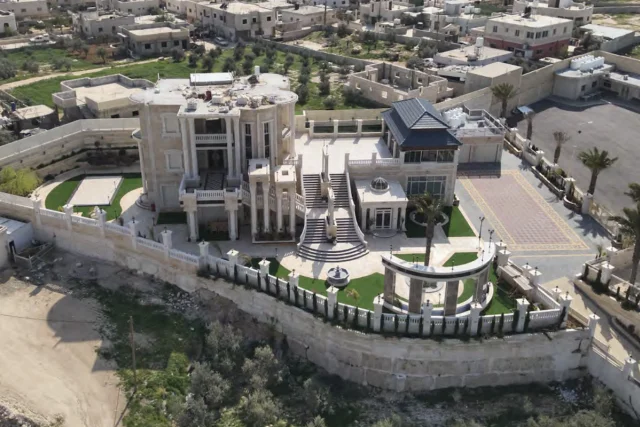
Israeli NGO Regavim, an organization dedicated to land-use policy in Israel and the disputed territories of Judea and Samaria, recently published a photo book depicting 100 Palestinian residences across Judea and Samaria that challenge narratives of Israeli oppression.
The digital photo book, titled Real Estate Under Occupation, depicts mansions, villas and estates that demonstrate a high level of wealth and opulence: sweeping marble staircases, large swimming pools, fountains, and multi-story residences, often on large, well-manicured properties.
“We have attempted to highlight the architectural elements that express the national aspirations of the oppressed people of Palestine, the design elements that reflect the harsh realities they contend with on a daily basis, and the structural elements that express the determination of a people whose wealth has been plundered and whose land has been stolen by the occupation,” Regavim says in the introduction to the photo book.
“In the pages that follow, we offer a glimpse into the reality experienced by Palestinians of the Occupied West Bank as reflected in their homes across the old-new territory,” the introduction continues. “Every brick tells the story of their oppression; every stairway speaks of their striving to rise above the cruelty of life under occupation, every courtyard echoes the aspiration to live free and to prosper.”
In Judea, near Hebron, a palatial residence of 1,100 square meters (approximately 3,610 square feet) stands three stories tall at the top of a hill, offering a commanding view of the surrounding territory.
A sweeping marble staircase leads from the entrance level up to the patio, which connects the primary three-story residence with a smaller, two-story guest lodging. Large columns form the residence's dominant architectural motif. The estate is complemented by a well-manicured lawn, a fountain, gardens, a pavilion, and a two-car covered garage, all enclosed by a well-lit perimeter wall.
Not too far away, also in the Hebron area, another three-story residence presents a more humble appearance, with fewer columns, topped by decorative arches, leading into the main entrance of the 770-square-meter (approximately 2,525 square feet) residence, which sits atop a raised platform, surrounded by gardens and a well-lit perimeter wall.
Moving north into the Binyamin region of Samaria, a massive multi-story residence dominates the side of a hill in the Palestinian town of Shukkba.
The colossal 4,800-square-meter (approximately 15,750 square feet) residence, with at least four stories, overlooks pastoral scenes of olive groves. Decorated with tall columns, semi-circular balconies, and sweeping staircases, the residence sits within a symmetrical property with a large swimming pool, bookended by covered pavilions.
The property also provides covered private parking, surrounded by a terraced perimeter wall.
A little further north, stands a relatively austere, modernist four-story villa in the Palestinian town of Mas-ha, in Samaria.
The 950-square-meter (approximately 3,250 square feet) structure, which is dominated by clean, straight-line elements, offers multiple balconies and patios overlooking terraced olive groves.
The property also includes a covered parking garage, a spacious paved courtyard, a guest pavilion, and natural landscaping, inside a perimeter wall.
The photo book also includes several properties still under construction, many of which hint at a level of opulence rarely seen even in the wealthiest Israeli neighborhoods.
According to Regavim, multiple teams photographed all the properties in a single day earlier this year.
Regavim said the photos “speak volumes about near-impossible living conditions, the extreme want, the paucity of resources and of hardship endured with humility. Every image is a cry against cruelty, dispossession, poverty and the yoke of occupation that is evident everywhere in the West Bank.”
“The crafting of living conditions under the shadow of repressive occupation is no small feat, but despite the unspeakable hardships of occupation, the ever-accelerating rate of displacement and the severe hardships they face, the Palestinians of the West Bank are practicing Sumud - steadfastness – in ways that have never before been seen,” it added.
You might also like to read this: