Israel wary of warming Egypt-Turkey relations, as Pakistan-led Sunni axis takes shape following Iran conflict





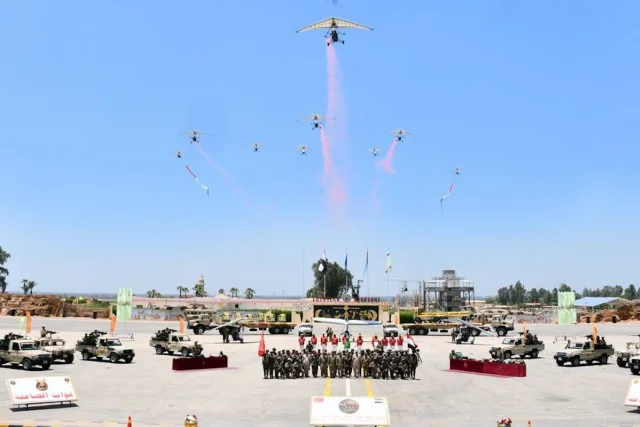
Egypt and Turkey hosted a joint military exercise named “Golden Eagle,” Saudi news agency A-Sharq Al-Awsat reported earlier this month.
The drill focused on fending off drone attacks and conducting live fire in unconventional scenarios. Fighters from the Egyptian Army’s Paratroopers and Commando units conducted the exercises alongside Turkish special forces, which also included counter-terrorism exercises.
The “Golden Eagle” exercise comes amid growing military cooperation between Egypt and Turkey, following the signing of a framework agreement for military cooperation during Turkish President Recep Tayyip Erdoğan’s visit to Cairo in February.
The exercise also comes after Egypt’s commander-in-chief of the armed forces and minister of defense and military production, Ashraf Salem Zaher, met Turkish Defense Minister Yaşar Güler in Turkey in mid July. According to Turkish reports, Zaher expressed interest in joining Turkey’s KAAN, fifth-generation jet fighter program during the visit.
Alongside the joint exercise with Turkey, Egypt also held a series of operational meetings with the Pakistani Navy, signaling that Cairo is expanding its military cooperation with Pakistan.
The move mirrors neighboring Saudi Arabia, which signed a strategic mutual defense pact with Pakistan in September 2025.
With increased instability in the region, demonstrated by the recent drone attack on a gas tanker at an Egyptian port, Egypt appears to be seeking its own defense agreement.
Cairo and Ankara have experienced a dramatic warming in relations after more than a decade of strained ties following the 2013 ouster of Egyptian President Mohamed Morsi, a Muslim Brotherhood leader backed by Turkish President Recep Tayyip Erdoğan.
In the aftermath, Erdoğan granted asylum and support to members of the Egyptian opposition, a move Cairo viewed as a threat to its national security.
However, since President Erdoğan’s visit to Cairo in February and the signing of the military framework agreement, there has been a significant acceleration in security cooperation.
Egyptian F-16 pilots participated in the “Anatolian Eagle 2026” aerial exercise, in which the Egyptian F-16s flew alongside Turkish and Azerbaijani aircraft. Just one week later, Turkish special forces came to Egypt for the “Golden Eagle” exercises.
The restoration of relations stems from a mutual understanding that the new regional uncertainty requires cooperation between friendly Middle Eastern states.
However, for Israeli observers, the increasingly hostile political line expressed by Turkish leaders toward Israel, alongside repeated warnings against expansion of Israeli regional influence, has raised alarm.
While Egypt has a peace treaty and security cooperation with Israel, Israeli leaders do not trust their southern neighbor, whose military leaders have also made hostile statements regarding the Jewish State.
According to the Jerusalem Center for Security and Foreign Affairs (JCFA), Egypt has informed U.S. officials that expanding cooperation with Ankara and Islamabad does not indicate an anti-Israel axis.
The Egyptian government explained the cooperation as an attempt to diversify its strategic partnerships and reduce dependence on any single actor, namely the United States.
The joint military exercises, security agreements, and meetings between Egypt, Turkey, and Pakistan come as Turkey has been expanding its own strategic military reach, signing or extending agreements with Sudan, Iraq, Saudi Arabia, the United Arab Emirates, and Libya over the past three years, alongside Egypt.
Egypt, meanwhile, hopes that Turkey can help it not only with defense capabilities, a growing market for Turkey, but in its dispute with Sudan over water rights and projects affecting the Nile River, on which Egypt is dependent.
The joint exercises and defense agreements appear to be part of a move towards a new Sunni axis, sometimes referred to as the Sunni NATO, meant to rebalance the region should the regime in Tehran collapse as a result of the U.S.-Israeli operations in Iran.
Meanwhile, the deepening military relationship between Turkey and Egypt has caused concern in Israel and Greece, both of which view Turkey’s strategic regional ambitions with considerable alarm.
The increased cooperation has also reportedly drawn the attention of the United States, according to the Jordanian news website Rai Al-Youm.
Citing diplomatic sources familiar with the matter, the outlet claimed in June that U.S. Secretary of State Marco Rubio sent a memo to the U.S. embassies in Ankara and Cairo requesting information on consultations between senior Turkish and Egyptian military officers.
The website claimed the U.S. was concerned about the development of a new pact which could potentially signal a “joint Arab-Islamic military alliance,” possibly including Pakistan and Saudi Arabia.
Israeli defense officials still regard the peace treaty and security cooperation with Egypt as a crucial strategic asset.
For that reason, they watch improving relations between Egypt and Turkey with caution, especially given Erdoğan’s hostile rhetoric towards Israel, and statements by Turkish officials pointing to a possible future conflict with Israel.
Pakistan's participation is another worrying sign. Pakistan is a nuclear-armed Islamic country with a well-developed military.
Turkish officials have even called for a defense pact with Pakistan, specifically due to its status as a nuclear power.
Growing ties between the three could lay the groundwork for broader security cooperation in the future, including a mutual defense pact.
However, Major General Dr. Sayed Ghoneim, a Fellow at the Academy of Military Higher Studies and Strategy, and President of the Institute for Global Security and Defense Affairs, told the Arab Defense Website that military relations between states do not transition directly into alliances.
He told the website that joint military exercises do not necessarily imply the existence of a common enemy or preparation for a military alliance.
Ghoneim cautioned against linking these exercises to circulating talk about forming a new regional axis or military alliance, but acknowledged Israeli and Greek concerns.
At the same time, an article by The Jerusalem Post’s Yonah Jeremy Bob highlighted the belief among senior Israel Navy officers that outstanding differences between Egypt and Turkey in Libya and the eastern Mediterranean could work in Israel’s favor.
Shortly after coming to power, Egypt’s el-Sisi signed a strategic partnership with Greece and Cyprus, aimed at maintaining Egyptian maritime rights and borders in light of expansionist Turkish practices in the Mediterranean.
Israel is also not standing by idly. It has been strengthening its strategic alliance with Greece and Cyprus, hosting a trilateral summit in late December, and recently inking an air defense deal with Greece, based on its own air defense systems.
Israel remains cautious, however, not wishing to take steps which could provoke a direct confrontation with Turkey, amid its ongoing unresolved conflicts with Iran and its proxies.
Currently, Israeli defense officials assess that Egypt and Turkey are taking steps to prepare for a new regional reality characterized by declining Iranian influence, uncertainty regarding American commitment, and growing uncertainty regarding trade routes and energy resources.
That said, several Israeli officials have already identified Turkey as Israel’s next major security concern, following the weakening of the Iranian threat.
Both former Prime Minister Naftali Bennett and Diaspora Affairs Minister Amichai Chikli have warned of the growing Turkish threat.
“A new Turkish threat is emerging,” Bennett said earlier this year. “Turkey and Qatar have gained influence in Syria, are seeking to influence elsewhere and everywhere throughout the region.”
“And from here I warn: Turkey is the new Iran,” Bennett added. “Erdoğan is sophisticated, dangerous, and he seeks to encircle Israel.”
Last month, Minister Chikli said that Turkey and Syria are "far more concerning than Iran,” while warning of a Muslim Brotherhood axis.
“The new axis is the Muslim Brotherhood axis of Erdogan's Turkiye, Syria and Qatar," Chikli said at the JNS International Policy Summit in Jerusalem. "And it's better to open your eyes now.”
Please take a moment to join believers worldwide praying for Israel right now. Add your light to the live prayer map—and show the world one more watchman praying for the peace of Jerusalem.

You might also like to read this: