








Iran protests Iranian regime may have used ‘toxic chemical substance’ to kill wounded protesters after several days
Regime police chief vows to ‘pursue the rioters and terrorists to the last person’
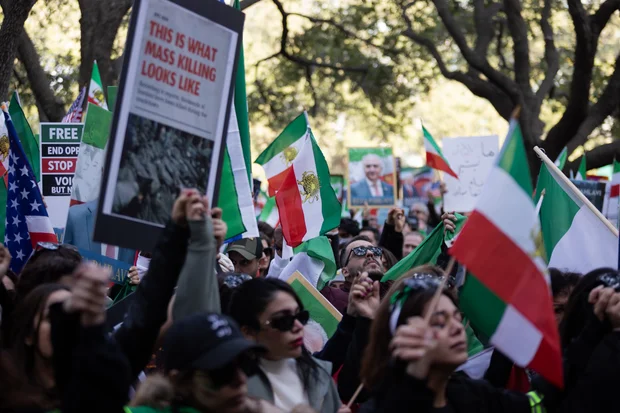
As more details about the Iranian regime’s crackdown against its own people emerge amid the ongoing internet shutdown, two recent unconfirmed reports suggest that the regime may have injected protesters with toxins that are meant to kill them days after the fact.
One report was cited by a former UK lawmaker, while the other is based on a testimony cited by the opposition-aligned news outlet Iran International.
Bill Rammell, a former Labour MP, told GB News on Saturday that he received a report that “People believe some kind of toxic chemical substance has been used against protestors, causing some of the injured to lose their lives days later.”
He noted that the report from Iranian-Kurdish sources had not been verified, but he estimated it to be credible.
On Monday, Iran International cited a source close to the family of a detained protester, who said that imprisoned Iranians underwent “abuse, including forced nudity, exposure to cold, and injections with substances of unknown composition while in custody.”
Protesters held in Iranian prisons have described abuse, including forced nudity, exposure to cold, and injections with substances of unknown composition while in custody, a source close to a detainee’s family told Iran International.
— Iran International English (@IranIntl_En) January 18, 2026
The source said a detained young protester… pic.twitter.com/6GcFnmF5kP
This was based on a message a young protester was able to transmit from inside a regime prison, where he said officers had stripped the prisoners naked in the courtyard, keeping them there for long periods amid freezing winter conditions and even spraying them with cold water.
The next day, the prisoner and several others were injected with an unidentified substance, the source added.
The brutal crackdown that could have killed as many as 16,500 protesters has, for now, largely managed to suppress the protests, according to available information.
According to NetBlocks, the internet has now been largely cut off for more than 12 days. However, it said that authorities are apparently experimenting with a tightly filtered intranet that allows some messages to slip through.
Despite U.S. President Donald Trump’s claims that the Iranian regime had vowed to halt planned executions of protesters, which ostensibly caused the postponement of planned U.S. strikes against the regime, Iranian officials have signaled that prosecutions of detained protesters would go ahead.
On Monday, Iran’s national police chief Ahmadreza Radan vowed to continue to pursue those involved in recent protests, adding that many had confessed to their alleged crimes. He said, “We promised the people that we would pursue the rioters and terrorists to the last person.”
The parliament's national security chief, Ebrahim Azizi, confirmed that protesters had been shot and killed outside Basij bases and police stations, acknowledging that thousands had died while adding that final death tolls would be announced at a later date.
Speaking to Newsweek, Rammell said that if the report about detainees being injected with toxic substances were true, it would be an “extraordinary” escalation.
“If it does transpire, [if] this is accurate, it is appalling, and there needs to be a concerted, robust response by the international community,” he said.
In his interview with GB News, he noted that “There’s a history in this part of the region – if you look at Saddam Hussein, who used gases against 5,000 people in Halabja, and murdered them brutally – I fear this has got real echoes of that.”
Remember when the media ignored and even discounted reports of chemical attacks on schoolgirls in Iran.
— Kasra Aarabi (کسری اعرابی) (@KasraAarabi) December 19, 2024
New evidence now reveals the IRGC has been developing pharmaceutical-based chemical weapons.
🧵1/ pic.twitter.com/MFByO91LGC
The Iranian regime had already been accused of using chemical weapons to suppress demonstrations in 2022, during the Mahsa Amini protest wave.
At the time, Kurdish-Iranian sources claimed that regime forces used tear gas, as well as gas containing nerve agents to crack down on protests in northwestern Iran.
In 2024, Kasra Aarabi, Director of IRGC Research at United Against Nuclear Iran (UANI), noted in a post on 𝕏 that there was evidence that the Revolutionary Guards (IRGC) have "been developing pharmaceutical-based chemical weapons.”
Aarabi pointed to research by the Institute for Science and International Security (ISIS) that the IRGC used “incapacitating ammunition containing medetomidine” in hand grenades and anti-riot munitions.
“During the 2022 Mahsa Amini protests, various persons present at the protests wrote that anti-riot gases used against them induced feelings of anesthesia which is not a characteristic of traditional CS gas and is associated with both fentanyl and medetomidine.”
“The new evidence further points to chemical attacks on schoolgirls by the regime in Iran. The Iranian people believe that with such attacks the regime has one goal: inflict terror & punish Iranian society – not least Gen Z schoolgirls – to deter future mass unrest,” Aarabi wrote in 2024.
Popular article:
interview Easter message of resurrection hope amid war at Jerusalem's Garden Tomb
biblical commentary Let my people go: a Passover message for today
4 IDF soldiers killed, 2 wounded in fighting in southern Lebanon, as Israel eliminates dozens of Hezbollah terrorists

Receive latest news & updates
A message from All Israel News
Help us educate Christians on a daily basis about what is happening in Israel & the Middle East and why it matters.
For as little as $10, you can support ALL ISRAEL NEWS, a non-profit media organization that is supported by readers like you.
Latest articles:
Iran protests North American Jewish organizations to recruit 100 professionals to combat antisemitism
Iran protests ‘No need’ for pre-election Iran strike, IDF chief says as gov’t, opposition trade blame for potential escalation – report
terror attack 2 Israeli soldiers killed, 2 terrorists eliminated in Hebron shooting; IDF says much larger attack was prevented
analysis A people dwelling securely? Israel’s strategic standing, 3 years after Oct 7
Iran protests Hamas on wheels: What I found in Dearborn reveals a troubling history and a battle over Israel