Iranian dissidents rally behind Reza Pahlavi’s call to fly historic Lion and Sun flag instead of Islamic Republic banner at embassies




Flags are always symbolic but the guerrilla replacement of the Iranian Regime flag displayed at embassies and consulates around the world has been an iconic part of the people’s uprising.
In a significant development, the icon for the Iranian flag was changed on 𝕏 last Friday, following petitions from users on the social network platform.
It's time. pic.twitter.com/yCIhsCPAoU
— 𝐍𝐢𝐨𝐡 𝐁𝐞𝐫𝐠 ✡︎ 🇮🇷 (@NiohBerg) January 9, 2026
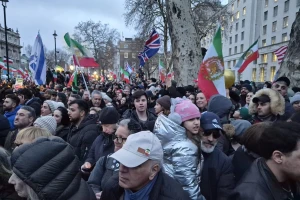
In a similarly significant moment the following day, a protester in London broke from the crowd and climbed onto the balcony of the Iranian embassy, tearing down the regime’s flag and replacing it with the historic Lion and Sun design.
On Monday, HM Reza Shah Pahlavi posted an exhortation to the Iranian people on 𝕏, calling for an uprising in Iran and activism everywhere in the diaspora.
Addressing the people of Iran as “brave compatriots,” he stated, “All Iranian embassies and consulates belong to the Iranian people. The time has come for them to be adorned with Iran’s national flag, instead of the disgraceful flag of the Islamic Republic.”
Since then, social media has been flooded with posts of people switching the flags all over the globe. Footage showing the Regime flag being replaced by the Shah-era Lion and Sun has been uploaded from Switzerland, Italy, Chile, Australia, Germany, Spain, Finland, Canada, Japan, and many other locations.
مترو مسکوا_میلان ایتالیا
— SHIN (@iwasshiin) January 10, 2026
مزین شده به پرچم شیر و خورشید #جاويدشاه pic.twitter.com/09TZP8adon
The flag of the Islamic Regime is green, white and red with the red “tulip” symbol of the regime and also represents the word “Allah”, while commemorating martyrs for the cause. The ensign could also represent a globe and two crescents, according to Encyclopaedia Britannica.
Along the two borders between the horizontal green, white, and red stripes on the flag is Arabic Kufic script that reads “Allāhu akbar” (the “takbīr,” meaning “God is greatest”) 22 times – 11 on each border. Kufic script, which originated in Iraq, is a square, box-like calligraphy often used for decorative purposes. The number 22 refers to the date of the 1979 revolution: 22 Bahman in the Iranian calendar.
Before the Islamic revolution, the historic Lion and Sun emblem was featured in the middle of the flag on a background of the same green, white, and red stripes – but without the addition of the takbir 22 times. The flag’s origins go back to the 15th century, although the background was plain in earlier forms. The green and red were added in late 1906 in recognition of the Islamic religion of the country.
In some designs an imperial crown and a wreath are added around the Lion and Sun. These are used for special purposes such as the naval ensign.
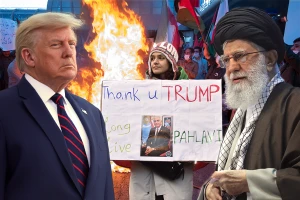
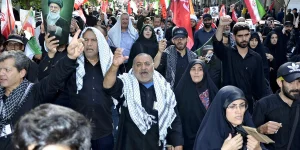
The Lion and Sun flag have become a standard for the protesters around the world, and even within Iran itself, as a symbol of yearning for the days before Iran became an Islamic theocratic state. It is common to see people draped in the flag, and for it to be waved alongside the flag of Israel, a country that many protesters look to for help in freeing themselves from the current regime.
“The freedom of Iran is near. The blood shed by Iran’s immortal sons and daughters lights our path to victory. We are not alone. International support will soon arrive,” the crown prince assured his people.
“Await my next messages. We will soon reclaim our beloved Iran from the Islamic Republic and celebrate freedom and victory across the entire country.”
The main media platform of the resistance movement, Iran International, reported yesterday that at least 12,000 protesters have been killed during the internet blackout, and there are fears that now the number could be over 20,000, according to GB News.
You might also like to read this: