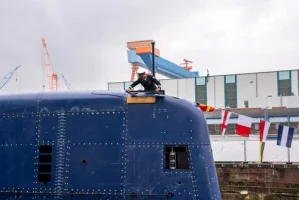
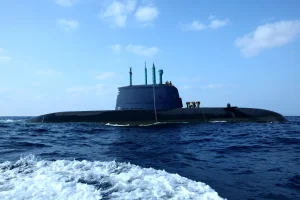
Inside INS Drakon: Israel’s most powerful submarine brings new ‘lethal combat capabilities’



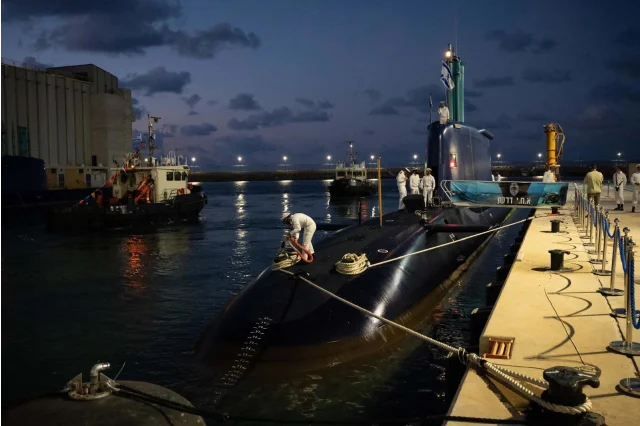
The Israeli Navy has welcomed the INS Drakon, Israel’s sixth and most powerful submarine, to its fleet after the 70-meter vessel docked this week at the port of Haifa following its voyage from Kiel, Germany, where it was built by the German industrial conglomerate Thyssenkrupp.
The Drakon is the largest and most sophisticated submarine Israel has ever possessed. It will now undergo the installation of Israeli-built systems and weapons and is scheduled to be declared operational around the end of November.
President Isaac Herzog, Defense Minister Israel Katz, and IDF Chief of Staff Lt. Gen. Eyal Zamir oversaw a ceremony to welcome the Drakon home on Thursday.
The Drakon’s new commander, Lt. Col. O, who has been in Germany participating in the final stages of the submarine’s construction for the past several months, described the extensive preparations required to bring the vessel into Israeli service:
“This is the result of almost 14 years of preparation. It really is an enormous project. We carried out a huge number of actions to make it possible for the submarine to reach Israel. You literally go pipe by pipe, check every machine and approve it, making sure it works perfectly before signing off on it and transferring it into Israeli hands.”
The Israeli Navy has released extremely rare — though equally scarce — footage from aboard (and around) its new submarine, INS Drakon, the latest representative of the Dolphin II class.
— Yigal Levin (@YigalLevin) September 27, 2026
As a reminder, Drakon differs noticeably from the previous boats in the series: its length… pic.twitter.com/m19lxU0UN2
A few days after the ceremony, Ynet News was granted access to the new submarine and reported on what its journalists saw inside.
Despite being the largest submarine in Israeli history, the Drakon is still a tightly packed vessel, with machinery, computers, cables, pipes and equipment occupying nearly every corner.
Dozens of sailors and officers work in close quarters, each highly trained to know exactly what to do in a wide range of circumstances.
Most of the sailors are in their 20s. They left Germany at the beginning of the month, stopped at several points along the way and reached Israel after almost a month at sea.
Col. Y., commander of the Israeli Navy's submarine flotilla Shayetet 7, said the ability to function together in such a confined environment for prolonged periods is a crucial part of submarine service.
“The ability to stay together for so long in conditions like these is not something to take for granted, and the people who come here know that,” said Col. Y., commander of Shayetet 7. “You really live together inside one vessel for many days.”
Although the Drakon has improved amenities compared with previous submarines, including a small common area for recreation, the crew is still largely cut off from the outside world while on patrol, with no internet access or cell phone service.
Brig. Gen. Guy Levy, chief of staff of the Israeli Navy and the officer responsible for force buildup, briefed the Ynet team on plans to replace older vessels with follow-on submarines on a one-to-one basis. Under the plan, a new boat equipped with the latest technology will be delivered every few years while the overall size of the fleet remains constant.
“This submarine brings new and lethal combat capabilities,” Levy said. “It brings the ability to remain at sea longer, the ability to carry more weapons, and it does so under complete secrecy and in distant places where Israel has never been before.”
“Look at what is happening in the world now,” Levy said, referring to the attempts by Iran and its proxy force in Yemen, the Houthis, to seize control of the strategic Strait of Hormuz and the Bab al-Mandeb, respectively. “This war proves to us how critically important control of the maritime arena is.”
“I know the missions of the Navy and the missions assigned to us by the political echelon and the General Staff,” he said. “There is a critical need for these platforms, and beyond that there is a need to expand the Navy in response to the developing threats from neighboring countries in the Middle East.”
Levy also highlighted the submarine’s ability to operate undetected near enemy territory while gathering intelligence and carrying out strikes.
“When you take a 3,000-ton vessel with significant weaponry and extremely advanced intelligence-gathering systems, and manage to bring it all the way to an enemy coast, remain under his nose, collect intelligence, strike and leave without him even understanding you were there, you realize you are dealing with something completely different.”
However, he was quick to add that the Drakon is just one component in the IDF’s deterrent posture, designed to convince opponents not to start wars with Israel but also to deliver a decisive victory in any war that might start, even by accident.
“The submarine fleet does not stand alone,” he said. “The Navy is undergoing a significant transformation in response to the threats developing around us. We are now building a Navy that will be more lethal, have a longer operational reach and complete secrecy ahead of the next rounds of fighting Israel will face.”
You might also like to read this: