









‘Golden country’ no longer? Australian Jews alarmed by sharp rise in antisemitism, gov't inaction
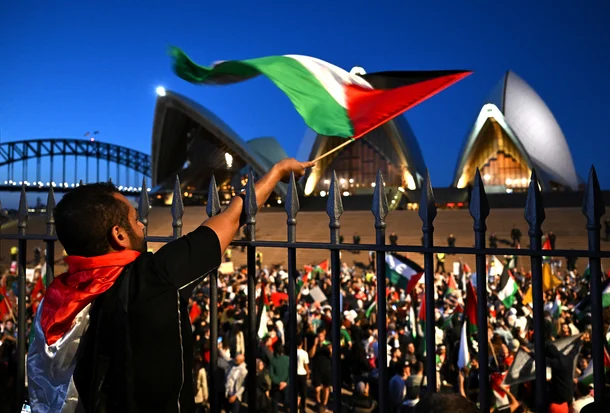
Australia has long been viewed positively by many Jewish immigrants, including Holocaust survivors who referred to it as the “goldene medina,” Yiddish for “golden country,” reflecting a sense of safety and opportunity. In recent months, however, the sharp rise in antisemitic incidents following the Hamas Oct. 7 attack in Israel has left many Australian Jews concerned and disappointed by what they perceive as widespread silence or indifference from parts of the broader population.
The president of the Zionist Federation of Australia, Jeremy Leibler, reflected on the surprising rise of antisemitism in Australian society during an interview with The Jerusalem Post.
“I grew up living in a society that was easygoing and never experienced it [antisemitism] at all, even though I was very visibly Jewish,” Leibler recalled. Yet he acknowledged that some degree of low-level antisemitism existed in Australia even before the Oct. 7 attack two years ago.
“...While we didn’t feel it [antisemitism], it was there, because [of] the speed at which those who harbored these feelings were then given permission to allow them to be ventilated and articulated, because of these false accusations of genocide thrown at Israel and Zionists – and we are a very Zionist community. It didn’t take much for the memory of the Holocaust, which perhaps kept that antisemitism under the table, to [be superseded]. And once it’s out of the bag, it’s very difficult to put back in,” Leibler said.
The Australian Jewish community numbers some 100,000 people, forming a tiny but well-integrated and socioeconomically successful minority in a multicultural country with around 27 million people.
However, Australia has reportedly seen one of the sharpest rises in antisemitism in the Western world, with anti-Jewish incidents increasing by a whopping 700% since Oct. 7.
Jewish and Israeli individuals have been attacked and synagogues and other Jewish institutions have been targeted, especially in Melbourne and Sydney.
While being troubled by the blatant Jew-hatred, Leibler says he is more concerned about the silence or even tacit approval from the general population in Australia.
“I actually find that a lot more confronting because these are people who otherwise are the beneficiaries of enormous Jewish support, not just philanthropic support, but in many, many respects they work with us,” he explained.
“I’m a lawyer and my firm has a very, very large public interest law pro bono practice where we do work both for the Jewish community, but also in the arts. And we found very, very quickly after October 7 – within a week or two before Israel had even responded – we found a very significant proportion of that client base were explicitly antisemitic. They were accusing Israel of genocide before they’d [Israel had] responded. They issued statements attacking Israel without condemning Hamas,” Leibler said.
“And that sense of betrayal from people – not from the Muslim community, not [from those] that have skin in the game – people who have been in our houses, often artists whose paintings are hanging on our walls in our offices, in our homes, forget picking up the phone to say, ‘Are you okay? Are your family and your friends okay?’ but turned on us in a way,” he added.
Leibler told the Jerusalem Post that he is disappointed that the silent majority in Australia has allowed a situation where the radical anti-Jewish mob sets the agenda.
“What I didn’t appreciate was the extent to which ordinary well-meaning people would be intimidated by the mob,” Leibler stated. “They would be intimidated into silence, to turning the other way. And I think that’s one of the most disappointing aspects of the way in which the Australian Jewish community has experienced the post-October 7 world.”
The majority of Jewish Australians identify with Israel, Zionism and the Jewish people. Leibler is, therefore, particularly concerned by the ongoing effort to falsely equate Zionism – the national liberation movement of the Jewish people – with “genocide,” “apartheid” and “racism.”
“That is what globalizing the intifada looks like,” Leibler assessed. “Once it’s out of the bag; once you’ve normalized this; once you’ve normalized the idea that anyone who is a Zionist is now a genocide supporter; once you stop calling those things out, it’s difficult to put back in, back in the box.”
Like other members of the Jewish population in Australia, Leibler is concerned by what he views as the Australian government’s failure to adequately address the growing threat of antisemitism.
“I think there is no question that the government failed to understand what was happening on the ground and how it was impacting the Jewish community. I don’t believe that the Australian government [at] either the federal level or the state level are motivated by antisemitism or are antisemitic. I know that to be fundamentally not true. But that doesn’t excuse failures to properly address antisemitism,” he added. In July, Jillian Segal, Australia’s special envoy to Combat Antisemitism, recommended defunding institutions that fail to combat antisemitism.
Looking ahead, Leibler believes Australia needs leadership that will draw a clear line by forcefully declaring and acting against antisemitism.
“I think what we need is leadership. What we need is our political leaders to draw a line in the sand and say, ‘free speech is sacred,’ but when it crosses into incitement, violence, to have the clarity to be able to say, when we have people marching through the streets of Victoria, New South Wales, chanting, ‘globalize the intifada,’ and ‘from the river to the sea,’ that these are inherently violent calls to action,” Leibler stated.
Popular article:
interview Easter message of resurrection hope amid war at Jerusalem's Garden Tomb

biblical commentary Let my people go: a Passover message for today

4 IDF soldiers killed, 2 wounded in fighting in southern Lebanon, as Israel eliminates dozens of Hezbollah terrorists

Receive latest news & updates
A message from All Israel News
Help us educate Christians on a daily basis about what is happening in Israel & the Middle East and why it matters.
For as little as $10, you can support ALL ISRAEL NEWS, a non-profit media organization that is supported by readers like you.
Latest articles:

Hamas openly threatens Israel with ‘more Oct 7 attacks’ as intelligence shows terror group is rearming
More than 1,300 antisemitic posts blame Israel, Jews for French riots – report

Thailand turns to Israeli anti-drone technology to counter growing battlefield threat

Israeli fighter jets flew to Iranian border in ‘power projection,’ deterrence exercise ahead of elections next week

Israel targets nuclear fusion leadership as AI drives soaring energy demand