





Former UN torture expert blasts ‘obsessive’ focus on Gaza, says hostage-taking was overlooked


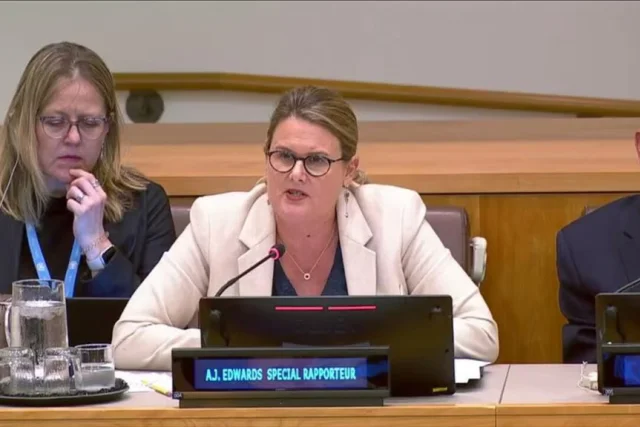
Alice Jill Edwards, who served as the UN special rapporteur on torture from August 2022 to July 2026, sharply criticized the organization’s handling of the Gaza war in a Monday column for the UK’s Daily Telegraph, accusing it of focusing almost exclusively on Palestinian suffering while overlooking evidence of torture and abuse committed by Hamas against Israeli hostages.
Edwards argued that the UN’s failure to adequately address hostage-taking and other abuses undermined its commitment to neutrality and impartiality. She described a visit to Kibbutz Kfar Aza about 14 months after the Oct. 7 massacre, where she met Mandy Damari and Simona Steinbrecher, the mothers of hostages Emily Damari and Doron Steinbrecher.
"I tried to remind myself that I needed to avoid feeling too emotional,” Edwards said. “After all, I was a neutral observer – the role each United Nations special rapporteur is supposed to fulfill. Yet the suffering of these mothers made me realize that we must consider hostage-taking as a form of torture."
Edwards also cited Hamas’ use of hostage videos to pressure Israel through the captives’ families. She pointed to footage showing hostage Evyatar David being forced to dig a hole that his captors said would be his own grave. David appeared severely malnourished in captivity and was made to speak Hebrew in the video, Edwards noted.
She also criticized her UN colleagues Francesca Albanese, the special rapporteur on the occupied Palestinian territories, and Reem Alsalem, the special rapporteur on violence against women, for failing to formally document abuses against Israeli hostages.
"They never formally documented these horrors, despite the growing body of evidence which to most of us is indisputable, but which they dispute," Edwards said.
“I feel strongly that during the Gaza-Israel war, the UN has been doing itself no favors by obsessively focusing on only one set of abuses – especially as neutrality, independence and impartiality are the cornerstones of a trustworthy UN," she continued.
Edwards defended her own record of impartiality, pointing to previous work defending Palestinian security prisoners in European courts and documenting their accounts of discrimination by Israeli forces.
Beyond the UN’s response to the war, Edwards highlighted structural problems within the organization, including inadequate funding for essential projects. She said she had to pay her own expenses to investigate conditions in Israel and the Palestinian territories.
Other special rapporteurs, she added, receive funding from individual countries or NGOs, potentially allowing those funders to influence the findings of investigations.
"However, despite these problems, and many others, there appears little appetite to fix the system – not even by the UN secretary-general, Antonio Guterres (who, incidentally, was my former boss as UN High Commissioner for Refugees)," she wrote. "Independence is both the strength and the vulnerability of these positions, but when misused to dogmatically pursue political agendas, the UN as a whole is weakened.”
Edwards also called on the next UN secretary-general to take a more active role in addressing international conflicts, arguing that the organization has failed to fulfill its founding mission:
"With more wars today than at any time since the organization’s founding in 1945, the next secretary-general needs to take a more decisive role and exercise a greater amount of the power that is actually at his or her disposal."
"Guterres has, in my view, failed to carry out the original mandate of the UN – to step in efficiently and fairly as a mediator to dampen down international conflicts. While the blame for today’s wars can’t be laid at his feet, it’s disappointing that he has adopted a rather fatalistic posture, as though he has no sway other than to convene meeting,” Edwards continued.
Israeli attorney Ayelet Razin Bet-Or, who works to document and secure recognition of the sexual violence committed on Oct. 7 and during captivity, welcomed Edwards’ criticism, saying her “clear, honest and courageous voice stands in sharp contrast to the silence and conduct of other officials within the UN's human rights mechanisms, who failed to fulfill their fundamental duty toward the victims of sexual violence and torture perpetrated by Hamas."
"Edwards' testimony is particularly important because it comes from within the system itself, from someone who has devoted her life to defending human rights, regardless of the national identity of the victims or the identity of the perpetrators," Bet-Or continued.
"Edwards' courage should not be the exception. It should be the standard. It is time for the UN to engage in genuine soul-searching, ensure accountability among its officials and put victims of violence, rather than political agendas, back at the center of its work," she concluded.
You might also like to read this: