Canaanite complex from time of Abraham discovered in northern Israel
Archaeologists are unsure of the purpose of the massive, not fully uncovered building
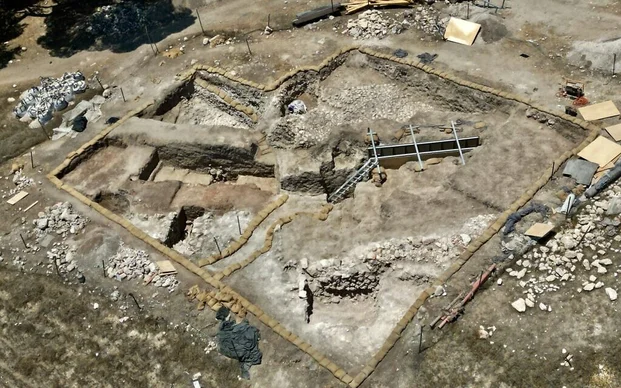
Archaeologists excavating Tel Shimron in the Jezreel Valley uncovered a long, well-preserved vaulted passageway from about 3,800 years ago, roughly from the time of biblical Abraham.
The vaulted passageway, noted for its use of corbelled mudbricks, is part of a massive complex on top of the tel, which archaeologists have yet to fully excavate.
The complex is about the size of an Olympic swimming pool, covering approximately 1,200 square meters (13,000 square feet).
The passageway is remarkably well-preserved, particularly because the sun-dried bricks are usually fragile and don’t often survive long periods.
Rounded arches were not yet known so corbel was used to create raised spaces, as each brick or stone is placed inward in progressive layers until they meet.
Prof. Mario Martin, co-director of the excavation, said that corbelled structures were common in that time period in Mesopotamia and the Levant.
“Yet, a fully preserved mudbrick-built passageway with this type of corbelled vault is without parallel. Such structures, made of unfired mudbrick, almost never survive,” Martin noted.
“When we started digging, we found that this area between the mud bricks was filled with gravel, which is very unusual, so we started removing the gravel,” said Archaeology Prof. Daniel Master of Wheaton College, co-director of the dig.
The gravel was intentionally placed sometime shortly after the construction of the complex and the passageway.
Master explained that filling in the complex and passageway allowed them to be preserved while supporting and protecting the fragile mudbricks.
“We kept digging down further, and it was preserved at a depth of one meter, then two meters, then three meters, then four meters,” said Master. “This structure was totally intact, and suddenly we realized we were dealing with the foundation of a building or a superstructure that had been constructed at the top of the site.”
The floor and the stairs of the passageways, which were also made of mudbrick, show little wear, leading the archaeologists to conclude that the site was not used very often.
An intact Middle Bronze Age vessel, known as a Nahariya bowl, allowed the archaeologists to date the complex to the Middle Bronze period. The vessel has seven cups and was most likely used in some kind of ritualistic offering.
Because Nahariya bowls have been found in cultic sites in the past, the team believes the monumental complex probably served a cultic function.
One end of the passageway goes progressively deeper underground leading to a monumental arch.
The other end, leading from the complex, is scheduled to be excavated by the archaeologists next season.
“What we are going to have to do is dig down from the other side to try to reach whatever this passage leads to from above,” said Master.
The excavation at Tel Shimron is a joint expedition of Wheaton College in Illinois and Tel Aviv University and has been ongoing since 2017.
Popular article:

interview Easter message of resurrection hope amid war at Jerusalem's Garden Tomb

biblical commentary Let my people go: a Passover message for today

4 IDF soldiers killed, 2 wounded in fighting in southern Lebanon, as Israel eliminates dozens of Hezbollah terrorists

Receive latest news & updates
A message from All Israel News
Help us educate Christians on a daily basis about what is happening in Israel & the Middle East and why it matters.
For as little as $10, you can support ALL ISRAEL NEWS, a non-profit media organization that is supported by readers like you.
Latest articles:

editorial Evangelical Christians, please vote: The future of the US-Israel alliance is on the line

Breaking silence, Liberman annouces he will support Eisenkot for PM, Lapid for Knesset speaker

Israel's Christian ambassador warns against support for Muslim Brotherhood candidates

Eisenkot slams Likud for ‘malicious attempt to deny election results’ amid foreign interference probe

Maronite community forgives vandals who targeted historic church in Nahariya