





opinion Why Mamdani’s executive order is concerning for Israel
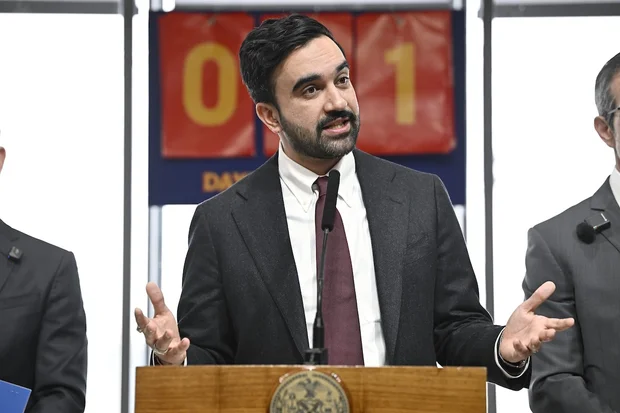
On January 1, 2026, Zohran Mamdani was inaugurated as the first Muslim mayor of New York City. On his very first day in office, he took quick executive action that significantly shifted the city’s policy on two issues that directly impact the Jewish community in that state. Couching it as a way to provide an administrative fresh start, in actuality, the executive order dismantled two significant pro-Israel policies.
To understand the implications of this move, let’s consider two things this executive order did and why Mamdani’s act could be detrimental to Jewish communities not just in New York, but across the United States.
1. It Nullified the IHRA Working Definition of Antisemitism
Mamdani’s executive order annulled the state’s previous order that had officially adopted the IHRA Working Definition of Antisemitism.
The IHRA, or International Holocaust Remembrance Alliance, is an intergovernmental organization mandated to focus on Holocaust-related issues. To address the problem of rising antisemitism, IHRA constructed this core working definition of what it is:
Antisemitism is a certain perception of Jews, which may be expressed as hatred toward Jews. Rhetorical and physical manifestations of antisemitism are directed toward Jewish or non-Jewish individuals and/or their property, toward Jewish community institutions and religious facilities.
Upward of 40 governments, including the United States and more than 1,200 entities worldwide, have adopted this definition of antisemitism. Though it’s not intended to be a legal code, it’s a vital tool to help educate on anti-Jewish bias, assess claims of antisemitism, assist in identifying whether a crime might also be categorized as a hate crime targeting Jews, and aid in determining the impact of certain behaviors.
However, Mamdani argues that the IHRA definition can blur legitimate criticism of the Israeli government with antisemitism, limiting political discourse.
His argument misinterprets the purpose of the IHRA definition, which was designed precisely to identify antisemitic rhetoric, including instances where criticism of Israel relies on antisemitic symbols or tropes. The 11 examples within the full definition illustrate how antisemitism can manifest: when antisemitic symbols or tropes against the Jewish people are used in the context of criticizing the Jewish State of Israel, that crosses the line into antisemitism.
Not surprisingly, pro-Israel organizations and several New York City council members quickly condemned the revocations, viewing them as a dangerous shift that could embolden bad actors. Without the IHRA definition, chances are higher that New York will only recognize “classic” antisemitism, like swastikas, which could send a silent signal of permission to use antisemitic rhetoric about the Jewish State and potentially lead to increased harassment or more hostile protests across the city.
2. It Removed Anti-BDS Regulations
Mamdani’s executive order also removed regulations that restricted BDS, or “Boycott, Divestment, Sanctions” against Israel. This Palestinian-led BDS movement seeks to exert international economic and political pressure on Israel. The new mayor believes anti-BDS laws are a type of government overreach that violates the First Amendment and sees their revocation as a step toward protecting free speech.
In actuality, BDS is a form of economic pressure aimed at isolating the Jewish State through boycotts, divestment from Israeli businesses, and sanctions. It is often connected with antisemitic incidents, particularly on college campuses, where Jewish students are often targeted for the actions of the Israeli government.
Revoking New York’s anti-BDS regulations removes guardrails that prevent city agencies from divesting from Israel, which could disproportionally affect local businesses with ties to Israel. Worse, it could cause discrimination against Jewish citizens of New York as well as isolate our longstanding US ally in the Middle East.
Opening the Door to Antisemitism
Mamdani’s motivation for these actions is to remove any restriction on anti-Israel expressions and policies due to his own position critical of Israel and in support of Palestinian causes. Though not all criticism of Israeli policy is antisemitic, the line is crossed when such criticism denies Israel’s right to exist, uses antisemitic rhetoric, or applies double standards not expected of other nations. This demonization of Israel is, in fact, a modern form of the world’s longest hatred—antisemitism.
The BDS movement, in particular, is a tool in the hands of those seeking to bring about the end of Israel. They are inspired by the dismantling of the apartheid South African regime in the mid-1990s. After a wave of global boycotts and sanctions, the minority White government fell, and Nelson Mandela became the first Black president, ending the legal racism that had discriminated against the black majority. The BDS movement is fed by false claims that Israel is a racist, apartheid state. One only needs to visit Israel to see firsthand how ludicrous the apartheid accusation is. Equating the Jewish State with racism fans the flames of antisemitism, and if left unchecked, it will produce a very dangerous environment for the largest Jewish community in the United States.
Conclusion
Mamdani’s actions withdraw practical tools and signals that help establishments identify and respond to modern-day antisemitism, lowering the threshold for antisemitic rhetoric and allowing it to flourish. Ultimately, Mamdani’s executive order should ignite Christians’ concern for the physical safety of the Jewish community—not just in New York but across the United States—and spark a renewed focus on prayer for their protection and advocacy against dangerous movements influencing those like the Mamdani administration.
Source: What Is the IHRA Definition of Antisemitism? ICEJ USA Branch.
Popular article:
interview Easter message of resurrection hope amid war at Jerusalem's Garden Tomb

biblical commentary Let my people go: a Passover message for today

4 IDF soldiers killed, 2 wounded in fighting in southern Lebanon, as Israel eliminates dozens of Hezbollah terrorists
Receive latest news & updates
A message from All Israel News
Help us educate Christians on a daily basis about what is happening in Israel & the Middle East and why it matters.
For as little as $10, you can support ALL ISRAEL NEWS, a non-profit media organization that is supported by readers like you.
Latest articles:

opinion Israeli fighter jets flew to Iranian border in ‘power projection,’ deterrence exercise ahead of elections next week
opinion Israeli intel chief Zini travels to France to give counterterrorism advice amid violent riots – report
opinion Founding trustee of Oxford’s Islamic studies department believed Muslims should ‘continue the work of Hitler’
opinion 'Peaceful dialogue is not a crime:' Petition urges Lebanon to abolish its Israel Boycott Law
opinion Israeli defense companies expand global reach with new deals in Cyprus, Germany and Canada