








opinion The army of Israel
Today, no one can mock Israel’s army; so formidable is the Jewish state because of its military superiority. In this field, as in others—medical, scientific, agricultural, technological—the Jewish people excel. All nations, openly or discreetly, buy “Israeli” for their security and defense.
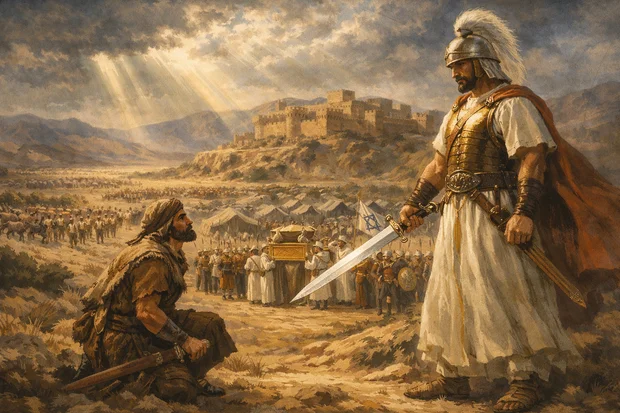
It has not always been so—far from it. Above all, the world must know that Israel has a “heavenly” Chief of Staff, like the One who appeared to Joshua before the battle of Jericho:
“When Joshua was near Jericho, he looked up and saw a man standing before him with a drawn sword in his hand. Joshua went up to him and asked, ‘Are you for us or for our enemies?’ ‘Neither,’ he replied, ‘but as commander of the army of the Lord (Sar Tsava Adonai) I have now come’” (Joshua 5:13).
When the children of Israel came out of Pharaoh’s Egypt, G-d was already speaking of “His armies.” Addressing Moses, He says (Exodus 7:4): “I will lay My hand on Egypt, and I will bring My armies (Tziv’otai), My people the Israelites, out of the land of Egypt.”
What audacity! How can a broken, unarmed people—crushed by centuries of slavery—be described as “armies”? Yet this designation reveals one of the most powerful secrets of Israel’s identity.
“Tsava” refers to an army, a troop, a mobilized body. But biblical Hebrew does not speak only of a military force; it also refers to a people gathered together to accomplish a higher purpose.
Exodus 12:41 says, “All the armies of the Lord left the land of Egypt.” Israel departs not as fugitives, but in formation—an army led by the Divine Presence.
In 1948, when Israel was reborn, seven Arab armies attacked the young state to crush it. Many of the Jewish fighters were survivors of the ghettos, returnees from the camps—thin and traumatized. Others were young intellectuals who had never held a gun. And yet they resisted and ultimately defeated some of the best-trained forces in the Middle East, including the Arab Legion, commanded by “the Pasha,” trained by the British.
And Israel won the War of Independence. The land was secured at the price of blood.
Today, facing the mullahs’ Iran—Haman’s Persia—and its allies (Hezbollah, Hamas, and the Houthis in Yemen), Israel remains the “army of the Lord,” mobilized for the unfolding of His purposes.
Israel’s history is not merely about strategy, technology, or military strength. It is part of a deeper reality: that of a people called, set apart, mobilized by the God of armies. From Egypt to Jericho, from 1948 and 1967 to the present day, the same truth runs through the centuries: when God calls a people “His armies,” it is not because they are strong, but because they fight with Him.
The real battle is not only geopolitical—it is spiritual. And in this struggle, victory depends neither on numbers, nor on chariots, nor on alliances—but on the faithfulness of the God of Israel.
“It is not by might nor by power, but by My Spirit” (Zech. 4:6).
Help more people find our reporting from Israel! Leave a quick Google review of our website HERE .
Popular article:

interview Easter message of resurrection hope amid war at Jerusalem's Garden Tomb

biblical commentary Let my people go: a Passover message for today

4 IDF soldiers killed, 2 wounded in fighting in southern Lebanon, as Israel eliminates dozens of Hezbollah terrorists

Receive latest news & updates
A message from All Israel News
Help us educate Christians on a daily basis about what is happening in Israel & the Middle East and why it matters.
For as little as $10, you can support ALL ISRAEL NEWS, a non-profit media organization that is supported by readers like you.
Latest articles:
opinion North American Jewish organizations to recruit 100 professionals to combat antisemitism

opinion ‘No need’ for pre-election Iran strike, IDF chief says as gov’t, opposition trade blame for potential escalation – report

terror attack 2 Israelis critically wounded, 2 terrorists killed in Hebron shooting; IDF says larger attack was prevented
analysis A people dwelling securely? Israel’s strategic standing, 3 years after Oct 7
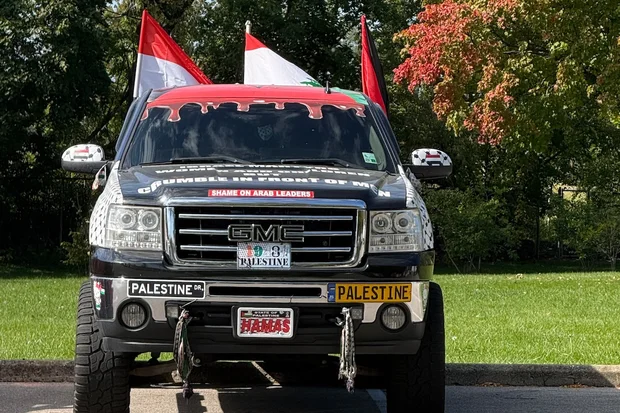
opinion Hamas on wheels: What I found in Dearborn reveals a troubling history and a battle over Israel