










explainer 'Between war and peace:' Lebanon's agreement with Israel in limbo as Hezbollah disarmament stalls
Reports show Hezbollah rearming, threatening civil war as border slides back to pre-war conditions
Over the past few months, Lebanon and Israel have engaged in unprecedented diplomatic contact and direct negotiations mediated by Washington with the stated shared goal of disarming Hezbollah and reaching a lasting security agreement.
Lebanese and Israeli officials met for the eighth time in the U.S. at the end of October to continue talks as part of the June Tripartite Framework Agreement, celebrated as a historic step of rapprochement between the countries.
However, rather than moving toward disarmament, Hezbollah is actively strengthening and rebuilding its military, according to several assessments from Israeli, American and even Lebanese sources.
The terror group is taking advantage of the Lebanese government’s disunity, the military’s weakness, threats from Iran and the prospect of the U.S., Israel, and the Iranian regime returning to full-scale war.
While President Joseph Aoun is committed to Hezbollah's disarmament, other key actors in the government are waiting to see whether regional developments will derail any diplomatic progress.
Lebanese army intimidated by threats of confrontation
The terror group’s patrons are working to prevent further harm to Hezbollah and are assisting the organization's rebuilding efforts.
Lebanese Parliament Speaker Nabih Berri, the group’s most important political ally, warned that the country's fate is inextricably tied to broader regional developments. Lebanon is in a state of “neither war nor peace,” Berri said, urging national unity—ostensibly placating Hezbollah.
Hezbollah claims it needs weapons in order to defend Lebanon against Israel. It also claims it a willingness to disarm, but not according to “foreign dictates,” including America’s diplomatic intervention and negotiations with Israel.
Hezbollah Secretary-General Naim Qassem said the group “cannot but be resistance as long as this aggression exists.” Lately, the group has ramped up its rhetoric against the Lebanese government, warning against the dangers of “internal discord,” and threatening civil war while actively preparing its forces for this possibility, according to Lebanese reports.
However, despite the influences of Iran, Turkey, Syria, the U.S. and Israel in Lebanon, the central obstacle to disarming Hezbollah remains the Lebanese military’s failure to do so, citing the risk of violent confrontations with the terror group.
The threats are clearly working. Even anti-Hezbollah figures like Member of Parliament Ghassan Hasbani of the Christian Lebanese Forces Party have warned the Iranian regime would fight to keep Hezbollah armed.
“Iran will not relinquish the Lebanese card without using it,” Hasbani said, adding that “it wants to retain Hezbollah’s weapons as a bargaining chip in future negotiations should tensions escalate.”
The state's reluctance is reflected in statements by Lebanese Armed Forces (LAF) Commander Gen. Rodolphe Haykal, who reiterated again in November that the military’s priority isn’t to fulfill this mission but rather to preserve “internal unity, stability, and civil peace.”
He also called Israel’s continued presence in southern Lebanon “the fundamental problem and the foremost threat facing our nation.”
The LAF has reportedly avoided raiding suspected weapons storage on private property, according to several reports in the past few months. The few Hezbollah weapons caches that have been confiscated followed advance warnings to and negotiations with the group.
Failure of pilot zones
This likely explains the failure of the pilot zones, established under the June 26 Trilateral Framework, as a first step toward a full Israeli withdrawal. Under the agreement, as the Israel Defense Forces (IDF) withdraws from the designated areas, the LAF would move in to restore the state’s authority over the region, disarm non-state actors such as Hezbollah and dismantle their military infrastructure.
Beirut-based newspaper Al Modon reported that the Military Coordination Group for Lebanon (MCG4L), headed by a U.S. general, called it a failure. Diplomatic sources told the outlet that U.S. officials blamed the political establishment rather than the military.
But according to other reports, the LAF did not establish control over the pilot zones and, in some cases, allowed Hezbollah back into some areas, including ones close to IDF positions.
In one example, Lebanese media reported that the LAF deployed some 180 troops to the town of Zawtar al-Gharbiyeh. However, journalists at the news outlet This Is Beirut witnessed soldiers waving cars through a main LAF checkpoint without checking the occupants’ identities or inspecting the vehicles.
An LAF intelligence source told the outlet that the troops were primarily tasked with clearing unexploded ordnances and rubble and assisting residents, not demolishing Hezbollah infrastructure or barring them from the area. A local source said he didn't know of a single case in which the LAF dismantled a weapons depot in the town.
When asked by a CNN journalist whether preventing another civil war was the actual goal, a Lebanese colonel admitted to it.
“For sure,” he answered, adding, “That is part of the main pillar of the army’s thinking. Who will fight the children of this country?”
Meanwhile, Israeli and Lebanese news outlets have reported that terrorists are returning to the pilot zones under the guise of a humanitarian group, where they are assessing damage to Hezbollah infrastructure, working to restore its intelligence-gathering capabilities and examining opportunities for redeployment.
Return to ‘normalcy’
These developments essentially mirror the conditions that prevailed before the war, when IDF troops monitored a tense border opposite Hezbollah positions. The main difference is that the front is now several kilometers deep within Lebanese territory.
In light of this, Israel has been ramping up airstrikes against Hezbollah in recent months, targeting areas close to the border and deeper inside Lebanon. Ground troops have advanced toward what security officials described as a “forward and offensive defense” posture in southern Lebanon, Ynet reported in October.
With no significant change on the horizon – and barring a renewal of war with Iran that would likely reignite intensified Israeli strikes against Hezbollah – the current situation appears poised to become the new normal.
An Israeli military source told Sky News Arabia that IDF troops could occupy south Lebanon “for years,” while continuing to locate and destroy the massive terror infrastructure left behind in the security zone.
Political changes in Israel could also impact the situation. Yair Golan, chairman of the left-wing Democrats who could be a key player in a government led by Yashar’s Gadi Eisenkot, favors military disengagement. Closing one or more of the security zones in Lebanon, Syria and Gaza could be a way to reduce the need for reservists, Golan argues.
“If we want to immediately ease the burden on reservists, we need to start closing fronts,” he said.
Popular article:
interview Easter message of resurrection hope amid war at Jerusalem's Garden Tomb

biblical commentary Let my people go: a Passover message for today
4 IDF soldiers killed, 2 wounded in fighting in southern Lebanon, as Israel eliminates dozens of Hezbollah terrorists

Receive latest news & updates
A message from All Israel News
Help us educate Christians on a daily basis about what is happening in Israel & the Middle East and why it matters.
For as little as $10, you can support ALL ISRAEL NEWS, a non-profit media organization that is supported by readers like you.
Latest articles:
Israeli Defense Minister warns of chemical weapons threat, extended range of Iranian missiles
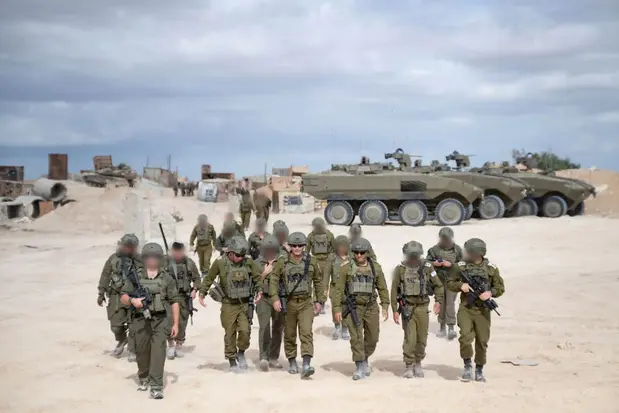
IDF returns to intensive training as fighting continues on multiple fronts
Netanyahu’s allies call to end corruption trial, opposition in stunned silence after court recommends dropping most charges
Israeli Presidential Medal of Honor to be awarded to Evangelical Christian for 1st time
netanyahu trial Netanyahu corruption trial close to collapse as judges recommend dropping most charges, including bribery