Ben Shapiro rejects chorus of genocide accusations against Israel at UN

If there’s one word Israel’s critics seem increasingly comfortable using at the United Nations, it’s “genocide.”
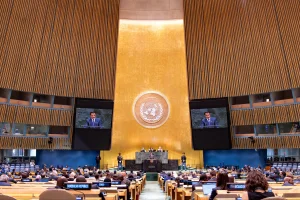
World leaders gathering in New York this week for the 81st United Nations General Assembly repeatedly accused Israel of committing genocide in Gaza, turning the allegation into one of the central themes surrounding the Israeli-Palestinian conflict.
Brazilian President Luiz Inácio Lula da Silva was blunt. “Generations of Palestinians” will carry “the pain and trauma left by the genocide of women and children,” he told the General Assembly, specifically blaming the government of Israeli Prime Minister Benjamin Netanyahu.
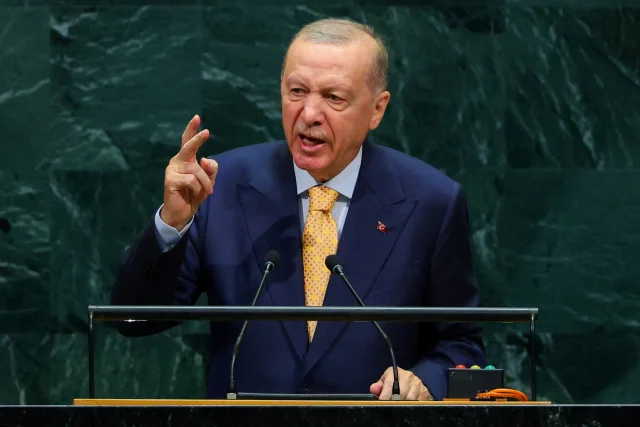
Turkey’s President Recep Tayyip Erdogan went even further, describing Gaza as “the most inhumane and shameful concentration camp of our time.”
“We are faced with a genocidal mindset that can never get enough of killing,” Erdogan told the UN gathering. His remarks drew applause from portions of the General Assembly while Israel’s delegation walked out during his address.
Even UN Secretary-General António Guterres, while stopping short of making his own legal finding of genocide, described Israel’s military campaign as an “onslaught” involving a “scale of killing and destruction unlike anything I have witnessed” during his years as secretary-general. He pointed delegates to the genocide case currently before the International Court of Justice.
That’s the atmosphere surrounding Israel at the UN. It’s an atmosphere filled with poison and lies against Israel.
Ben Shapiro thinks the genocide charge is nonsense. During my recent sit-down interview with the Daily Wire co-founder, I asked him directly whether the accusation drives him “up a wall,” especially considering Israel possesses more than enough military firepower to level Gaza if extermination were actually its objective.
Shapiro began with what he sees as a basic demographic contradiction.
“First of all, it’d be the only genocide in human history in which the population base has increased over the course of the genocide,” Shapiro told me.
“So the population of Gaza is actually larger today through birth than even including the number of deaths. And so that’s never happened before in human history. It’s also the only genocide in which the amount of food aid that’s gone in post-genocide is actually larger than it was before the genocide," he continued.
Israel is not committing Genocide. So ridiculous. Ben Shapiro lays out the truth with me in our interview. @benshapiro @BenShapiroShow #ISRAEL pic.twitter.com/40aFap2OxY
— David Brody (@DBrodyReports) September 23, 2026
Shapiro’s broader argument goes beyond those raw numbers. He says Israel’s conduct on the battlefield — including placing its own soldiers at greater risk during urban operations — is inconsistent with an Israeli policy designed to physically eliminate Palestinians.
“Again, having spent an enormous amount of time in Israel, knowing a lot of people, personal friends who have served in IDF, some of whom have been severely wounded in Gaza, these really seem like house-to-house, right?” Shapiro said. “That’s not the thing that they need to do. And frankly, I don’t think so. I think that in many cases they should do — I think that Israel has been so concerned about the optics of the war that they have put their own soldiers in harm’s way.”
Shapiro says he applies the same standard to the United States.
“I’ve been just as critical of US rules of engagement for 25 years,” he continued. “I think that when we’re in a battle zone, our first priority must be protection of our own soldiers. I think for Israel, the same thing should be true. But everyone is so fearful of the consequences of ugly pictures on the TV that they end up putting Americans, or in this case Israelis, in harm’s way in order to avoid the ugly pictures on the TV.”
That brings Shapiro to Hamas.
He argues that the international reaction to civilian casualties has actually created a grotesque incentive for terrorist organizations to operate among civilian populations.
“Ironically, what they end up doing is actually incentivizing their enemies to actually take the most inhumane positions possible,” Shapiro told me. “In other words, there’s a reason why Hamas hides behind children. The reason they hide behind children is because they are hoping the children will die, because then they will get to spread that on TV. If Israel did not care about killing kids, Israel could just blow everybody away and then Hamas would have no incentive structure.”
He then broadened the point historically:
“You know what they don’t do in Chechnya? Hide behind kids. The reason they don’t hide behind kids — Russia just kills everybody, right? I mean, that’s been the reality throughout human history. The Geneva Conventions were written specifically to incentivize people to get in uniform and not do things like dress as civilians and hide behind women and children. And we’ve now created, through our media space, an entire incentive structure for terrorists to act more like terrorists, because even if they lose the battle, they’ll win the PR war.”
There’s another point frequently lost in the political shouting match: “genocide” has a specific legal definition.
Under the 1948 Genocide Convention, killing civilians — even on a horrific scale — does not by itself establish genocide. Prosecutors must demonstrate specific intent to destroy, “in whole or in part,” a national, ethnic, racial or religious group. The United Nations itself describes that intent requirement as the most difficult element to prove.
The ICJ genocide case against Israel remains a legal proceeding; its provisional measures have not constituted a final judgment that Israel committed genocide. Guterres himself has previously stressed that the ultimate legal determination belongs to judicial bodies such as the ICJ.
Debate can focus on Israeli tactics. There can be arguments over proportionality, civilian casualties, humanitarian aid and whether individual military actions violated international law.
But genocide is an additional and extraordinarily serious accusation requiring something more: proof of an intent to destroy a protected group.
At the UN this week, plenty of world leaders appear convinced that line has been crossed.
Ben Shapiro says the evidence points in precisely the opposite direction.
You might also like to read this: