25,000 Haredis protest against military service outside IDF prison; Netanyahu quarrels with senior rabbi
Poll: Nearly 40% of Israelis think ‘unjustified’ Haredi protests should be prevented





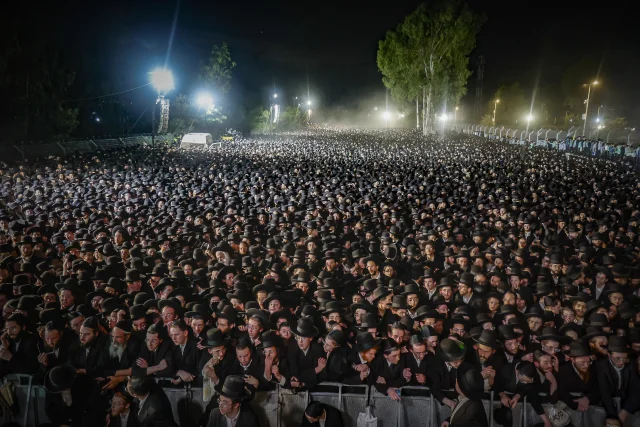
With new elections less than 100 days away, the controversy over IDF service for ultra-Orthodox (Haredi) men continues to dominate the headlines in Israel and looks to become one of the main election issues.
Specifically, the massive protests blocking roads and access to secular neighborhoods, which happened again on Monday, could further polarize Israelis and drive out voters in the October elections.
According to the latest Israeli Society Index for July 2026, published by the Jewish People Policy Institute (JPPI), 39% of Israelis (and over 50% of those identified as secular) view the street protests as “unjustified” and think the police should prevent them from taking place.
In addition, nearly half of all Israelis (46%) and half of Jewish Israelis (50%), “believe that it is possible to conscript young Haredi men and that additional sanctions and pressure should be applied,” according to the report.
“About one-third (31%) prefer conscription only by agreement with the Haredi leadership, and 11% believe there is no chance of conscripting young Haredi men into the IDF and that attempts to do so should stop.”
Another inflammatory statement by a senior rabbi against IDF service on Sunday even drew a rare, sharp rebuke from Prime Minister Benjamin Netanyahu, who has been intent on keeping his alliance with the Haredi parties in order to preserve his chances of being re-elected.
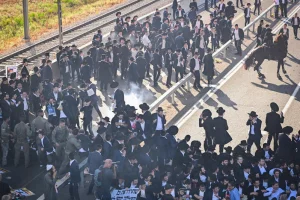
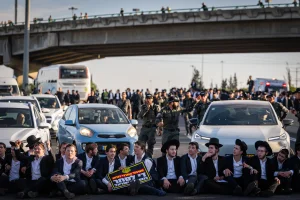
On Monday night, tens of thousands of Haredi men protested against military service outside IDF Military Prison 10 in Kfar Yona, as well as at the private home of Attorney-General Gali Baharav-Miara.
The immediate trigger was the sentencing of a draft dodger to 20 days in a military prison.
מהומות עזות: גדר בכניסה לבסיס כלא 10 פורקה בידי אלפי חסידי גור https://t.co/53hc4sEwza pic.twitter.com/qxQCIjSBcv
— דניאל גרובייס Daniel Grovais (@daniel_grovais) July 20, 2026
Addressing the crowd, Rabbi Meir Falkser said, “We protest and warn you. You are disgracing Torah scholars. You want to abolish the Torah. Be careful—the punishment is that one has no share in the World to Come. You are going to lose eternal life.”
Notably, Rabbi Yaakov Aryeh Alter, one of the most respected spiritual leaders in the Haredi community, attended the Kfar Yona protest in person. Alter is the Gur Rebbe, leader of the Gur Hasidic dynasty and the senior leader of the Agudat Yisrael faction, one half of the United Torah Judaism (UTJ) party.
Its chairman, Yitzhak Goldknopf, also attended the protest, signaling the endorsement of the mass protest by the most senior leaders of the community. However, the gathering escalated into violence, with some of the protesters breaking a fence surrounding the army base and clashing with military police.
The clashes in Kfar Yona caused another large protest at Baharav-Miara’s house to be called off; nevertheless, several hundred protesters showed up and clashed with local residents there.
Despite recent overtures by Haredi leaders toward Yashar party chairman Gadi Eisenkot, most observers expect Netanyahu to attempt to preserve his alliance with the Shas and UTJ parties after the election.
However, he clashed with Rabbi Dov Lando, leader of UTJ’s Degel HaTorah faction, on Sunday in a rare public dispute. A recording of Lando that surfaced showed him criticizing national-religious IDF soldiers, whom he accused of “murder” for serving the state rather than a religious obligation.
“If the state sends people, soldiers, for the honor of the state, and they kill people, is that also permissible? It’s very much murder. So they incite murder. They wage wars not only for the sake of salvation, but for the honor of the state,” Lando was heard saying.
Netanyahu responded, “IDF soldiers - religious, secular, and ultra-Orthodox... deserve deep appreciation, gratitude, and full support from every part of the public, and certainly from the world of Torah as well.”
Aides of Lando later argued that his remarks were misconstrued, warning that “the words of the great Torah scholars are the holy of holies of the people of Israel, and we live by them.”
“For those who do not live the world of the Torah and do not understand the depth of their words, it is better not to rush to interpret them, and certainly not to attack them.”
According to the latest Channel 12 News opinion poll, 59% of coalition voters said they were “satisfied” with Netanyahu’s reported deal with the Haredi parties, who supported that bill to slash the power of the attorney general in return for the Torah Study law. However, 19% said they were “dissatisfied,” while the remainder said they did not know.
Among opposition voters, only 6% said they would like to see a government formed with the Haredi parties if the opposition bloc failed to reach an outright majority, as opposed to 44% who said a coalition should be established with the support of an Arab party.
Even among coalition voters, who include Haredim, 19% said they didn’t want the Haredi parties to be part of the next governing coalition; however, 70% still said they want to continue the alliance with them.
You might also like to read this: