WATCH: IDF shows glimpse of massive Gaza tunnel where Hamas terrorists held IDF soldier Hadar Goldin’s body for 11 years




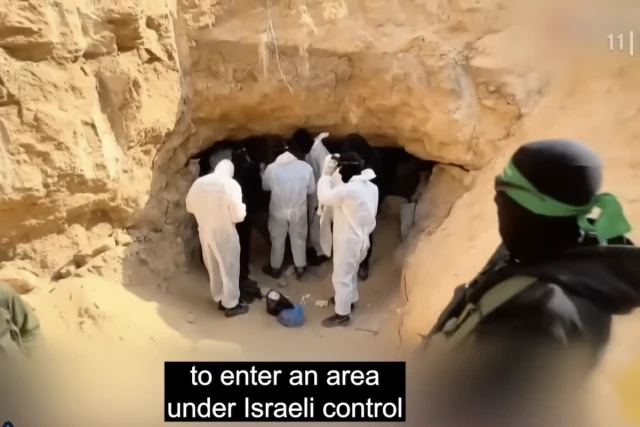
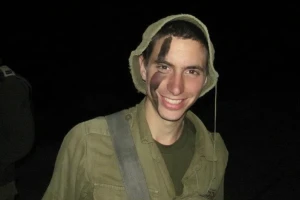
On Nov. 8, 2025, Israel allowed Hamas and Red Cross staff to cross into Israeli-held territory in the Gaza Strip to retrieve the body of IDF soldier Lt. Hadar Goldin, 11 years after he was killed and his body stolen by Hamas terrorists.
This week, the IDF allowed several Israeli journalists to enter the underground complex underneath the city of Rafah to witness where the terrorists had hidden Goldin for so many years.
The tunnel in Rafah is estimated to be one of the most complex the IDF has ever encountered during the ground operations in the Gaza Strip.
The network reaches to within 1.5 km (about one mile) from the Egyptian border, runs 25 meters (82 feet) below the earth and spreads over 10 km (6.2 miles).
Footage published by Kan News showed the remains of the Israeli efforts to find Goldin, including a massive crater measuring dozens of meters across and several meters deep, dug in an attempt to find the tunnel entrance.
Despite the decade-long intelligence effort, Israeli soldiers of the Yahalom engineering commando were not able to locate Goldin, despite coming within one meter of his burial place at one point.
“Looking back, we realized we were literally a meter or two from the exact spot where Hadar was held, but unlike in similar cases, we had no precise intelligence or a captured terrorist who could point us to the location,” officers told Ynet News.
IDF spokesman for International Media, Lt.-Col., Nadav Shoshani, accompanied the journalists.
“Our journey took us into the very tunnels where Hadar Goldin was held, away from light, away from humanity, away from dignity, for over a decade. These were not just any tunnels—they became the operational hub for Hamas’ most senior leaders, including the head of the Rafah Brigade, Muhammed Shabana, and Muhammed Sinwar, who was Hamas leader prior to his elimination,” Shoshani wrote.
“Inside the 10-kilometer-long, 25-meter-deep tunnel, IDF troops told me they uncovered shafts near the UNRWA facility and learned the tunnel system ran under a mosque, allowing Hamas to hide while using civilians above ground as shields,” he added.
The massive network included connections to two other strategic underground systems, according to Ynet. One ran north toward the “Kingdom,” a compound used by the killed Hamas leader Yahya Sinwar in Khan Younis, and the other ran south beneath the border to Egypt’s Sinai Peninsula.
Lt.-Col. H., commander of a team of fighters in the Yahalom Unit, told Kan that Israeli soldiers and Shin Bet agents invested “one and a half years of Sisyphean, intensive work.”
“Whoever hasn’t been here physically won’t understand the complexity of this system,” he explained. “In the area of these 10 km, there are dozens of rooms, communication centers, doors and hidden doors, ascents and descents, shafts, and all the while a large deficit of oxygen.”
“Hadar was a vital asset for the terror group Hamas. They guarded him closely and, in my opinion, even obsessively,” he added, noting that Hamas’ willingness to return him indicated the group had suffered significant blows in the fighting.
“We assume Hamas saw how close we were getting and didn’t want its prestige damaged,” officers told Ynet. “They preferred to be the ones to retrieve him. Very few in Hamas knew exactly where Hadar was kept. He became a symbol within Hamas. Rafah Brigade commander Muhammad Shabana had a personal obsession with guarding Hadar.”
“What stings even more is that these tunnels had been expanded, exploited, and meticulously burrowed in for over two decades by Hamas,” wrote Shoshani.
“Every brick, every corridor, every hidden room – built with millions of dollars and resources meant to help civilians– was instead turned into instruments of terror. The aid, intended to improve life above ground, was diverted below, transformed into a sprawling underground city. Hallways, crossroads, and entire chambers were constructed not for homes or schools but for planning, hiding, and orchestrating violence.”
“This visit was a stark reminder: if we ever hope for a better future for Gaza, it must be free from Hamas’ control,” he concluded.
Want to help more people find our reporting from Israel? Leave a quick Google review of our website HERE .
You might also like to read this: